AI reveals new operating model for Việt Nam’s manufacturing sector
Artificial intelligence is opening up a fundamentally new operating model for manufacturing enterprises, according to the Investment and Trade Promotion Centre of HCM City.
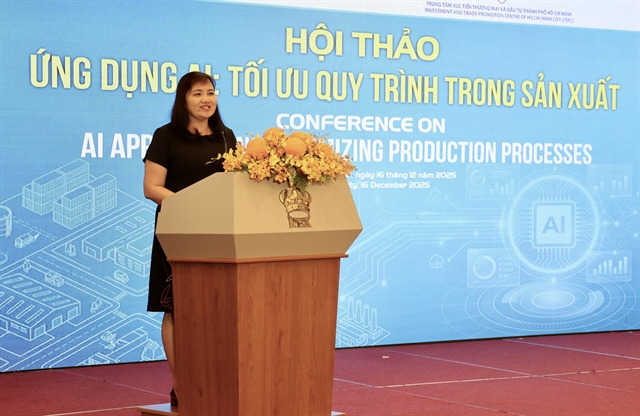
HCM CITY — Artificial intelligence is opening up a fundamentally new operating model for manufacturing enterprises, according to the Investment and Trade Promotion Centre of HCM City.
Speaking at a conference on “AI Application: Optimising Production Processes” organised by the ITPC and the British University Vietnam (BUV) on December 16, Cao Thị Phi Vân, deputy director of the ITPC, said AI is now widely used across supply chain management, production planning and scheduling, energy optimisation, predictive maintenance, and product quality inspection through computer vision.
As a result, smart factory models are increasingly becoming a mainstream trend in global manufacturing, she said.
AI has become a practical tool helping businesses cut costs, improve productivity, enhance accuracy, and ensure operational stability, she pointed out.
However, using it also presents certain challenges like data readiness, workforce capability, investment costs, system integration, and the need to define a roadmap suited to each company’s capacity, so each enterprise must identify an appropriate approach, avoiding fragmented or inefficient investment, she added.
Viewing Việt Nam’s manufacturing sector as standing at a critical turning point, Professor Rick Bennett, deputy vice-chancellor and vice president of BUV, said AI is no longer an experimental technology but is rapidly becoming a key driver of productivity, quality and competitiveness for both large manufacturers and small- and medium-sized enterprises (SMEs).
“The key question for Vietnamese businesses is no longer whether to adopt AI, but how to adopt it effectively, responsibly and in a way that truly fits each enterprise’s resources and level of readiness.”
But AI should be seen as an ecosystem built on three core pillars: people, processes and technology.
“Without the right people and a clear roadmap, even the most advanced technologies may fail to deliver sustainable value.”
Associate Professor Ali Al-Dulaimi, head of the School of Computing and Innovative Technologies at BUV, said Việt Nam has the potential to shift at a macro level from a “China plus one” strategy to a “Vietnam plus Intelligence” development model.
However, he warned of the risk of a “two-tier economy.”
While around 9 per cent of pioneering enterprises – mainly foreign-invested firms and large corporations – have proactively adopted digital twins, AI-driven analytics and smart manufacturing platforms, the remaining 91 per cent, largely SMEs, remain stuck in pilot stages, relying heavily on manual Excel-based records and outdated systems, he said.
“The gap between digital leaders and laggards is widening faster than ever. Companies that delay transformation risk becoming permanently uncompetitive.”
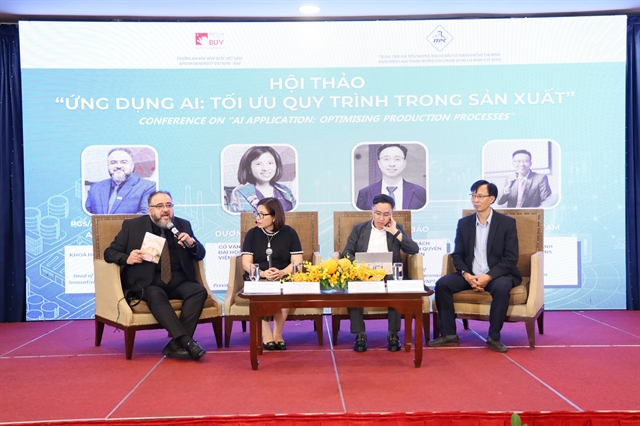
He highlighted the tangible benefits of AI adoption.
He referred to a mid-sized electronics assembler in Bắc Ninh who deployed a computer vision system using open-source AI models, increasing defect detection speed by 400 per cent and reducing the scrap rate by 15 per cent, effectively addressing high error rates in micro-soldering operations.
He also underlined AI’s role in meeting international green standards, particularly the EU’s Carbon Border Adjustment Mechanism, and accessing preferential green capital.
AI systems can track energy consumption in real time at the product level, enabling the provision of “green passports” for exports and delivering average energy savings of 15–20 per cent, he added.
Hoàng Văn Tam, founder and CEO of Digitech Solutions, speaking from a business perspective, said enterprises are facing growing pressure to ensure on-time delivery, maintain product quality, streamline distribution channels, and address persistent challenges related to labour availability and occupational safety.
Effectively addressing these challenges requires coordinated operations between people, machinery and AI.
In this model, AI does not replace humans but supports faster and more accurate decision-making, monitors equipment to predict failures, optimises capacity, and manages materials to reduce inventory.
Companies can also integrate AI with existing management systems such as ERP (Enterprise Resource Planning) and MES (Manufacturing Execution Systems) to improve production planning and scheduling.
By analysing historical and real-time data, AI can forecast delivery delays, identify bottlenecks, and suggest flexible alternatives when disruptions occur, he said.
According to Dr Dương Hồng Loan, senior strategic advisor at BUV and director of the Institute for Vietnam Initiatives, improving labour productivity through technology adoption is an urgent requirement for Việt Nam to keep pace with regional economic growth, but it is a bit of a laggard in this.
A recent survey of more than 200 companies found that around 70 per cent of employees require additional AI-related knowledge, while 17 per cent will need advanced technology training in the near future.
Meanwhile, 58 per cent of businesses are concerned about costs, and 60 per cent of workers cite limited time for learning.
Short training courses lasting one or two days are insufficient to keep pace with rapid technological change, she said.
She suggested that SMEs should prioritise practical, cost-efficient solutions such as AI chatbots for customer service, demand forecasting for inventory management, and data analytics to support decision-making.
Large enterprises should focus on comprehensive automation, intelligent quality control, real-time data processing and financial risk management to build an integrated, data-driven governance framework, she added. — VNS