Deforestation-free supply chains boost competitiveness
As global markets tighten environmental and sustainability requirements, traceability, supply chain transparency and deforestation-free production are becoming essential for agricultural exporters seeking to maintain market access and strengthen competitiveness.
HÀ NỘI — As global markets tighten environmental and sustainability requirements, traceability, supply chain transparency and deforestation-free production are becoming essential for agricultural exporters seeking to maintain market access and strengthen competitiveness.
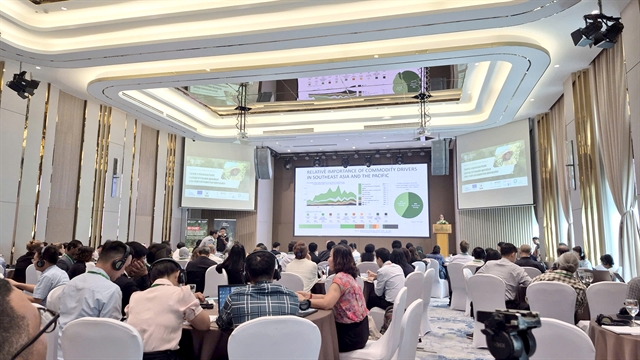
The issue was at the centre of discussions during a regional workshop on sustainable agricultural value chains held in Hà Nội on Tuesday, bringing together policymakers, international organisations, businesses and production firms from across the Asia-Pacific region.
Co-organised by the Department of Forestry and Forest Protection under the Ministry of Agriculture and Environment and the Food and Agriculture Organisation of the United Nations (FAO), the event attracted around 100 delegates from 16 countries to exchange experiences and explore practical solutions for building transparent, sustainable and deforestation-free supply chains.
Nguyễn Văn Diện, deputy director general of the Department of Forestry and Forest Protection, said in his opening remarks that the Asia-Pacific region remains one of the world's largest agricultural production hubs, playing a critical role in global food security and economic growth. However, agricultural expansion has also placed increasing pressure on forests and biodiversity in many countries.
"The region must shift from growth driven by expanding cultivated areas to growth based on higher added value, balancing economic development with environmental protection and people's livelihoods," he said.
For Việt Nam, the transition has become increasingly urgent as key export products such as timber, coffee and rubber maintain a strong presence in the EU market.
One of the most significant developments shaping global trade is the EU Deforestation Regulation (EUDR), which takes effect on December 31 and requires products in the EU market to be free from deforestation and forest degradation, produced legally in the country of origin and supported by robust traceability systems using geolocation data.
Diện noted that while compliance poses challenges, it also presents an opportunity for Việt Nam to strengthen governance, improve product quality, increase transparency and enhance the international standing of its agricultural exports.
To prepare for the new requirements, Việt Nam has accelerated efforts to improve traceability systems, establish databases for production areas, strengthen sustainable forest management and expand forest certification programmes. Training and technical support programmes have also been rolled out to help businesses, local authorities and farmers meet increasingly stringent international standards.
FAO Representative in Việt Nam Vinod Ahuja said unsustainable agriculture remains one of the leading drivers of global deforestation and forest degradation.
"It is a paradox that agricultural systems, which depend heavily on ecosystem services provided by forests, are simultaneously contributing to the depletion of those very resources," he said.
According to Ahuja, effective solutions require more than isolated interventions. Governments, businesses and producers must work together through integrated approaches combining sound policies, market incentives and stronger governance frameworks.
He highlighted traceability as a critical tool for identifying where products are made, how they are produced and whether they are linked to deforestation. Beyond meeting market requirements, traceability helps improve transparency, accountability and access to higher-value markets.
Ahuja also acknowledged Việt Nam's progress in forest protection and restoration, including the implementation of forest environmental service payments and REDD+ programmes. FAO is supporting the Government through initiatives such as AIM4Commodities to develop national traceability systems and digital tools for supply chain monitoring.
Representing the EU Delegation to Việt Nam, First Secretary Cyril Loisel said the challenge facing governments worldwide is how to reconcile economic development with the protection of forests and biodiversity.
"The answer lies not in choosing one over the other, but in ensuring that sustainable production and forest conservation go hand in hand," he said.
Loisel stressed that forests are indispensable for climate stability, biodiversity conservation, water security, disaster prevention and rural livelihoods, making their protection not only an environmental responsibility but also an investment in long-term economic resilience and food security.
He praised Việt Nam's achievements in restoring and maintaining forest cover at around 42 per cent, strengthening forest governance and advancing climate commitments.
"Việt Nam is well positioned to benefit from this transition," he said. "Its experience in forest governance reforms, sustainable forest certification, digital innovation and international partnerships provides a strong foundation."
Loisel also noted that the EU's objective extends beyond facilitating access to European markets.
"Our ambition goes well beyond market access. It is about decoupling agricultural development from deforestation," he said, adding that investments in digital traceability, geolocation systems, farmer registration and transparent supply chains create lasting benefits for producers, businesses and public authorities alike.
Through the Team Europe Initiative on Deforestation-Free Value Chains, the EU and its member states are supporting partner countries in improving traceability systems, strengthening forest monitoring, promoting sustainable land use and creating new opportunities for farmers and rural communities.
The initiative is currently being implemented in 37 countries across the Asia-Pacific, Africa and Latin America, with a focus on commodities affected by the EUDR. In Southeast Asia, programmes are supporting sustainable production, legal reforms, traceability development and policy dialogue.
Participants agreed that building deforestation-free agricultural value chains requires coordinated action among governments, businesses, development partners and farming communities.
As environmental standards become an increasingly important component of global trade, transparent and traceable supply chains are emerging not only as a compliance requirement, but also as a strategic pathway for agricultural producers to improve competitiveness, increase value creation and advance long-term sustainable development. — VNS