Customers seek greater value, not necessarily more cards: VIB
For VIB, the key question is not how many cards customers need, but whether a single financial solution can flexibly meet multiple needs at different stages of their lives.

HÀ NỘI — As consumers' lifestyles and financial needs become increasingly diverse, banks need to rethink how they design card products, with customers seeking more value without necessarily wanting to manage multiple cards.
For VIB, the key question is not how many cards customers need, but whether a single financial solution can flexibly meet multiple needs at different stages of their lives.
This is the thinking behind VIB's 'One Card', a product designed to consolidate multiple financial needs into a single card. Tường Nguyễn, deputy CEO of VIB, spoke about the bank's approach to changing customer needs and card design.
How have changing customer lifestyles affected the way banks design card products?
Customers are increasingly multitasking. One person can simultaneously be an office worker, a family financial manager, a parent, a travel enthusiast or someone seeking unique personal experiences.
As a result, financial needs are no longer divided into separate categories. A customer may shop for their family, pay tuition, settle insurance premiums, book flights or make an international transaction as part of the same spending journey.
This makes it increasingly difficult to define a typical customer. Two people of the same age and income can have completely different spending habits and priorities.
VIB has launched the One Card under the philosophy 'One is Enough'. What does enough mean in this context?
'Enough' does not mean less or merely adequate. It means having a solution that covers a customer's key needs without making the experience more complicated.
We believe customers may want greater value, but they do not necessarily want to manage multiple financial solutions to achieve it.
That is the thinking behind 'One is Enough'. Instead of dividing the customer experience according to individual needs, we consolidate different requirements into a single product that provides a more seamless and convenient experience.

How does the One Card differ from VIB's previous card products?
The One Card integrates different spending categories, including shopping, travel, education, insurance and international spending, into a single card that can evolve with the customer's financial journey.
Customers can select cashback categories according to their current spending needs, giving them greater flexibility as those needs change.
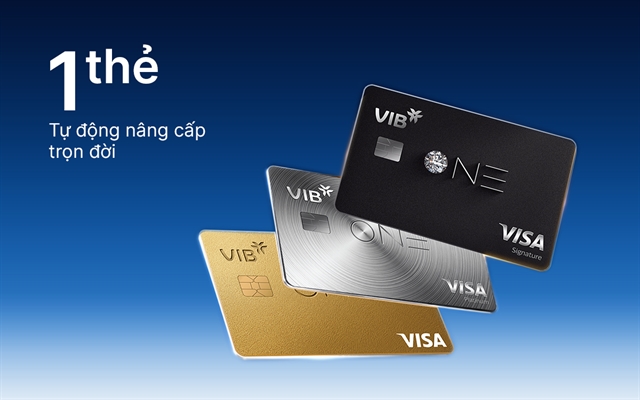
The One Card comes in three tiers – Gold, Platinum and Signature – based on the same underlying customer journey. Credit limits and benefits are upgraded as customers move up the tiers.
Importantly, customers do not need to apply for a new physical card when their needs or financial circumstances change.
The PayFlex feature also allows customers to link the One Card with other VIB payment cards, creating an integrated system for payments and cash withdrawals through a single card.
So rather than requiring a specialised card for every need, the One Card brings multiple functions together in one product. The card is designed to stay with customers as they move through different stages of their financial lives, rather than requiring them to start again each time their needs change.
Why did VIB choose to consolidate features into a single card rather than designing multiple specialised products for specific needs?
In the early years of our efforts to lead the card market, VIB developed specialised card products to address specific customer needs in greater depth.
However, as customers began to have multiple needs at the same time, we realised that the next step was not necessarily to introduce another card. Instead, we needed to develop a card flexible enough to reduce the need for customers to hold multiple cards.
When designing the One Card, our challenge was not simply to put as many features as possible into one card. It was to identify and integrate the right value propositions into a seamless customer experience.
If customers have to remember too many conditions, decide which card to use for each transaction or switch cards as their needs change, having more choices can ultimately create friction.
Our goal was therefore not to add more features to the card, but to reduce the number of decisions customers have to make.

If we visualise the same customer at different stages of life, how do their needs evolve, and how does the VIB One Card address them at each stage?
Let’s imagine the same customer at three different stages of life.
At 25, their focus may be on their first personal experiences – a trip, a long-desired purchase or expenses associated with starting a career.
By 35, the card accompanies them into a new chapter, covering needs such as children's tuition, family insurance and trips taken with family or friends rather than alone.
At 45, the focus may shift towards financial optimisation and experiences or privileges that reflect their changing lifestyle and status. At the same time, the needs from previous stages do not disappear; they accumulate.
A customer's life changes at every stage. But does every change necessarily require a new card?
With the VIB One Card, we aim to separate the card itself from the value it delivers. If customers had to close an existing product and open a new one every time their needs changed, the experience would become fragmented.
By contrast, if the product is adaptable across different stages of life, customers can continue using a familiar solution while the value it provides grows alongside their financial journey.
As customers' lives evolve, the value delivered by the card should evolve with them, without requiring them to start over with a different card.
Looking beyond the card itself, what kind of relationship does VIB aim to build with its customers?
In the past, 'leading the card trend' meant constantly developing new solutions to address specific customer needs. With the One Card, VIB wants to take the next step by creating a solution that can adapt as those needs evolve.
The One Card is not simply about bundling multiple benefits into a single product. It represents a longer-term relationship between customers and the bank, extending across VIB's personal finance ecosystem, from cards and payment tools to deposits and loans.
We want to offer a product that is not only a good fit when customers first choose it, but also gives them compelling reasons to stay and continue using it over the years.
A truly sufficient solution is not necessarily the one with the most features. It is the one that continues to deliver value as customers enter new stages of their lives.
That is our vision for the One Card: one card accompanying customers throughout their personal financial journey. 'Many' may be good, but 'One' is enough. — VNS