Cloud skills power next wave of AI innovation in Việt Nam
A report by McKinsey shows that 78 per cent of companies globally are already using generative AI in at least one business function.
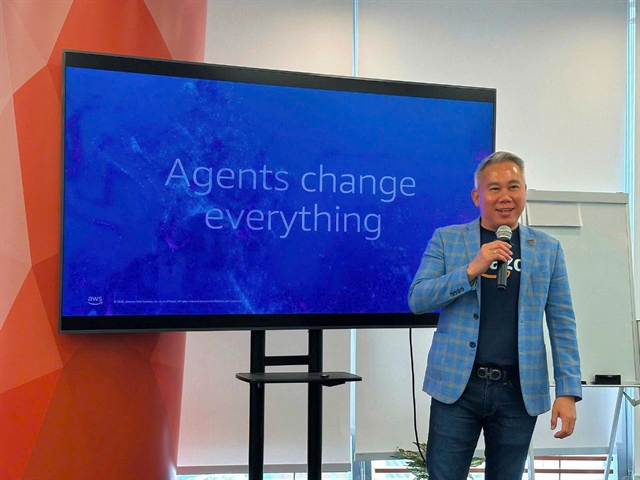
HÀ NỘI — The rapid adoption of generative artificial intelligence (GenAI) across industries is creating new demands for both technology platforms and skilled talent, according to Amazon Web Services (AWS).
While much attention has focused on the development of increasingly powerful AI models, the ability to translate those models into practical business applications depends heavily on engineers, developers and IT teams with strong cloud and AI capabilities.
Over the past year, AI adoption has accelerated sharply worldwide. Eric Yeo, country general manager of AWS Vietnam, said that just two years ago many organisations were still exploring AI in its early stages.
Today the landscape has changed significantly.
A report by McKinsey shows that 78 per cent of companies globally are already using generative AI in at least one business function. Research from IDC indicates that half of those companies have moved GenAI into production, while Deloitte estimates that about 40 per cent are already seeing measurable business impact.
As generative AI becomes more widely adopted, the focus is gradually shifting toward what experts call 'agentic AI'.
“Increasingly, the conversation is no longer only about generative AI. We are now moving toward agentic AI,” Yeo said.
Agentic AI refers to systems capable of performing tasks more autonomously, often coordinating multiple actions without continuous human supervision.
Data suggests that the trend is gaining traction. Deloitte reports that 75 per cent of organisations using agentic AI are meeting or exceeding their return-on-investment targets.
In customer service operations, McKinsey estimates that such technologies can improve resolution speed by 14 per cent and reduce handling time by about 9 per cent.
Looking ahead, Gartner predicts that by 2028 around 33 per cent of applications will incorporate some form of agentic AI, compared with just 1 per cent in 2024.
To support this shift, AWS recently introduced a range of autonomous systems known as Frontier Agents, designed to assist in areas such as software development, security and operations.
Among them is the Kiro Autonomous Agent, a virtual developer capable of navigating code repositories, identifying bugs and improving testing coverage. Other tools include the AWS Security Agent, which reviews system architectures and code during development, and the AWS DevOps Agent, which monitors operations, detects incidents and suggests improvements to system reliability.
These agents are designed to operate independently for extended periods, performing tasks such as debugging software, analysing infrastructure design and investigating operational issues.
AWS has also announced updates across its AI and infrastructure portfolio, including enhancements to Amazon Bedrock, the Amazon Nova model family and new computing hardware such as AWS Graviton5 processors and Trainium3 UltraServers.
Together, these developments aim to help organisations build and scale AI applications more efficiently as the technology evolves.
Vietnamese firms begin adopting agentic AI
Vietnamese technology companies are also beginning to explore applications of agentic AI.
One example is Katalon, a company founded in Việt Nam that specialises in automated software testing. Using technologies such as Amazon Nova Act and Amazon Bedrock AgentCore, the company recently introduced Katalon Scout, an AI-powered testing assistant designed for modern software development environments.
Scout uses agentic reasoning to interact dynamically with applications, automatically detecting issues, validating AI-generated code and suggesting fixes without relying on traditional static testing scripts.
According to the company, the system can reduce testing time by up to 60 per cent and save around 25 hours per development sprint while improving test coverage and reliability.
Such developments highlight how Vietnamese technology firms are not only adopting AI but also contributing to the development of next-generation applications.
Skills remain key to AI adoption
Despite rapid advances in technology, experts say human capability remains a decisive factor in successful AI deployment.
“AI innovation ultimately depends on people,” Yeo said.
“Technology can be adopted by any company, but what truly differentiates organisations is their skills, people and talent.”
To address the growing demand for digital talent, AWS has expanded training programmes in Việt Nam.
Since 2017, the company has trained more than 100,000 professionals in cloud computing, machine learning and generative AI through initiatives offering hands-on laboratories, certification pathways and online learning resources.
These efforts are also reflected in partnerships with local organisations.
VPBank, for example, uses AWS Skill Builder to provide employees with access to more than 600 training courses and 25 structured learning paths covering areas such as AI, cybersecurity, databases and cloud infrastructure.
Since 2023, the bank has migrated key banking systems to AWS, improving operational efficiency and resilience through dedicated disaster recovery infrastructure.
AWS and VPBank have also collaborated on talent development initiatives, including the VPBank Technology Hackathon in 2024 and 2025, which attracted hundreds of technology professionals from across the country.
Industry experts say that combining advanced technology with investment in workforce skills will be essential for Vietnamese businesses seeking to compete in the emerging era of agentic AI. — VNS