Businesses face hurdles in deploying AI agents at scale
Companies could increasingly use AI agents to handle multi-step tasks, but moving from prototypes to production required changes in infrastructure, security, monitoring and workforce skills.
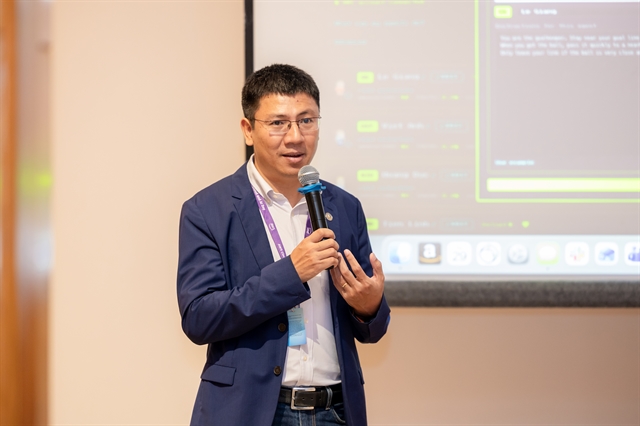
HÀ NỘI — The challenge for businesses adopting agentic artificial intelligence (AI) is shifting from building experimental systems to deploying and managing them at scale, according to an AWS executive.
Speaking at AWS Cloud & AI Day Hanoi recently, Hiếu Hoàng, Head of Solutions Architecture at AWS Vietnam, said companies could increasingly use AI agents to handle multi-step tasks, but moving from prototypes to production required changes in infrastructure, security, monitoring and workforce skills.
Unlike conventional chatbots and large language models, which primarily respond to prompts, AI agents are designed to reason, plan and take action based on defined goals.
“Think of them as digital teammates, not chatbots,” Hiếu said.
He cited research showing that 38 per cent of surveyed enterprises were familiar with the term “agentic AI”, while early adopters reported improvements in operational efficiency and decision-making. Nearly half of the organisations surveyed were planning or considering deploying such systems.
However, developing a prototype is only the beginning.
Once deployed in a production environment, AI agents need access to enterprise data, applications and other tools, while organisations must manage authentication, computing resources, networking and security.
The challenge is compounded by the non-deterministic nature of agentic systems, which may not always produce the same response or follow the same path when given similar tasks. This makes monitoring and understanding their decisions more complicated than with conventional software.
“Building an agent is a weekend project. Operating an entire fleet of agents safely in production is where months can disappear,” Hiếu said.
AWS has introduced Amazon Bedrock AgentCore to provide infrastructure for deploying and operating AI agents, covering areas such as runtime, identity, memory, tools and observability. The service is designed to work with different AI models and frameworks.
He cited Việt Nam-based VPBank as an example of an enterprise developing an agentic AI platform. Working with OneByZero and AWS, the bank built the NEO Agentic AI Platform using Amazon Bedrock AgentCore to support AI applications in customer service, sales, operations and compliance.
The broader adoption of agentic AI also raises workforce issues. Hiếu said skill shortages remained a significant barrier, while many organisations had yet to establish clear rules on when employees should intervene in or override decisions made by AI agents.
This means technology leaders may need to shift from managing individual software tasks to overseeing groups of AI agents, he said.
At the event, participants tested this idea through AWS’s “Agentic Football” interactive game, in which players set strategies and rules for AI agents before allowing them to act autonomously.
Hiếu compared the role of future technology leaders to that of football coaches, who establish strategies and assign roles rather than directing every individual movement.
“The tech leader of the future is not a project manager creating tickets; they are an agent manager,” he said.
The analogy reflects a broader shift in AI development, from giving systems step-by-step instructions to setting objectives, boundaries and responsibilities, and allowing multiple agents to coordinate their actions. — VNS