Business law reforms signal shift toward development-focused governance, VCCI says
VCCI has released its Business Law Flow Report in 2025, which identified five major trends shaping the country's business and regulatory environment.

HÀ NỘI — Việt Nam's legal and regulatory framework for businesses underwent significant changes in 2025, reflecting a shift from a management-focused approach to one aimed at promoting development and private sector growth, a conference heard in Hà Nội on Tuesday.
At the event, the president of the Vietnam Chamber of Commerce and Industry (VCCI) Hồ Sỹ Hùng said the year marked a turning point for the economy, with stronger growth and a series of major institutional reforms despite continued uncertainty in global geopolitics, trade and supply chains.
The domestic economy expanded by more than 8 per cent in 2025, while nearly 200,000 new businesses were registered and more than 100,000 companies resumed operations, bringing the total number of new and reactivated enterprises to nearly 300,000, up more than 27 per cent from a year earlier, Hùng said.
He attributed these figures partly to a series of policy initiatives, including four key resolutions issued by the Politburo covering science and technology, international integration, legal reform and private sector development.
According to Hùng, the measures signalled a shift in the role of institutions from primarily regulating economic activity to facilitating growth, unlocking resources and encouraging innovation.
Việt Nam also accelerated legislative activity, with the National Assembly passing 89 laws in three sessions, a record pace in recent years, he said. The reforms addressed a number of longstanding legal and regulatory obstacles affecting investment and business operations.
Against this backdrop, VCCI on Tuesday released its Business Law Flow Report in 2025, which identified five major trends shaping the country's business and regulatory environment.
The first is a change in State governance thinking, with policymakers increasingly viewing the private sector as a key driver of economic growth rather than simply a subject for regulation. Businesses are increasingly being treated as partners in development.
A landmark measure cited in the report is Resolution 206/2025/QH15, which allows the Government to address urgent legal bottlenecks without waiting for the completion of lengthy legislative procedures. Under the mechanism, authorities issued 15 resolutions in less than eight months, covering areas including planning, land use, minerals, food, investment, data management and administrative procedures.
The second trend is a shift in legislative drafting, with laws increasingly focused on broad principles and frameworks while leaving implementation details to the Government and ministries. This approach is intended to provide greater flexibility in responding to rapid changes in the economy and technology sectors.
Meanwhile, the third trend highlights progress in administrative reform and digital government initiatives. Business surveys cited in the report show that nearly 90 per cent of companies found online administrative procedures easier and less costly than traditional processes.
The fourth trend identified in the report is the removal of legal bottlenecks for businesses. Over the past year, more than 2,000 issues raised by companies were received, categorised and addressed, reflecting what VCCI described as an unprecedented level of responsiveness from the State, ministries and local authorities.
According to the report, institutional reform remains a long-term process, and progress made in 2025 provides a foundation for further reforms aimed at improving the business environment and supporting economic growth.
The fifth trend focuses on the low-altitude economy, an emerging sector that has attracted growing attention globally amid rapid advances in digital technologies and innovation.
This sector represents a potential new growth driver for the country, with the capacity to generate about US$10 billion in economic value and create around one million high-skilled jobs by 2035.
However, the report stressed that realising this potential would require an enabling regulatory framework capable of supporting experimentation, innovation and new business models.
VCCI's role in legal reform
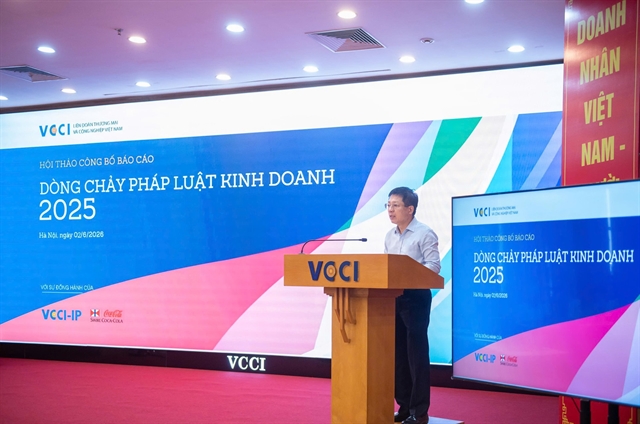
The report is not only an annual review of policy developments, but also reflects VCCI's ongoing role in contributing to legal and regulatory reforms, according to the president.
In 2025, VCCI provided feedback on hundreds of draft legal documents, submitting a total of 568 recommendations to drafting agencies. More than half of those recommendations, or 53 per cent, were adopted, while proposals related to improving consistency within the legal system recorded an acceptance rate of more than 61 per cent, according to VCCI.
The chamber also acted as a bridge between businesses and policymakers, collecting and reporting concerns related to planning, land use, investment procedures, administrative requirements and finance. Many of those issues were subsequently addressed through Government directives to ministries, agencies and local authorities, Hùng said.
VCCI also participated in a Government-led review of business conditions and administrative procedures aimed at reducing regulatory burdens. During a review process conducted in May, it submitted more than 10 recommendations based on consultations with hundreds of business associations and companies nationwide.
The recommendations identified specific administrative procedures and business conditions that companies consider obstacles and proposed measures to simplify or remove them, according to VCCI. — VNS