Brewing global ties for Vietnamese coffee growth
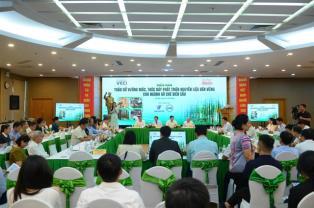
Global Coffee Alliance (GCA) has been officially launched at the 2026 International Coffee Conference on March 26 in Hà Nội, opening a new space for multinational connectivity aimed at the sustainable development and prosperity of the global coffee industry.
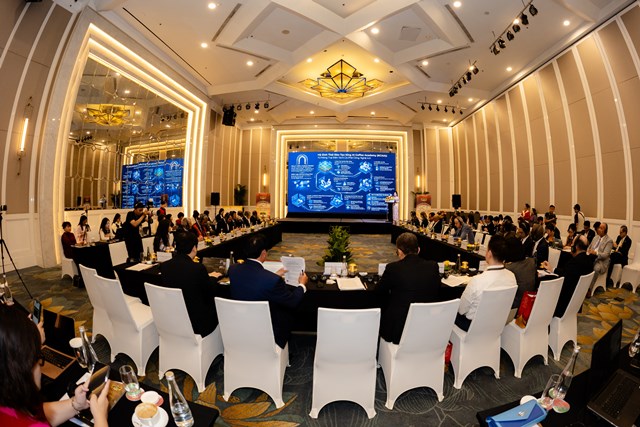
HÀ NỘI — The aroma of opportunity filled the 2026 International Coffee Conference on March 26 in Hà Nội as the Global Coffee Alliance (GCA) was officially launched, creating a new platform for multinational collaboration to support the sustainable development and prosperity of the global coffee industry.
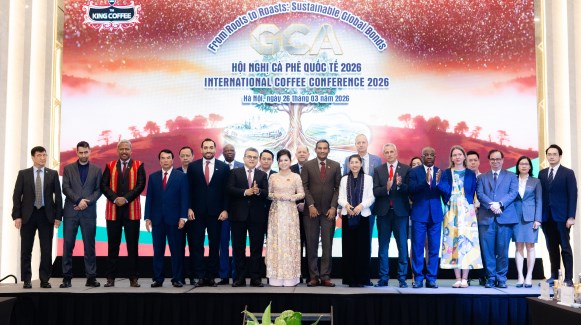
Representatives from 15 countries, diplomatic delegations, leading organisations, businesses and experts attended the event and signed the 2026 GCA Declaration.
Initiated and hosted by TNI King Coffee, one of Việt Nam’s leading coffee brands, the launch marked a milestone for the sector, highlighting the growing global influence and appeal of Vietnamese coffee.
Saadi Salama, Ambassador of Palestine and Dean of the Diplomatic Corps in Việt Nam, noted its significance beyond commerce.
"Coffee is not merely an economic product, but also a cultural ambassador, a bridge connecting diplomacy and promoting global cooperation," Salama said.
Lê Hoàng Diệp Thảo, founder and CEO of TNI King Coffee, stressed the importance of unity. "The global coffee industry is facing unprecedented challenges from climate change, market volatility and strict demands for transparent supply chains. In the face of this massive wave, no single country or enterprise can overcome it alone. We can only go far if we go together."
She added that the conference was not just an exchange forum but the starting point of a collective journey to write a new chapter for Vietnamese and global coffee.
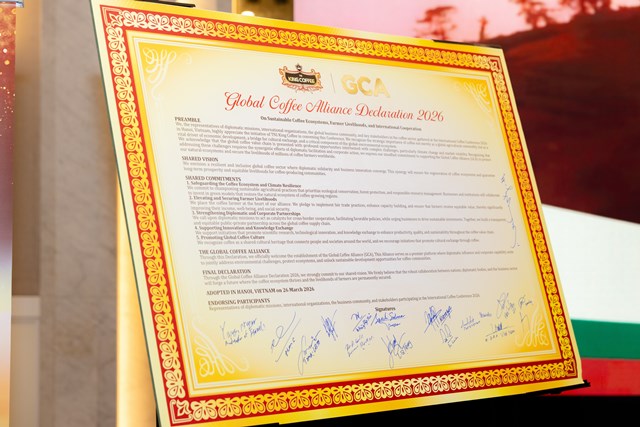
The GCA initiative acted as a pioneering public-private partnership, bringing together the influence of diplomatic networks with the execution capacity of enterprises.
"I appreciate the initiative. Angola in the 70s was the third world producer and exporter of coffee. Unfortunately, with the internal conflict, we fell behind many countries in coffee production and exporting," said Fernando Miguel, ambassador of Angola to Việt Nam.
"Our coffee is Robusta and Arabica of good quality. I especially value the saying that 'no coffee producer can be left behind'. It is very important because in our country most producers are families. This initiative can be greatly appreciated by all coffee producers."
Following the agreement, the 2026 GCA Declaration sets out five core commitments guided by a spirit of global responsibility: protecting ecosystems and promoting regenerative agriculture; ensuring fair livelihoods for farmers; strengthening diplomatic-business cooperation; fostering innovation and digitalisation; and promoting coffee as a shared global cultural heritage.
Panel discussions at the conference sparked lively debates and offered strategic perspectives on the sector.
Lương Văn Tự, chairman of Việt Nam Information Consultant Economic - Trade Association, shared sharp insights into the global market landscape and the challenges facing coffee-producing nations.
Dr Phạm S, former vice chairman of the People’s Committee of Lâm Đồng – Việt Nam’s largest producer of high-quality coffee – proposed practical solutions for climate change adaptation to ensure sustainable coffee development through 2050.
Representatives from Haiti, Angola, Laos and Timor-Leste outlined their coffee sectors and sought to learn from Việt Nam’s experience and cultivation models, while seeking advice for future development.
Ambassador Miguel said Angola was eager to learn from Việt Nam's experience, particularly from businesses such as TNI King Coffee, to train smallholder farmers, support the transfer of farming technology, and invest in deep processing in his country.
Dr S, speaking on behalf of Việt Nam's delegation, analysed the situations of each country, answered questions, and shared his expert knowledge, helping delegates to develop general plans for their coffee industries.
The conference included strategic dialogues on the GCA 2040 Strategic Vision, aimed at building a global coffee ecosystem driven by technology with people and nature at its core.
During discussions, the net zero emissions standard was identified as a long-term aspiration and guiding principle for a three-phase development roadmap from 2026 to 2040.
Applying technology to the global coffee trade network was another major focus.
Trần Chí Dũng, secretary general of the Việt Nam Logistics Business Association, said the initiative aims to create a safer, faster and more cost-effective trade network beyond knowledge sharing. He added that the association would partner with the GCA to roll out an AI-powered supply chain system, with a pilot expected within a month. — VNS