Billion-dollar investments pour into data infrastructure in HCM City
HCM City is seeing a sharp rise in FDI in high-tech sectors, particularly data infrastructure, which is emerging as a core pillar of the digital economy.
HCM CITY — HCM City is seeing a sharp rise in FDI in high-tech sectors, particularly data infrastructure, which is emerging as a core pillar of the digital economy.
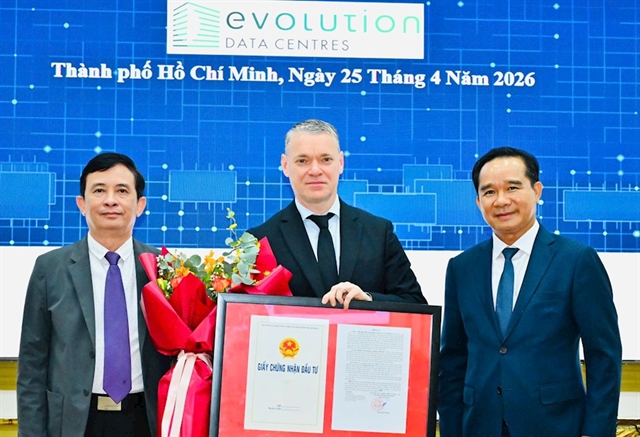
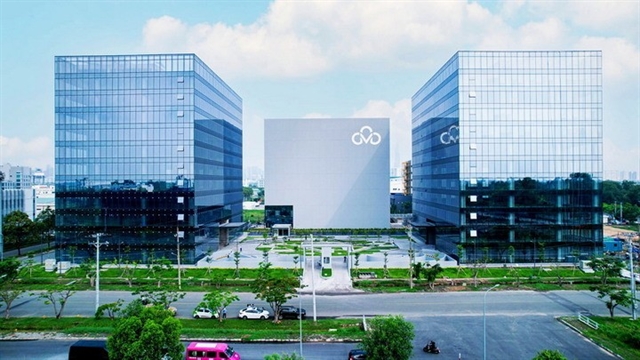
In late April, its People’s Committee awarded investment registration certificates to four high-tech projects at the Saigon Hi-Tech Park (SHTP) whose total registered capital exceeds US$1.23 billion.
They focus on data centres, biomedical technology and smart electronic devices, all offering high added value.
Notably, two of the projects are hyperscale data centres.
The Evolution Data Centre VN HCMC project, developed by a consortium of Singaporean investors comprising Hathor, Frontier and Evolution, has an investment of more than $508 million.
The facility is designed with a capacity of 52 MW IT load and will provide large-scale data storage and cloud computing services.
The project also commits to using more than 30 per cent renewable energy, with a long-term goal of achieving net zero emissions by 2045.
The Starmason hyperscale data centre complex, to be developed by a joint venture between Sembcorp Development, a subsidiary of Sembcorp Industries, and BB Holdings, has an investment of more than $480 million and a planned capacity of 60 MW IT load.
Once operational, the project is expected to significantly expand large-scale digital infrastructure capacity, attract ICT service providers and strengthen data storage, security and processing capabilities for cloud computing and big data demand across the region.
Beyond the licensed projects, several large-scale investment plans in the sector are also being called by city authorities in collaboration with international investors.
Earlier, on March 11, the city Department of Science and Technology signed a memorandum of understanding with Accelerated Infrastructure Capital (AIC) to develop an artificial intelligence data centre in Tân Phú Trung Industrial Park in Củ Chi Ward.
The project is expected to require around $2.1 billion in total investment and be implemented in partnership with Kinh Bắc Urban Development Corporation and international partners.
It will include data centre infrastructure, utilities, power systems, water supply and high-performance GPU clusters, with full capital disbursement targeted by the end of the first quarter of 2027.
In its initial phase, the project will develop a 50 MW AI factory, equivalent to about 28,000 GPUs, providing computing capacity for international clients, sovereign AI needs of Việt Nam and large-scale high-performance computing systems.
In February, Abu Dhabi-based G42 signed a framework agreement with domestic players FPT Corporation, Viet Thai and VinaCapital to develop a hyperscale data centre system in HCM City at an estimated cost of $2 billion.
The emergence of multiple billion-dollar projects within a short period highlights data infrastructure as a new magnet for FDI inflows into the southern metropolis.
Ecosystem shapes investment appeal
Behind the surge in data centre investment is a combination of structural advantages positioning the city as an attractive destination for global capital.
Analysts say the rapid increase in large-scale data centre projects reflects strong growth in domestic demand, driven by digital transformation, cloud computing expansion and the rise of artificial intelligence applications.
Although still an emerging market, Việt Nam is gradually building competitive advantages, particularly in terms of costs.
According to a report made in April by property consultancy Cushman & Wakefield, Việt Nam is becoming a notable destination in the next wave of data centre development across the Asia-Pacific.
Construction costs range from $5.7 million to $8.7 million per MW, with an average of $7.2 million, placing the country among the more cost-competitive markets in the region.
Annual construction cost inflation remains moderate at around 3.8 per cent.
Lê Hoàng Lan Như Ngọc, senior director and head of strategic consulting at Cushman & Wakefield Vietnam, said the country is still in the early stages of its data centre development journey, and has great long-term potential.
She said Việt Nam benefits from both competitive construction costs and rapidly growing demand driven by cloud computing, AI, and an expanding digital economy.
Amid constraints related to land and power availability in several neighbouring countries, Việt Nam, particularly HCM City, is increasingly seen as an attractive destination, provided infrastructure conditions are effectively addressed, she added.
Lee Ark Boon, CEO of Sembcorp Development, said Việt Nam’s digital economy is accelerating rapidly, supported by cloud expansion and advances in AI.
He described the approval as a significant milestone, enabling the company to participate in developing high-performance technology infrastructure for tech and AI enterprises.
One of HCM City’s key advantages is its land availability and diverse innovation ecosystem.
Following its geographical expansion, the city now has huge tracts of industrial land capable of accommodating data centres.
Specialised zones such as the SHTP and northern science and technology urban areas have been developed with excellent power, water and telecommunications infrastructure to support such investments.
Administrative efficiency is also a critical factor.
In November 2025, the city government established a dedicated task force to support AI data centre projects, streamline procedures and resolve bottlenecks to accelerate implementation.
At an investment promotion conference in March 2026, Oliver Jones, co-founder of AIC, praised the city’s administrative speed during preparations for the Tân Phú Trung project.
He said suitable land, reliable power supply, robust technical infrastructure, and a favourable policy environment are key conditions for developing advanced technology sectors, particularly AI.
From a policy perspective, the chairman of the municipal People’s Committee, Nguyễn Văn Được, said that attracting more than $1.23 billion worth of investments in the SHTP in the first quarter of 2026 and large-scale high-tech projects reflects the city’s transition towards a knowledge-based and green industrial economy.
He described these projects as the “nuclei” that will set new standards for high-tech investment while reinforcing international investor confidence in the city’s business environment.
But licensing is only the starting point, he admitted.
The city would continue to support investors, ensure a transparent and secure business environment, rapidly develop essential infrastructure, and avoid administrative delays that could disrupt strategic timelines, he promised.
Experts said that amid intensifying competition for foreign investment, this approach signals a shift from passive attraction to proactive facilitation, aiming not only to draw capital inflows but also to ensure effective implementation and long-term integration into the economy. — VNS