Amending VAT law proposed to address practical obstacles
HÀ NỘI — The Ministry of Finance proposes the latest amendments to the Value-Added Tax (VAT) Law in regulations concerning VAT policy on agricultural products, animal feed and VAT refund conditions, removing bottlenecks that have arisen in practice.
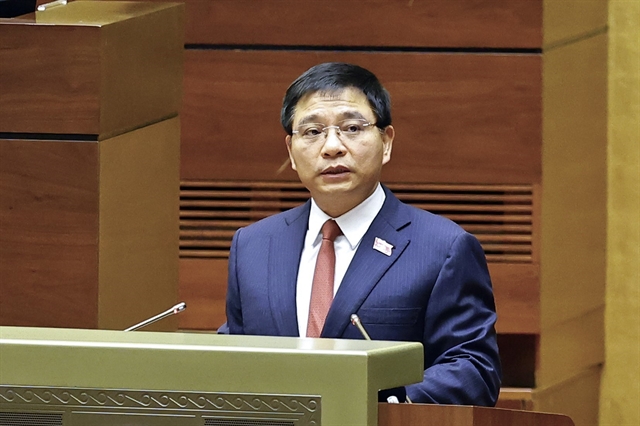
Continuing the 10th session, the National Assembly on December 8 heard Minister of Finance Nguyễn Văn Thắng, authorised by the Prime Minister, present the draft amending several provisions of the VAT Law.
Thắng said that since the current VAT Law took effect on July 1, 2025, the Government and the Ministry of Finance have received numerous petitions from business associations and individual businesses reporting difficulties in VAT policies related to the agricultural sector, animal feed, and tax refund conditions.
Specifically, enterprises are required to pay 5 per cent input VAT on agricultural products traded at the commercial stage. This tax is then refunded for items when most of the output is exported (such as catfish, pepper, coffee, etc.), leading to wasted time and capital stagnation for businesses.
At the same time, credit institutions do not disburse this tax portion as working capital, creating financial pressure and reducing business efficiency.
In addition, current regulations have led to differences between domestically produced agricultural and aquatic products and imported ones, since imported agricultural and aquatic products are exempt from VAT upon entry into Việt Nam.
Furthermore, because animal feed is VAT-exempt, input VAT cannot be deducted or refunded. As a result, animal feed manufacturers face higher costs and higher selling prices, ultimately affecting livestock farmers.
This regulation is also considered inequitable and may reduce competitiveness against imported animal feed, which is also VAT-exempt.
Therefore, to eliminate bottlenecks and address practical issues amid widespread natural disasters and flooding across the country where many localities urgently need to restore production and business activities, especially in agriculture, several provisions of the VAT Law must be immediately amended.
The Minister of Finance noted that the draft revises Clause 1, Article 5 of the current law to stipulate that enterprises, cooperatives, and cooperative alliances purchasing unprocessed or simply pre-processed products from cultivation, forestry, husbandry, aquaculture and fishing for resale to similar entities, will not have to calculate VAT.
At the same time, a new Clause 3a is added after Clause 3, Article 14, allowing full deduction of input VAT for goods and services that are not subject to VAT calculation.
According to Minister Thắng, these proposals will not affect state budget revenue but will reduce procedures related to calculating, declaring, paying and deducting VAT. They also maintain the core VAT principle.
This regulation also supports the export of agricultural, forestry, and aquatic products by eliminating the need for businesses to advance VAT payments and subsequently file for refunds.
At the same time, it simplifies procedures, reduces time and opportunity costs, and helps prevent invoice fraud and VAT refund fraud.
The next amendment mentioned by the Minister is removing the provision stating that unprocessed or simply pre-processed products from cultivation, forestry, husbandry, or aquaculture used as animal feed or medicinal materials shall be subject to the VAT rate applied to those products as specified in Clause 5, Article 9 of the current VAT Law.
“This ensures that animal feed is regulated consistently under the law on animal feed and helps ease difficulties for agricultural production, especially in the context of the agriculture sector being heavily affected by prolonged natural disasters and flooding,” Thắng said.
The Government also proposes removing the condition for VAT refunds, meaning buyers may only receive a tax refund when sellers have declared and paid VAT, as stated in Point c, Clause 9, Article 15 of the 2024 VAT Law.
When amended in 2024, this condition was considered a tax administration measure to prevent fraudulent refunds.
The draft amended Tax Administration Law being presented at this session introduces stricter tax management regulations to ensure accurate and sufficient tax collection and stronger oversight of VAT refunds and taxpayer inspections.
Regarding the amendments, Chairman of the NA Economic and Financial Committee Phan Văn Mãi said that the committee agrees that collecting stakeholder feedback during the implementation of the law is necessary to promptly address obstacles and bottlenecks for citizens and businesses.
The contents proposed for amendment were previously considered during the 2024 VAT Law revision and scheduled to take effect on July 1, 2025. Many opinions from the committee members suggest careful consideration, as the law and its guiding documents have only recently been implemented and have not yet undergone a comprehensive evaluation.
The committee said that the main difficulty lies in delayed VAT refunds. Therefore, it is essential to clearly distinguish which issues require legal amendments and which can be addressed through implementation or sublaw documents, ensuring no loopholes, revenue loss, or inconsistencies with current regulations.
However, to promptly address business challenges and given that the 10th session is ongoing, the Standing Committee of the National Assembly agrees to submit the draft amendment for consideration at this session.
Mãi said that the drafting body must thoroughly assess and foresee potential risks, fraud and legal loopholes related to VAT refund procedures.
Measures for addressing and assigning responsibility to state management agencies must also be clearly established in cases of fraudulent VAT invoices or refund schemes that cause losses to the state budget. VNS