AI era reshapes skills needed in Việt Nam’s IT workforce
Education experts noted that IT training programmes at many institutions remained heavily theory-based, even as technologies in the market evolved rapidly.
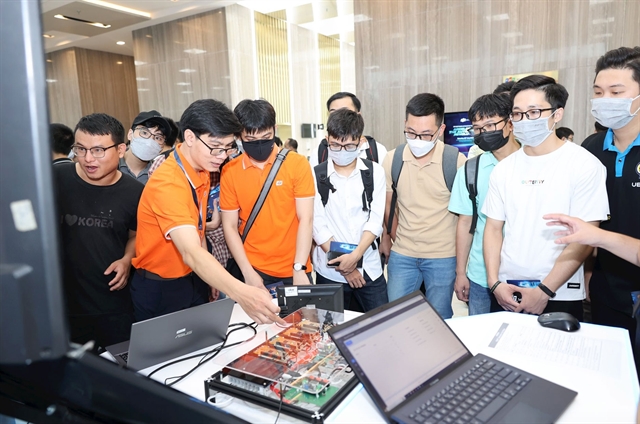
HÀ NỘI — Amid the rapid rise of artificial intelligence (AI), big data and other emerging technologies, the information technology (IT) industry no longer demands only programming skills, as students are now expected to demonstrate creative thinking, hands-on project experience and the ability to adapt quickly to technological change.
Many reports indicate that Việt Nam’s demand for IT workers could reach three million by 2030. However, the market is already facing a shortage of approximately 150,000–200,000 skilled professionals during the 2024–2026 period alone.
Notably, around 50,000 IT students graduate each year but only about 30 per cent are considered job-ready.
Most graduates still require retraining in practical skills, project-based thinking and adaptability to corporate environments.
Demand for IT personnel in Việt Nam is rising rapidly across almost every sector, from e-commerce, digital banking and smart logistics to AI, cloud computing and cybersecurity. All industries are undergoing digital transformation at high speed.
In this context, IT talent has become a form of soft infrastructure that determines the competitiveness of both businesses and the broader economy.
Yet the current paradox is that companies struggle to find capable workers while the labour market is not lacking degree holders.
"The biggest issue facing students today is not foundational knowledge but practical implementation capability," said Dương Anh Tuấn from the Artificial Intelligence and Digital Transformation Institute at Bình Dương University, speaking to Giáo dục và Thời đại (Education and Times) online newspaper.
“Students today can learn knowledge very quickly on the internet and gain early exposure to AI and cloud computing. However, what businesses truly need is the ability to work on projects, solve problems and handle deadline pressure. This is the area where higher education must change if it wants to meet market demands,” Tuấn said.
Education experts note that IT training programmes at many institutions remain heavily theory-based even as technologies in the market evolve rapidly.
AI, data science, cybersecurity, cloud computing and the Internet of Things (IoT) are becoming core skills of the digital era, yet many academic programmes have not kept pace with business demand.
Nguyễn Thị Diệu Anh, vice dean of the Faculty of Information Technology at Văn Hiến University, said AI could currently support programming and coding tasks but could not completely replace the thinking ability of a software engineer.
To build a complete system, companies still need people who can analyse problems, design systems, think logically, understand users, manage security and data, collaborate with teams and provide practical business solutions, according to Anh.
Therefore, students need to build a solid knowledge foundation along with logical problem-solving skills.
Young people should also equip themselves with knowledge of data structures and algorithms, systems analysis thinking, teamwork and project management skills and the ability to self-learn new technologies.
In addition, they need specialised English proficiency and the ability to apply AI effectively in their work.
Some education experts believe that future competition in IT human resources will no longer be competition among universities but rather competition in national capabilities.
In the AI era, countries capable of training engineers who are not only technologically skilled but also globally minded and highly adaptable will gain long-term development advantages.
Therefore, higher education must move one step ahead instead of simply chasing market demand, experts say. — VNS