A new economic layer in the skies to power Việt Nam’s next growth chapter
Việt Nam is not simply preparing to use more drones but is laying the foundations for an entirely new economic ecosystem built in the skies below 1,000m.
HÀ NỘI — Above a futuristic Hà Nội skyline, autonomous drones skim between skyscrapers, electric aircraft rise vertically from rooftop hubs and flying taxis glide through invisible aerial corridors. The sequence lasts only seconds in a recent promotional video unveiling the capital's 100-year development blueprint, but it points to a much bigger ambition: turning the skies into Việt Nam's next economic frontier.
The vision is already beginning to take shape beyond computer-generated images.
Hà Nội’s newly unveiled master plan is the first long-term blueprint for the capital to designate low-altitude airspace as a new development frontier, expanding urban planning beyond roads, railways and metro lines into a multi-layered city where drones, electric aircraft and electric vertical take-off and landing (eVTOL) aircraft could share the skies below 1,000 metres.

"We are studying how to manage airspace below 1,000 metres to create opportunities for new economic models, including flying taxis, communications networks and unmanned aerial vehicles (UAVs),” Nguyễn Trọng Anh, director of Hà Nội’s Department of Planning and Architecture, said.
Hundreds of kilometres northwest of the capital, that vision is already being tested.
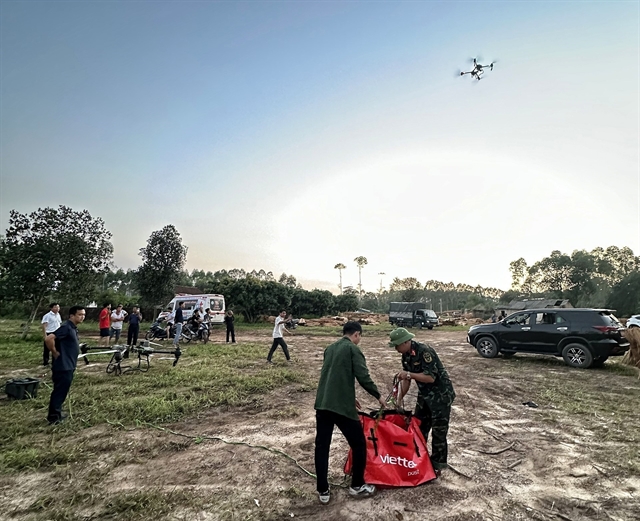
The northwestern mountainous province of Điện Biên last month became the first locality in Việt Nam to launch a regulatory sandbox dedicated to the low-altitude economy in which unmanned aircraft will be tested across four sectors, agriculture, logistics, healthcare and digital mapping.
Through May 2027, UAVs will transport medicines, agricultural supplies and consumer goods, laboratory samples and other essential items, while also sowing seeds, spraying pesticides, monitoring crop health and surveying terrain to produce high-resolution digital maps.
The Điện Biên sandbox, involving about 6,000 UAV flights, is designed not simply to prove that drones can fly, but to answer more fundamental questions: how low-altitude airspace should be managed, how commercial operations can coexist with national security requirements, and where drones can create the most economic value?
Officials see Điện Biên as an ideal laboratory for the low-altitude economy. Its rugged mountains and scattered communities make transport costly and time-consuming, but also offer an opportunity to demonstrate where drones can provide the greatest economic value.
Deputy Minister of Science and Technology Bùi Hoàng Phương said the sandbox could help transform the province's challenging terrain into a competitive advantage, testing whether low-altitude technologies can improve logistics, healthcare and agriculture to support double-digit economic growth.
The sky as the next frontier
Hà Nội and Điện Biên are only pieces of a much larger national strategy.
For the first time, Việt Nam's revised airport development plan calls for modernising low-altitude airspace management to lay the groundwork for UAVs, eVTOL aircraft and other next-generation aviation technologies.
The move signals a fundamental shift in thinking, treating the skies below 1,000 metres as economic infrastructure rather than simply as controlled airspace.
Under a Prime Minister’s decision that took effect on July 1, UAVs were added to Việt Nam's list of strategic technology products, placing them alongside semiconductors, artificial intelligence and digital infrastructure.
Officials say the goal is not simply to import drones but to build domestic capabilities spanning flight-control software, artificial intelligence, sensors and data transmission systems, while supporting dual-use applications for both civilian and defence purposes.
The Ministry of Science and Technology has submitted a draft national strategy on the development and application of UAVs through 2030, with a vision to 2045, while domestic companies have already begun developing and testing UAVs for commercial use.
Earlier this year, Việt Nam moved closer to commercialising UAV applications, with HCM City, Vietnam Post and CT UAV launching the country’s first cross-sea unmanned postal delivery route between Cần Giờ and Vũng Tàu, cutting delivery times by up to 90 per cent compared with road transport.
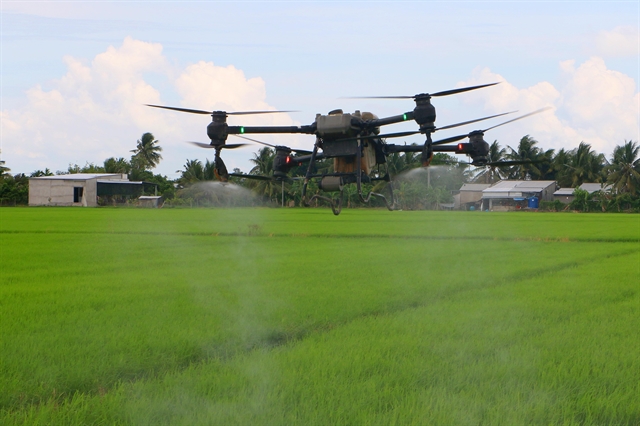
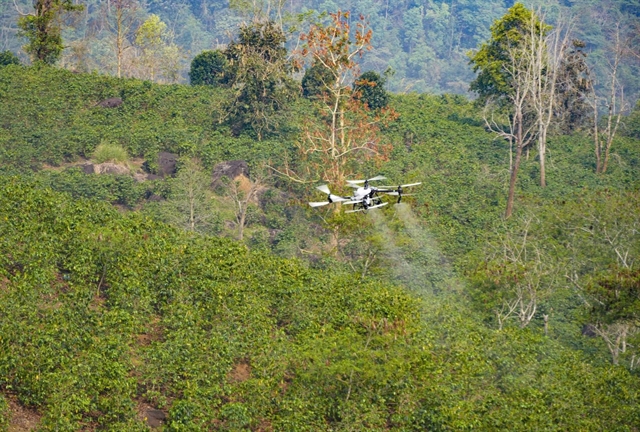
Beyond logistics, drones have rapidly expanded into agriculture, surveying and tourism, with agricultural UAVs helping automate spraying, fertilising and crop monitoring in the Mekong Delta, where a single drone can cover up to 67ha a day compared with about 1ha using manual labour.
Taken together, the moves suggest Việt Nam is not simply preparing to use more drones. It is laying the foundations for an entirely new economic ecosystem built in the skies below 1,000m as ground space becomes increasingly constrained by traffic congestion, logistics pressures and rapid urbanisation.
Officials believe Việt Nam is well placed to develop this emerging sector, thanks to its 3,260km coastline, thousands of islands and vast mountainous areas, which create strong demand for drones to transport goods, monitor forests, map terrain, manage natural resources and support disaster response and search-and-rescue operations.
The Ministry of Science and Technology cited estimates that the global low-altitude economy could reach US$700 billion by 2035, driven by rapid growth in commercial eVTOL aircraft.
Initial assessments suggest the sector could reach a value of around $10 billion and create about one million jobs in Việt Nam by 2035, with significant room for further expansion towards 2045 if Việt Nam establishes an appropriate legal and institutional framework.
Unprecedented opportunity
Momentum accelerated after the Communist Party adopted Resolution 57, which identifies science, technology, innovation and digital transformation as key drivers of economic growth and encourages investment in strategic technologies, including autonomous systems.
Trần Anh Tuấn, vice chairman of the Việt Nam Low Altitude Economy Alliance, said the resolution had transformed confidence among researchers and investors, helping bring together hundreds of companies, universities and technology organisations to build a domestic ecosystem for unmanned aircraft.
“For the first time, we have both the policy support and the technological foundation to compete in a new industry where every country is still relatively close to the starting line,” he said.
However, he warned that Việt Nam would have only around two years to secure a place in global UAV supply chains before they become firmly established elsewhere.
The opportunity extends beyond manufacturing drones. The low-altitude economy encompasses an entire ecosystem operating below 1,000m, combining UAVs, eVTOL aircraft, artificial intelligence, big data, Internet of Things networks and smart air traffic management systems to support logistics, precision agriculture, emergency response, infrastructure inspection and, eventually, urban air mobility.
“UAVs are not just flying vehicles. They are tools for creating a new layer of digital infrastructure,” Tuấn said.
Vũ Hoàng Liên, chairman of the Vietnam Internet Association, said the Điện Biên sandbox would give Việt Nam a rare opportunity to develop the low-altitude economy on broadly equal footing with other countries to create a new engine of long-term economic growth.
Managing the skies
The rapid expansion of UAV operations also presents significant regulatory challenges.
Unlike traditional aviation, low-altitude operations could involve thousands of small aircraft operating across cities, rural areas and industrial zones, requiring new approaches to airspace management, safety monitoring and security.
One of the biggest concerns is the risk of interference with civil aviation. Airports in Việt Nam and other countries have reported incidents involving unauthorised drones near flight paths, raising concerns about potential disruption and safety risks.
Authorities therefore face the challenge of balancing innovation with security requirements: excessive restrictions could slow commercial development, while weak oversight could create risks to aviation safety and national security.
Lưu Quang Minh, deputy director of the Department of Science and Technology under the Ministry of Science and Technology, said UAV policies were being developed with two parallel objectives: promoting technology development while ensuring aviation safety, defence and social security.
The ministry is working on standards and technical regulations for UAVs, unmanned aircraft system traffic management (UTM), data protection requirements and electronic identification systems for drones.
The ministry is also proposing sandbox mechanisms to allow companies to test new services, including drone delivery and future air mobility solutions, in controlled environments, together with a national UAV testing and certification centre.
The road ahead
Experts say the development of a low-altitude economy will require a complete ecosystem involving manufacturing, infrastructure, regulation, finance and skilled human resources.
Đậu Anh Tuấn, deputy general secretary of the Việt Nam Chamber of Commerce and Industry (VCCI), said the low-altitude economy should become a new policy priority as Việt Nam shifts towards a technology-driven growth model.
He proposed developing a national legal framework or pilot mechanism for the sector, allowing large-scale trials in major cities, the Mekong Delta, border areas and regions with high demand for logistics and public services.
“The management mindset needs to shift from controlling individual aircraft to governing an entire low-altitude economic space,” he said.
Ngô Văn Chung, deputy head of the High-Tech Industry Division at military-run telecommunications group Viettel, said existing regulations were still largely designed around traditional aviation and national security rather than around the commercial management of low-altitude airspace.
He said Việt Nam should adopt a national strategy for the low-altitude economy, establish airspace corridors based on different risk levels and gradually open the market to services ranging from drone logistics to urban air mobility and flying taxis, while providing dedicated testing zones for businesses to commercialise new technologies.
Economist Trần Anh Tùng of the University of Economics and Finance in HCM City said buying drones alone would not create a new industry. Sustainable growth would require four foundations, including a legal framework governing low-altitude airspace, air traffic management systems, professional operators and commercially viable business models. — VNS