5G infrastructure ready but application in business and government slow
Viettel, VNPT, and MobiFone all consider 2025 a pivotal year to lay the foundation for 5G to truly play its role as a growth driver in the 2026–2030 period.
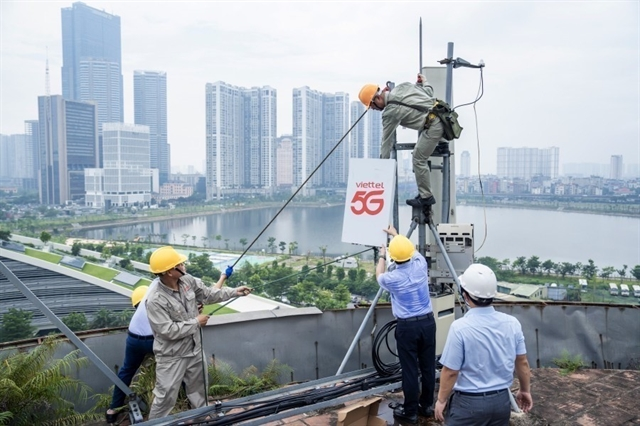
HÀ NỘI — Unlike previous mobile network generations, 5G deployment in Việt Nam is being carried out within a clear and consistent policy framework.
Resolution 57 of the Politburo, together with related Government resolutions, has designated 5G as one of the country’s strategic national infrastructures, guided by a consistent viewpoint: infrastructure must lead by one step.
Following this orientation, major telecommunications companies have simultaneously accelerated investment.
Viettel, VNPT and MobiFone all consider 2025 a pivotal year to lay the foundation for 5G to truly play its role as a growth driver in the 2026–30 period.
Nguyễn Hà Thành, deputy general director of Viettel Telecom, said that Viettel deployed more than 23,500 5G base stations in 2025 alone, bringing the total nationwide to around 30,000.
Outdoor coverage reaches about 90 per cent of the population, while indoor coverage is at 70 per cent and continues to expand.
Meanwhile, VNPT Group is also accelerating strongly. Nguyễn Quốc Khánh, deputy head of the technology division at VNPT Group, said that VNPT officially launched 5G at the end of 2024 and had focusing on expanding coverage in urban areas, industrial parks, seaports, airports and high-traffic locations last year.
Its goal is to cover 55–60 per cent of the population this year, while also building core 5G capabilities such as Network Slicing, Network APIs and piloting private networks for higher education and smart factories.
This is seen as a necessary preparation step for forming new business models on the 5G Standalone architecture.
MobiFone, by contrast, has chosen a more cautious approach. According to Nguyễn Tuấn Huy, deputy head of the technology division at MobiFone, 2025 is a foundation-building phase, with 5G expected to truly become a growth driver from 2026 onward.
MobiFone is piloting 5G in new urban areas and industrial zones, preparing for B2G (business-to-government) solutions such as smart cities, intelligent transportation, flood prevention, and smart energy, areas that require low latency and large-scale IoT connectivity.
Behind the rapid rollout is strong policy support. The Government has issued financial support mechanisms, including a policy that subsidises 15 per cent of investment capital for enterprises that achieve at least 20,000 5G base stations in 2025.
Nguyễn Anh Cương, deputy director of the Vietnam Telecommunications Authority under the Ministry of Science and Technology, said that rapid 5G deployment was not only a technological requirement but also a prerequisite for realising the goal of the digital economy contributing 30 per cent of GDP by 2030, as set out in Resolution 57.
From livestreaming to smart cities
In contrast to the speed of infrastructure deployment, the current picture of 5G applications in Việt Nam shows clear differentiation.
Consumer-oriented applications (5G to C) are developing quickly and visibly, while business and government models (5G to B, 5G to G) still need more time to be fully developed.
On the consumer segment, 5G has quickly demonstrated its advantages through high-speed, low-latency Internet experiences, especially in entertainment, livestreaming, and e-commerce.
The proportion of 5G-capable devices has risen rapidly, from about 30 per cent before commercialisation to over 60 per cent.
Nguyễn Duy Lâm, senior telecommunications solutions expert at Huawei Việt Nam, said that 5G applications for individual consumers tended to lead globally, because they were easier to deploy and generate market impact more quickly.
In many countries, streaming and livestreaming were the largest contributors to 5G data traffic, he said.
Notably, 5G is creating profound changes in rural and remote areas – once considered technological 'lowlands'. By combining 5G with digital platforms and logistics, farmers can livestream to sell agricultural products directly from their fields, connecting straight to consumers.
“Developing applications for economic sectors such as smart factories and smart cities is more difficult and requires time, as well as participation from the business community and guidance from the State,” said Lâm.
In more complex fields such as smart factories, smart cities, seaports, airports or low-altitude economy applications using UAVs, 5G is still at an early stage. These models require not only 5G networks, but also data, cloud computing, AI, edge computing and a high level of digital transformation readiness among enterprises and government bodies.
In reality, many factories in Việt Nam remain at low levels of automation, mainly focused on processing and assembly; therefore, they lack strong impetus to invest in advanced 5G solutions such as private networks.
Conversely, B2G projects in new urban areas offer clearer application opportunities, as infrastructure is designed in a coordinated manner from the outset.
Experts agreed that 5G is not an 'instant lever' that generated immediate economic growth, but rather a catalyst for comprehensive digital transformation.
Once infrastructure is in place and devices become widespread, the remaining challenges lay in application development, policy refinement and society-wide readiness improvement, said experts. — VNS