Will the semiconductor industry help Việt Nam escape the middle-income trap?
Việt Nam’s inclusion in the World Bank’s upper-middle-income group from July 2026 marks an important milestone.
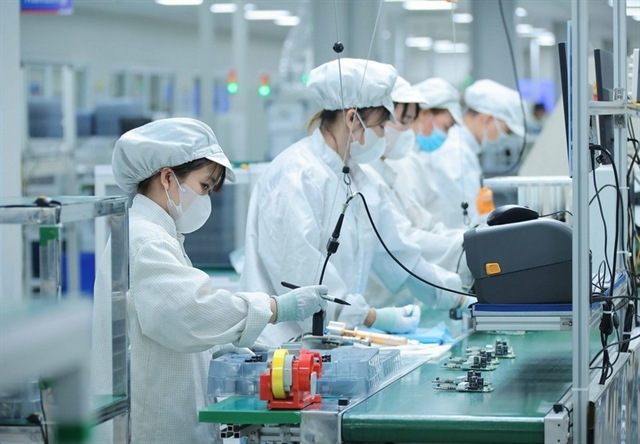
HÀ NỘI — Having established itself as an electronics manufacturing hub, Việt Nam is now seeking to move further up the semiconductor value chain, as global industry giants including Intel, Amkor, Hana Micron, Coherent and VDL expand their presence in the country.
The opportunity is significant, but whether semiconductors can help Việt Nam escape the middle-income trap will depend on more than the number of factories built or billions of dollars in foreign direct investment (FDI) attracted.
The key question is whether Việt Nam can turn semiconductor investment into higher productivity, stronger domestic technological capabilities and greater value added.
Việt Nam’s inclusion in the World Bank’s upper-middle-income group from July 2026 marks an important milestone. Under the new classification, upper-middle-income economies have a gross national income (GNI) per capita of US$4,636-$14,375, while high-income economies must exceed $14,375 per person.
Yet the journey from upper-middle-income to high-income status will be considerably harder. The World Bank estimates that Việt Nam needs to more than triple its current per capita income over the next two decades to achieve high-income status by 2045, while sustaining average annual growth of around six per cent.
This means that a growth model driven primarily by capital accumulation, low-cost labour and production expansion will no longer be sufficient.
In comments published by Vietnam News Agency on July 28, Lê Xuân Sang, deputy director of the Institute of Vietnam and World Economy under the Vietnam Academy of Social Sciences, said Việt Nam could break out of the middle-income trap only by raising its level of scientific and technological development and moving beyond low-value segments.
As labour costs rise and demographic advantages weaken, higher productivity, technology and innovation will therefore become increasingly important drivers of growth.
FDI should be a catalyst, not the destination
Foreign direct investment (FDI) has been one of the main engines of Việt Nam’s industrialisation.
According to the OECD, annual FDI inflows into manufacturing were equivalent to around 4.8 per cent of GDP between 2015 and 2023. FDI also accounted for roughly 15 per cent of Việt Nam’s total investment over the past decade.
The result is a large-scale export manufacturing base. Việt Nam’s merchandise exports reached about $475 billion in 2025, with the FDI sector accounting for $367.1 billion, or 77.3 per cent.
The same pattern is emerging in semiconductors. Việt Nam had attracted more than 170 FDI projects in the sector by November 2025, with total investment approaching $11.6 billion, according to the Ministry of Science and Technology.
The presence of global companies brings capital, technology, markets and skilled jobs. But the long-term economic impact will depend on how much of those benefits spill over into the domestic economy.
The OECD has stressed the importance of stronger links between foreign-invested companies and Vietnamese suppliers, while the World Bank has identified weak linkages between foreign-invested and domestic firms as a constraint Việt Nam needs to address to unlock the potential of its semiconductor industry.
The real test, therefore, is not simply how many billions of dollars in FDI Việt Nam can attract, but how much technology, skills and domestic value the investment can generate.
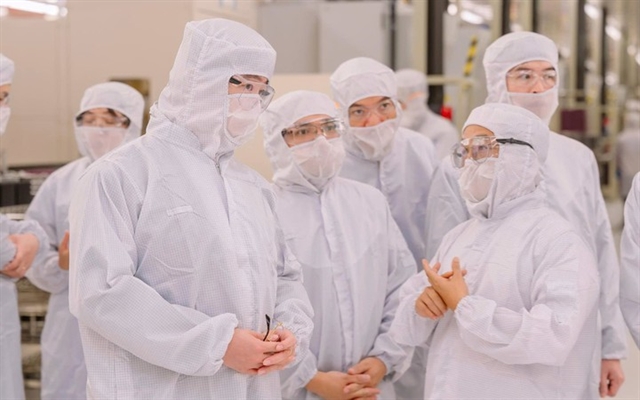
Moving up the semiconductor value chain
The scale of Việt Nam’s semiconductor exports illustrates the challenge. The country was the world’s 10th-largest semiconductor exporter in 2021, accounting for around two per cent of global semiconductor export value, according to the OECD. Yet Việt Nam still does not manufacture semiconductors and remains heavily dependent on imported chips. In 2022, it recorded a semiconductor trade deficit of around $25 billion.
The figures highlight the difference between participating in a global supply chain and capturing a substantial share of the value it generates.
Domestic companies such as FPT Semiconductor, Viettel High Tech, SDS Vietnam and VSAP Lab remain relatively young, with activities focused mainly on integrated circuit design and back-end packaging and testing.
Large-scale chip fabrication requires enormous capital investment, so Việt Nam does not necessarily need to dominate every stage of semiconductor production. A more realistic goal is to capture greater value in areas where it can build sustainable advantages, including chip design, engineering, advanced packaging and testing, software, research and development and intellectual property.
Talent will be critical. The Government aims to develop at least 50,000 semiconductor professionals with university-level qualifications or higher by 2030. The greater challenge, however, is ensuring that this growing pool of expertise also strengthens Vietnamese companies, start-ups, universities and research institutions.
A semiconductor factory can generate exports. A strong semiconductor ecosystem can build technological capabilities and raise productivity across a much broader section of the economy.
The foreign-invested sector can generate substantial export revenues without necessarily creating an equivalent level of domestic value added. In semiconductors, much of the value lies in technology, intellectual property, design, engineering and research.
If Việt Nam remains concentrated in assembly, packaging or manufacturing based largely on technologies developed elsewhere, exports may continue to rise without a corresponding increase in domestic productivity.
But if Vietnamese companies become technology owners, suppliers and innovators, the impact could be very different.
This is why FDI should be viewed as a catalyst rather than the destination. The semiconductor industry should not be judged solely by the number of factories it attracts or the value of chips exported from Việt Nam, but by how much technology, know-how, skilled employment and domestic value it generates.
A billion-dollar factory can lift exports, but only sustained improvements in productivity and domestic technological capabilities can lift incomes over the long term.
For Việt Nam, semiconductors could therefore become more than another export engine. If FDI helps develop domestic technological capabilities and enables local companies to move further up the global value chain, the industry could become a platform for transforming the country’s growth model and escaping the middle-income trap.
Otherwise, Việt Nam risks attracting more billion-dollar factories while remaining concentrated at the lower end of the value chain. — VNS