Wave of cars made in Việt Nam goes global
As the global automotive market continues to evolve, Việt Nam’s exports of CBU vehicles are also reaching new milestones.
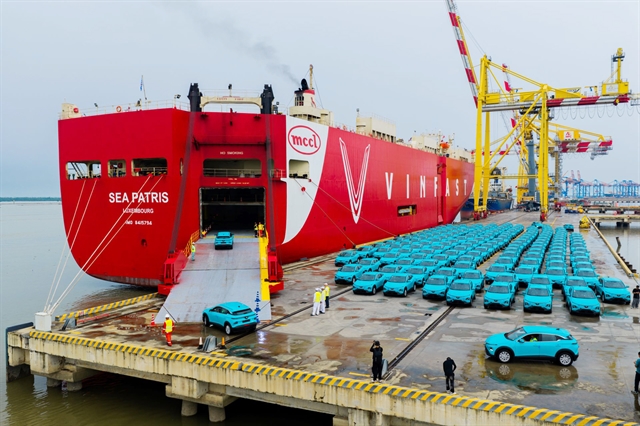
HÀ NỘI — Exports of completely built-up (CBU) vehicles from factories in Việt Nam are gaining strong momentum. VinFast and Hyundai’s growing shipments of thousands of vehicles to Europe, Australia and the US signal a new direction for Việt Nam’s automotive industry.
As the global automotive market continues to evolve, Việt Nam’s exports of CBU vehicles are also reaching new milestones.
Previously, exports of vehicles manufactured and assembled by Vietnamese companies were largely concentrated in ASEAN markets. Domestic automakers are now beginning to expand beyond the region and reach more distant international markets.
Two specialised international vehicle carriers arrived at Hải Phòng Port in late July, transporting more than 5,000 VinFast electric vehicles to markets in Europe and Southeast Asia. These mark VinFast’s 37th and 38th dedicated vehicle shipments, coming less than four years after the company exported its first batch of 999 vehicles to international markets.
VinFast now has a presence in more than 10 key international markets, including the US, Canada, Europe, India, Indonesia, the Philippines and the Middle East. Meanwhile, Green SM has expanded its operations into Laos, the Philippines, Indonesia, India and Kazakhstan, with Europe also in its sights.
Thanh Cong Group and its Hyundai Thanh Cong joint venture have also made their mark by exporting Hyundai vehicles to major markets including Mexico, Australia, Taiwan and China.
The shipments mark the expansion of vehicles produced at the Ninh Bình plant from Asian markets to four continents: Asia, the Americas and Oceania. The company aims to export 5,120 components and 10,160 finished vehicles this year.
Nguyễn Minh Sơn, director of the Hyundai Thanh Cong plant, said the company’s export programme has been prepared and carried out over several years, from building its manufacturing base and mastering technology and quality standards to gradually expanding into international markets, according to Xe Giao Thông online newspaper.
Exports to Mexico and Australia represent an important milestone and pave the way for more ambitious targets, he said.
The push to take 'Made in Việt Nam' cars overseas comes as the automotive industry continues to record a significant trade imbalance. Việt Nam imported 178,223 CBU vehicles worth US$3.5 billion in the first seven months of this year, up 46.7 per cent in volume and 30.3 per cent in value year-on-year. Meanwhile, Việt Nam’s automotive export capacity remains largely focused on components.
Localisation challenge
Ninh Hữu Chấn, former secretary general of the Vietnam Automobile Manufacturers’ Association, noted that Thaco had previously exported a significant number of trucks to Africa, Laos and Cambodia, while Daewoo Bus had also exported long buses. However, the current shift reflects a much larger scale and greater ambitions among domestic companies.
VinFast’s export drive is a bright spot, with India and Indonesia currently showing the clearest signs of success, he added.
By contrast, entry into markets with some of the world’s most stringent quality standards, such as the US and Europe, remains largely exploratory. Building a strong brand presence in these markets poses significant challenges, he said.
Economist Nguyễn Trí Hiếu offered a more candid assessment, noting that although vehicles bear the 'Made in Việt Nam' label, most core components are still imported and the country’s automotive industry remains largely assembly based.
To truly compete in global markets, automakers must step up investment in research and development (R&D) and develop key components themselves, including engines and vehicle operating systems, he said.
Market strategy is equally critical. Rather than competing head-on in large and highly competitive consumer markets, Vietnamese manufacturers should focus on niche markets or establish a strong foothold in Asia before expanding into Europe.
Hiếu also stressed a fundamental rule of the global automotive industry: selling cars is only the starting point. After-sales service and customer care are what ultimately determine long-term success. To maintain market share in demanding markets, manufacturers need reliable supplies of spare parts, well-trained maintenance staff and a comprehensive service network to build customer confidence.
To attract high-quality foreign direct investment into the supporting industries, Hiếu said the domestic market and export volumes must become large enough to reduce production costs.
Without rapid improvements in logistics infrastructure, stronger access to credit and, above all, greater exchange-rate stability, the current export momentum could face significant risks to costs and profit margins, he said.
Only by addressing the full chain, from R&D and supply chains to macro-level infrastructure, can 'Made in Việt Nam cars achieve sustainable growth in global markets. — VNS