VN seeks new growth model in a changing world
Việt Nam is seeking to reposition itself in a changing global landscape and adopt new growth model centred on productivity, innovation and sustainability to meet its development goals by 2045, experts said at the Việt Nam Economic and Financial Forum held on Friday.
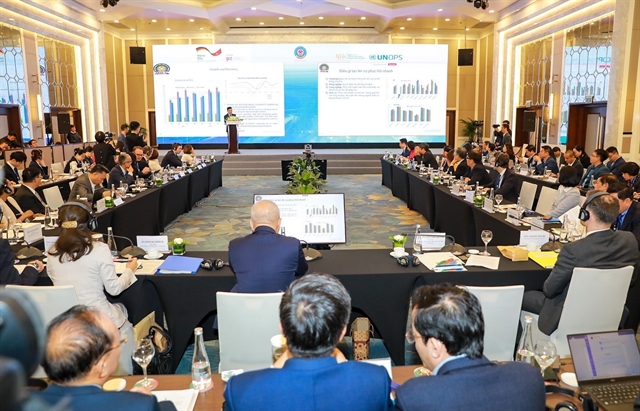
HÀ NỘI — Việt Nam is seeking to reposition itself in a changing global landscape and adopt a new growth model centred on productivity, innovation and sustainability to meet its development goals by 2045, experts said at the Việt Nam Economic and Financial Forum held on Friday in Hà Nội.
Speaking at the forum jointly held by the Ministry of Finance, the German Agency for International Cooperation (GIZ) and the United Nations Office for Project Services (UNOPS), Deputy Minister of Finance Đỗ Thành Trung said Việt Nam is entering a new development phase with ambitious targets amid increasing global uncertainty.
The forum, which brought together more than 200 participants from ministries, local authorities, agencies, universities, research institutes, businesses, economists and international organisations, discussed external opportunities and challenges, defined new growth drivers and proposed strategic solutions to key economic issues toward 2030.
Trung said global economic and political instability has intensified, particularly since April 2025, marked by escalating trade tensions and geopolitical conflicts which are creating multi-dimensional impacts on the Vietnamese economy.
In the domestic market, a series of strategic orientations and breakthrough policies were issued in 2024–25 aiming at creating a foundation for rapid and sustainable growth, he added.
“The target of becoming a high-income, developed nation by 2045 requires a fundamental repositioning of Việt Nam in the new era to create breakthroughs in resource mobilisation, renew the growth model and expand development space sustainably,” Trung said.
Trung stressed the need for a new growth model centred around productivity and innovation, adding that this model requires the combination of traditional growth drivers, including investment, exports and labour, with new momentums such as the digital economy, green economy, knowledge economy and circular economy.
Under the new growth model, the Government would play a facilitating role by investing in strategic infrastructure and establishing a transparent legal framework while the private sector should serve as the main engine of innovation and lead in digital industries, high-quality manufacturing and services. Foreign direct investment (FDI) should promote technology transfer and international standards including ESG criteria.
Nguyễn Như Quỳnh, Director of the Institute for Economic and Financial Strategy and Policy, warned of outdated growth structures and the risk of remaining stuck in the middle-income trap together with unresolved legal bottlenecks.
“The current situation is neither pessimistic nor overly optimistic,” he said, adding that Việt Nam now faces a more complex environment with challenges outweighing opportunities while the country is pursuing very ambitious targets.
Quỳnh pointed out structural challenges such as low productivity, a resources-based growth model, rapid population ageing and policy bottlenecks.
“It will be difficult to achieve new results without new approaches,” Quỳnh said, stressing the need for a new mindset and new growth model to unlock resources and development space.
“Việt Nam has a strong post-pandemic recovery and impressive trade growth figures, but to truly accelerate, we must be able to adapt to the new geopolitical context and transform decisively in terms of economic space and administrative institutions,” Quỳnh said, adding that growth in 2026–30 must focus on quality.
According to Nicholas George, Deputy Regional Director for Asia and the Pacific at UNOPS, climate change pressures, the evolution of global supply chains and rapid technological advances are reshaping growth trajectories, creating an opportunity for Việt Nam to reposition itself and harness the transition toward low-emissions development.
This transition requires a new growth model based on greener and cleaner industries, more efficient energy systems and digitised public services alongside stronger mobilisation of both public and private investment, he said.
It’s time for Việt Nam to shape its next development phase, especially in economic and financial policies to address mounting challenges, said Sascha Hocke, Deputy Country Director of GIZ Viet Nam.
Although Việt Nam has demonstrated strong economic resilience, Hocke said reforms need to accelerate further in response to growing volatility and emerging trends.
Jochen Schmittmann, IMF Representative, pointed out two major headwinds for Việt Nam, including growth slowdown as incomes rise and fading demographic advantage making improving productivity more critical.
With strong determination for reform commitment and the right strategies, Việt Nam can achieve robust growth in the medium term but the biggest driver of growth in the years ahead will depend on the ability to implement reforms and seize restructuring opportunities in the new global context, he said. — VNS