Vietnamese shrimp exports to China offset weaker sales to US
China has become the main growth engine for Việt Nam's shrimp exports, offsetting weaker sales to the US as exporters navigate trade uncertainty, high shipping costs and tougher market requirements.
HÀ NỘI — China has become the main growth engine for Việt Nam's shrimp exports, offsetting weaker sales to the US as exporters navigate trade uncertainty, high shipping costs and tougher market requirements.
Việt Nam's shrimp exports regained momentum in the first half of 2026 after a volatile period, supported by robust demand from mainland China and Hong Kong.
Strong demand from mainland China and Hong Kong helped lift Việt Nam's shrimp exports 14.2 per cent in the first half of 2026, industry data showed, highlighting a shift in the sector's export mix as geopolitical tensions and changing trade policies continue to reshape global seafood flows.
Data from the Vietnam Association of Seafood Exporters and Producers (VASEP) showed Việt Nam's shrimp exports rose by 24 per cent year-on-year to about US$458 million in June, bringing first-half export earnings to $2.35 billion, up 14.2 per cent.
Exports to China and Hong Kong totalled about $845 million in the first six months of the year, accounting for more than one-third of Việt Nam's shrimp export revenue, according to VASEP.
Shipments to mainland China jumped 47 per cent from a year earlier, the fastest growth among Việt Nam's major export destinations, supported by recovering seafood demand, shorter delivery times and improving cross-border logistics.
Industry executives say recovering seafood consumption in China's large urban centres, coupled with Việt Nam's geographic proximity, has shortened delivery times, lowered freight costs and helped preserve product quality for fresh and frozen shrimp.
Cross-border trade has also benefited from upgrades to border infrastructure, wider use of electronic customs clearance, closer quarantine coordination and risk-based customs management, reducing clearance times for perishable seafood products.
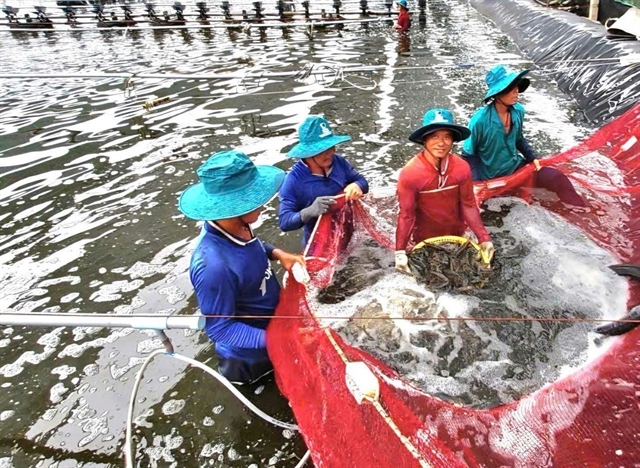
Many exporters have responded by expanding certified shrimp farms, strengthening product traceability systems and investing in higher-value processing to meet increasingly stringent requirements from Chinese buyers.
The outlook remains more challenging in the US, where shrimp exports fell by 15 per cent year-on-year to about $290 million in the first half of 2026, according to VASEP.
Industry analysts say June's improvement in shipments to the US largely reflected exporters and importers accelerating deliveries ahead of potential changes to US tariff policy, rather than a sustained recovery in underlying consumer demand.
Logistics also remains a major headwind for exporters.
Freight rates on trans-Pacific shipping routes remain volatile, while shortages of refrigerated containers and shipping delays continue to increase costs for frozen seafood exporters. Even short disruptions in transit times can significantly raise storage and cold-chain expenses.
Nguyễn Quang Thạnh, deputy director of Hoàng Hà Logistics JSC, said exporters serving Europe faced similar challenges, with ocean freight costs on long-haul routes still above pre-pandemic levels and shipping lines frequently adjusting schedules in response to global supply chain disruptions.
European markets were also imposing stricter requirements on traceability, sustainability, carbon emissions, illegal fishing controls and environmental standards, adding to exporters' compliance costs.
Industry experts say China's rapid growth provides an opportunity for Vietnamese exporters to diversify their customer base and reduce reliance on other traditional export markets.
However, they caution that the US, the European Union and Japan remain critical destinations because they generate higher-value sales and will continue to shape the industry's long-term competitiveness.
Maintaining export growth will require more than expanding production capacity, analysts say. Improving logistics efficiency, diversifying shipping routes and making greater use of free trade agreements will be essential to lowering export costs, while further customs reforms and digitisation could help speed border clearance and strengthen the global competitiveness of Vietnamese shrimp.
With demand from China remaining strong, Việt Nam's shrimp industry is moving closer to its target of $5 billion in exports this year. Whether that momentum can be sustained, however, will depend on exporters' ability to reduce logistics costs and adapt to evolving trade and regulatory requirements in key markets, including the US and Europe. — VNS