Việt Nam's industrial zone demand to rise in 2027, high-tech projects to gain ground: TVS
New policies are also expected to support industrial park leasing from 2027, although their impact will depend on projects' ability to meet the infrastructure requirements of high-tech industries and foster domestic supply chains.
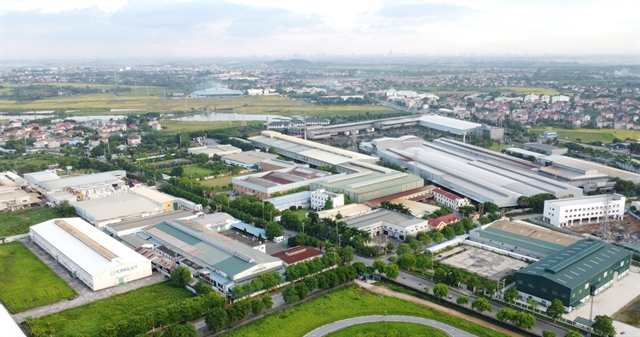
HÀ NỘI — Demand for industrial zone space in Việt Nam is expected to strengthen in 2027, although growth will vary across projects as foreign investment shifts towards electronics, semiconductors, data centres and other high-tech industries, Thien Viet Securities JSC said in a September report.
These sectors require more capital per hectare and place greater demand on electricity supply, water and drainage systems, digital infrastructure and local supplier networks, giving industrial zones with developed infrastructure and established manufacturing ecosystems a competitive advantage, the report said.
As a result, rising foreign investment may not translate proportionally into an increase in leased industrial land, while projects in prime locations with land ready for immediate handover are better positioned to maintain rental rates and high occupancy, it added.
New policies are also expected to support industrial park leasing from 2027, although their impact will depend on the ability of projects to meet the infrastructure requirements of high-tech industries and foster domestic supply chains.
Resolution 10-NQ/TW sets a target of attracting US$200 billion to $300 billion in registered foreign investment and $150 billion to $200 billion in disbursed capital over 2026-30, equivalent to annual averages of $40 billion to $50 billion and $30 billion to $40 billion, respectively.
The resolution also aims for developed economies to account for 75 per cent of newly registered foreign investment and for localisation rates in key industrial sectors to reach 40-50 per cent.
High-tech tenants typically require more sophisticated infrastructure, including reliable power supplies, water and drainage systems, digital connectivity and environmental treatment facilities. Industrial zones' ability to provide these facilities and connect tenants with local suppliers is likely to become an increasingly important factor in attracting investment, the report said.
Meanwhile, Resolution 198/2025/QH15 is expected to provide an additional source of demand by supporting domestic high-tech companies, small- and medium-sized enterprises (SMEs) and innovative start-ups in newly established industrial zones and industrial clusters.
Under the resolution, local authorities are to allocate an average of 20 hectares per industrial zone or industrial cluster for these enterprises, equivalent to 5 per cent of the total industrial zone and cluster land area within their jurisdiction.
The policy also provides subsidies covering at least 30 per cent of land lease costs for the first five years, with the state reimbursing project developers.
TVS said the measures would boost demand for industrial space from domestic businesses and support the development of local supplier networks around major foreign-invested projects.
As per the report, industrial real estate leasing activity recovered in the first half of this year, with the northern region recording 217 hectares of net absorption in the second quarter, its highest level since the first quarter of that year.
In the South, net absorption reached 124 hectares in the first half, up 125 per cent year-on-year.
Industrial land rental rates remained stable at around $143 per square metre in the North and $184 per square metre in the South. — BIZHUB