Việt Nam to host CPTPP meetings to deepen trade, investment ties with EU, ASEAN
Việt Nam will host a series of high-level CPTPP meetings from November 23 to 27, bringing together member economies and partners from the EU and ASEAN to discuss trade, investment and supply chain cooperation.
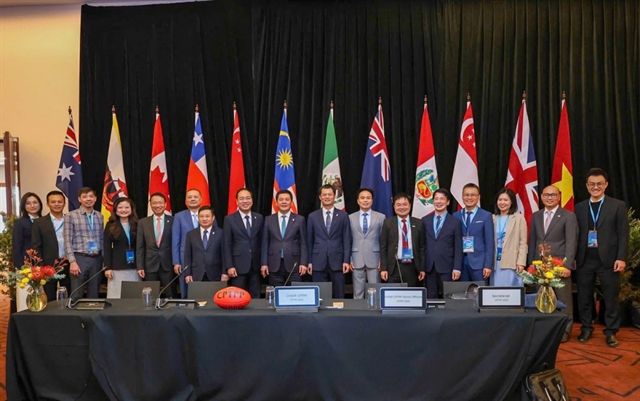
HÀ NỘI — Việt Nam will host a series of high-level Comprehensive and Progressive Agreement for Trans-Pacific Partnership (CPTPP) meetings from November 23 to 27, bringing together member economies and partners from the EU and ASEAN to discuss trade, investment and supply chain cooperation.
According to the Ministry of Industry and Trade, the programme will include the fifth CPTPP Senior Officials' Meeting, the 11th meeting of the CPTPP Commission, ministerial-level dialogues on trade and investment between the CPTPP and the EU and ASEAN, a CPTPP-ASEAN-EU Ministerial Business Forum, a CPTPP ministerial press conference and related activities.
Việt Nam's role as this year's CPTPP chair provides an opportunity for members to discuss issues related to the agreement's implementation while expanding dialogue with partners outside the bloc. Discussions are expected to cover trade, investment, supply chains and business connectivity.
The CPTPP-EU and CPTPP-ASEAN dialogues in Hà Nội will extend discussions to partners outside the agreement's 12-member bloc. However, holding these dialogues does not mean that the EU or ASEAN is joining the CPTPP, nor does it indicate that the parties have reached new trade commitments.
The CPTPP-ASEAN-EU Business Forum is expected to provide a platform for policymakers and the business community to exchange views. Key issues include market access, partner identification, participation in supply chains and efforts to increase product value.
For Vietnamese businesses, capitalising on opportunities offered by the CPTPP and strengthening links with ASEAN and EU partners will require the ability to meet market standards, access relevant information and mobilise investment resources.
In the financial and banking sector, expanding trade and investment activities could increase demand for working capital, trade finance, guarantees, international payments and risk management services.
Businesses may also need additional funding to upgrade machinery and technology, develop raw material sources and improve production processes to meet new standards.
The CPTPP has a dedicated chapter on financial services, setting out rules governing the provision of such services within the scope of members' commitments. The agreement also recognises members' right to adopt prudential measures to safeguard the stability of their financial systems.
For SMEs, challenges include meeting market requirements and securing the resources needed to do so. The CPTPP has a separate chapter on SMEs that focuses on information sharing and cooperation to support these businesses, but it does not establish a common lending fund.
Việt Nam will also host discussions on the implementation of the agreement and cooperation with partners outside the bloc. The outcomes of the meetings will provide a basis for assessing prospects for improving market access, strengthening investment links and increasing business participation in regional supply chains.
The CPTPP was signed in Chile on March 8, 2018, and entered into force for Việt Nam on January 14, 2019. It currently has 12 members: Việt Nam, Japan, Singapore, Malaysia, Brunei, Australia, New Zealand, Canada, Mexico, Chile, Peru and the UK.
The agreement goes beyond tariff reductions, covering commitments on trade in goods, rules of origin, services, investment, e-commerce, intellectual property, labour, the environment, competition and state-owned enterprises. It also contains specific provisions on financial services and small and medium-sized enterprises.
Under the agreed tariff schedules, members have committed to eliminating tariffs on most goods traded within the bloc. However, products must meet the relevant rules of origin to qualify for preferential tariff treatment.
This requires businesses to maintain control over raw material sourcing, production processes and documentation certifying the origin of their goods. — VNS