Việt Nam, Australia aim to double two-way investment over next five years
Việt Nam invited Australian investment funds, financial institutions and businesses to explore opportunities in priority sectors, including electronics, digital technology, semiconductors, artificial intelligence, clean energy and strategic infrastructure.
HÀ NỘI — Việt Nam and Australia aim to double two-way investment over the next five years, as the two countries seek to deepen economic ties, expand trade and strengthen supply chain resilience amid global economic uncertainties and rising protectionism.
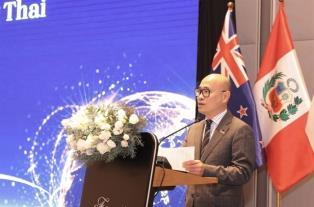
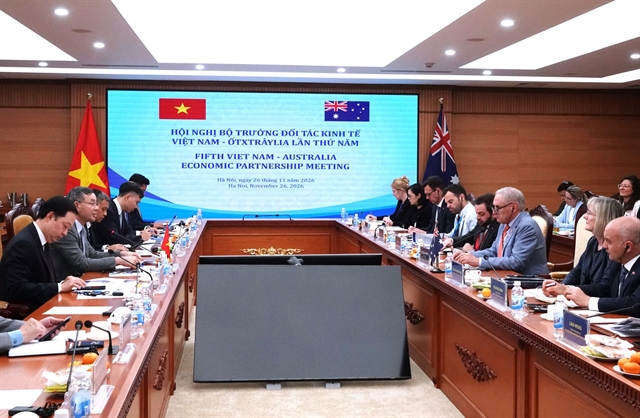
The target was discussed at the fifth Vietnam-Australia Economic Partnership Ministerial Meeting, co-chaired by Vietnamese Finance Minister Ngô Văn Tuấn and Australian Minister for Trade and Tourism Don Farrell in Hà Nội on Thursday.
The meeting reviewed progress under the Enhanced Economic Engagement Strategy and identified priorities for bilateral trade and investment cooperation in the coming years.
Tuấn said economic and investment ties had made positive progress since the two countries launched the strategy.
Bilateral trade reached US$13.9 billion in the first 10 months of 2026, up 21.2 per cent from a year earlier.
By the end of October, Australia had 758 active investment projects in Việt Nam, with registered capital exceeding $1.9 billion. Meanwhile, Vietnamese businesses had invested more than $605 million in Australia, making it the 12th-largest destination among 87 overseas investment markets for Vietnamese companies.
Tuấn called for a concrete action plan built around three priorities: developing a long-term investment partnership aligned with Việt Nam's development priorities through 2030; expanding two-way trade and investment in industry, agriculture, services, tourism, the digital economy and the green economy; and strengthening coordination at regional and multilateral forums, particularly during Việt Nam's hosting of APEC 2027.
Việt Nam invited Australian investment funds, financial institutions and businesses to explore opportunities in priority sectors, including electronics, digital technology, semiconductors, artificial intelligence, clean energy and strategic infrastructure.
Australian financial institutions were also encouraged to participate in the development of the Vietnam International Financial Centre in HCM City and Đà Nẵng.
The two sides also discussed maintaining Australia's official development assistance and grants. Australia will provide A$98.3 million (US$65.5 million) in development assistance in the 2026-27 financial year to support essential infrastructure, capacity building and climate change adaptation projects in the Mekong Delta and mountainous northern regions.
Speaking at the meeting, Farrell described Việt Nam as one of Australia's most promising economic partners in Southeast Asia, highlighting growing Australian business interest in the Vietnamese market.
This interest was also reflected in the establishment of a dedicated investment promotion team in Việt Nam by Export Finance Australia, he said.
Against a backdrop of global economic volatility, geopolitical tensions and rising trade protectionism, Australia reaffirmed its commitment to free and fair trade and its desire to work more closely with Việt Nam to strengthen supply chain resilience.
In agriculture and food, Australia is ready to send technical experts to help Việt Nam meet biosecurity requirements, facilitating greater access for Vietnamese high-quality agricultural products to the Australian market.
Australia also seeks to expand exports of its competitive agricultural products to Việt Nam. Both sides recognised the complementary nature of bilateral agricultural trade, with Việt Nam importing Australian raw materials and agricultural products for domestic consumption, manufacturing and processing.
On energy and critical minerals, Australia reaffirmed its commitment to being a reliable, long-term supplier of coal, liquefied natural gas (LNG) and critical minerals to support Việt Nam's green transition.
It also offered to share experience in developing wind and solar power, regional electricity grid connectivity, submarine cable infrastructure, safe artificial intelligence and cross-border e-commerce.
The two countries highlighted the importance of maintaining stable, long-term critical mineral supply chains and expanding cooperation in trade promotion, the digital economy, digital transformation and e-commerce.
Tuấn said Việt Nam would work with relevant agencies to review and address difficulties facing Australian businesses operating in the country within its authority.
The meeting also discussed cooperation in labour and efforts to facilitate market access for Vietnamese agricultural products in Australia.
Concluding the meeting, the two ministers agreed on three main areas of cooperation for 2026-27.
These are promoting a long-term investment partnership in science, technology, strategic infrastructure and clean energy, improving market access for agricultural and seafood products while expanding digital and green economy cooperation, and strengthening coordination at regional and multilateral forums.
Australia also welcomed Việt Nam's role in coordinating the Comprehensive and Progressive Agreement for Trans-Pacific Partnership and voiced support for its hosting of APEC 2027, including the APEC Finance Ministers' Meeting in Hạ Long and the APEC Economic Leaders' Meeting in Phú Quốc. — VNS