Việt Nam – a rising star in Asia: Indian professor
Việt Nam is emerging as a standout growth performer not only in Southeast Asia but across Asia as a whole, according to Professor Reena Marwah from the University of Delhi, and Secretary-General of the Association of Asia Scholars (AAS).
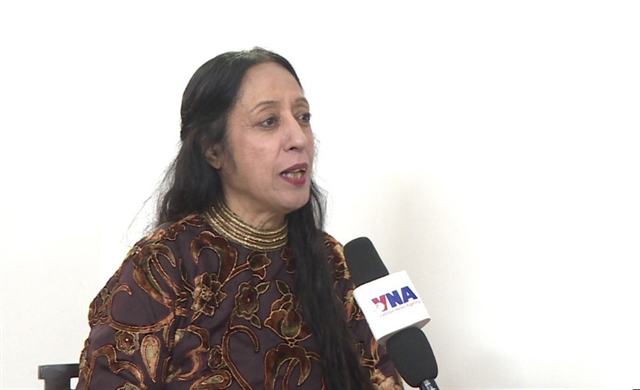
HÀ NỘI — Việt Nam is emerging as a standout growth performer not only in Southeast Asia but across Asia as a whole, according to Professor Reena Marwah from the University of Delhi, and Secretary-General of the Association of Asia Scholars (AAS).
In an interview granted to the Vietnam News Agency’s correspondents in New Delhi, the Indian scholar assessed that Việt Nam’s projected GDP growth of around 8 per cent in 2025 shows that its economy is on an impressive growth trajectory, driven by multiple reinforcing engines.
Export remains a key pillar, with shipments to the US rising sharply at around 18-20 per cent despite tariff barriers and global trade uncertainties. Việt Nam is no longer merely a base for low-value manufacturing; it is moving up the value chain into high-tech production, supported by major multinational investments such as Apple’s expanding footprint. This shift has strengthened Việt Nam’s position as a leading electronics exporter to the US market.
Tourism represents another powerful growth engine. International arrivals have surged, not only from China but increasingly from India and beyond, boosting real domestic consumption to nearly 10 per cent when combined with tourism-driven spending. Meanwhile, strong public investment, steady FDI inflows, and vibrant construction activities continue to reinforce economic momentum. Administrative restructuring at the provincial level is also expected to enhance governance efficiency and enable more effective infrastructure development.
For the 2026–30 period, Việt Nam aims for double-digit growth. According to Professor Marwah, this target is achievable but will require sustained policy consistency and deeper structural reforms.
Việt Nam’s advantages lie in its deep economic integration, competitive labor costs. Its export structure is shifting strongly toward higher–value manufactured and electronic products, while several direct competitors in the textile sector are struggling with political instability and production disruptions. In this context, Việt Nam has emerged as a safe and reliable destination, with low unemployment and growing demand for skilled labour.
The ongoing realignment of global supply chains continues to provide strong momentum for Việt Nam. Stable FDI inflows, combined with public–private partnerships and prudent fiscal management, are helping the country maintain high growth while keeping inflation under control, she stated.
However, to achieve and maintain two-digit growth, Việt Nam will need to further stimulate domestic consumption and strengthen foreign-exchange reserves to better withstand external shocks. Political stability remains a decisive factor, as global experience shows instability quickly deters foreign investors. In this regard, Việt Nam benefits from long-term political stability, disciplined economic management, and a clear commitment to reform. Nearly 40 years since “Đổi mới” (Renewal), the country is entering what many describe as “Đổi mới 2.0,” focusing on institutional improvement, sustainable growth quality, and higher-value investment.
Việt Nam’s development strategy is reinforced by strong infrastructure expansion, rapid digital transformation, strengthened banking stability, and improving credit credibility. Its youthful population, at least through 2040, provides an additional demographic advantage, Marwah said.
With political stability, consistent reform, deep global integration, responsible governance, and inclusive social policy, Việt Nam is not only positioned to meet its near-term growth targets but is steadily consolidating its role as a rising, reliable, and increasingly influential economy in Asia and the world, she added. — VNS