VEFTA opens doors, but businesses must seize opportunities
Việt Nam’s newly signed trade deal with EFTA promises wider market access and preferential tariffs, but businesses must meet strict rules of origin, quality and sustainability standards.
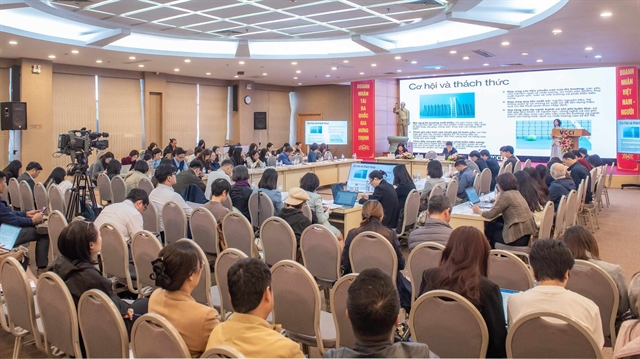
HÀ NỘI — Việt Nam's free trade agreement with the European Free Trade Association (EFTA) promises wider market access with preferential tariffs, but businesses must prepare to meet rules of origin, quality standards and requirements on sustainable development.
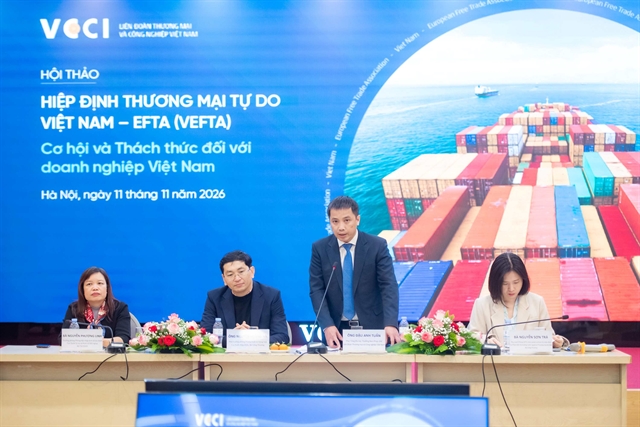
These issues were discussed at a seminar on opportunities and challenges from the Việt Nam-EFTA Free Trade Agreement (VEFTA) for Vietnamese businesses, held in Hà Nội on November 11.
On October 18, Việt Nam and the four members of EFTA (Switzerland, Norway, Iceland and Liechtenstein) signed the VEFTA, concluding 14 years of negotiations involving 21 formal rounds.
The deal must now be ratified by the member nations before entering into force, with Minister of Industry and Trade Lê Mạnh Hùng previously expressing the hope that the VEFTA will take effect in early 2027.
The VEFTA is expected to create new opportunities for Vietnamese exporters through preferential tariffs and access to markets with high purchasing power, according to the Vietnam Chamber of Commerce and Industry (VCCI).
However, businesses will need to meet rules of origin, quality standards, environmental requirements and traceability obligations under the deal.
Speaking at the seminar, Đậu Anh Tuấn, deputy secretary-general and head of the VCCI's legal department, said market diversification is essential for businesses seeking to mitigate risks from disruptions to global supply chains and shifts in trade policies.
According to data from the Việt Nam Customs Department, bilateral trade between Việt Nam and EFTA reached about US$1.92 billion in 2025, up nearly 29 per cent from 2024.
Việt Nam's exports to the bloc were valued at about $405 million, mainly footwear, textiles and garments, seafood, electronics and mechanical products. Imports totalled $1.52 billion, largely machinery, equipment, pharmaceuticals and high-tech inputs.
In terms of investment, Switzerland had 247 active projects in Việt Nam with total registered capital of about $2.5 billion as of the end of September. Norway had 64 projects with registered capital exceeding $203 million as of the end of 2025.
Tuấn said the economic structures of Việt Nam and EFTA member states were complementary. EFTA countries have strengths in technology, finance, pharmaceuticals and energy, while Việt Nam has manufacturing and processing capabilities.
At current export levels, Vietnamese goods still have room to expand in markets with high purchasing power and per capita income, he said.
Under the deal's commitments, EFTA countries will eliminate tariffs immediately upon the agreement's entry into force on more than 90 per cent of tariff lines, covering 99.5 per cent of import value from Việt Nam.
All industrial goods, including seafood, will enjoy zero tariffs immediately upon entry into force. Tariffs will also be eliminated or reduced on many agricultural products, including coffee, rice, produce and honey.
Aside from export opportunities, VEFTA will also enable Vietnamese businesses to gain access to advanced technologies, equipment and management practices through cooperation with EFTA partners, particularly in renewable energy, clean technology and the circular economy.
Nguyễn Sơn Trà, a representative of the Ministry of Industry and Trade's Department of Foreign Market Development and Multilateral Trade, said VEFTA has a relatively comprehensive scope, covering trade in goods and services, investment and sustainable development.
The agreement will create further opportunities for businesses to participate more deeply in global value chains, promote green transformation and meet increasingly stringent consumer standards in EFTA markets, she said.
Businesses face obstacles
Despite the tariff benefits, speakers at the seminar said businesses could not rely on lower duties alone to gain access to EFTA markets.
Experience from previous free trade agreements (FTAs) showed that about one-third of businesses have been unable to benefit from tariff preferences under the EU-Việt Nam Free Trade Agreement because they failed to meet rules of origin. A lack of information about commitments and their implementation was another obstacle.
Businesses should also note that EFTA is not a customs union, meaning each member has its own tariff schedule. Iceland and Norway maintain separate schedules, while Switzerland and Liechtenstein share a common one.
The level of agricultural market opening also varies among members. Switzerland will immediately eliminate tariffs on about 40 per cent of agricultural tariff lines, compared with 53 per cent for Norway and 74 per cent for Iceland.
Businesses therefore need to identify the correct Harmonised System (HS) codes, check the tariff schedules of individual markets and examine the rules of origin applicable to each product to ensure eligibility for preferential treatment.
Trà said EFTA countries impose stringent requirements on product quality, safety, the environment and traceability.
Businesses need to understand regulations governing raw material origins, production processes, food safety and hygiene, sanitary and phytosanitary measures, technical barriers to trade and import management in each country, she said.
Transport and distribution arrangements are another issue that exporters need to consider.
Nguyễn Phương Linh, head of the Financial and Economic Integration Division at the Ministry of Finance's Department of Debt Management and External Finance, said Nordic markets are closely connected with the EU.
Many Vietnamese exporters ship goods to distribution hubs in Europe, such as Belgium or Germany, before splitting consignments for onward distribution to Nordic markets, she said.
This practice highlights the need for mechanisms to facilitate the transit of goods through the EU before they reach EFTA countries, while ensuring that the goods remain eligible for preferential rules of origin, Linh said.
In addition to tariff and origin requirements, businesses must address logistics costs, find partners, establish distribution networks and develop their brands.
For small and medium-sized enterprises, limited financial resources, technology and investment capacity make it more difficult to meet EFTA market standards.
The VEFTA has been signed, but has not yet entered into force. Linh said businesses should use the interim period to prepare for the implementation of the agreement.
She said the Ministry of Finance would work with the Ministry of Industry and Trade to ensure that the decree on tariff schedules took effect in line with the agreement, minimising policy gaps and allowing businesses to benefit from preferential tariffs as soon as VEFTA comes into force.
At the seminar, speakers also stressed that businesses should promptly study tariff schedules, rules of origin and import requirements in each market, review their sources of raw materials, strengthen production controls and improve traceability.
Investment in clean technologies, more efficient resource use and compliance with green certification requirements were also identified as factors that could improve the competitiveness of Vietnamese products. VNS