Transparent cash flows help household businesses expand access to capital and partners
Authorities have strengthened connections with banks to support cashless payments, streamline cash flow management, and simplify tax compliance.
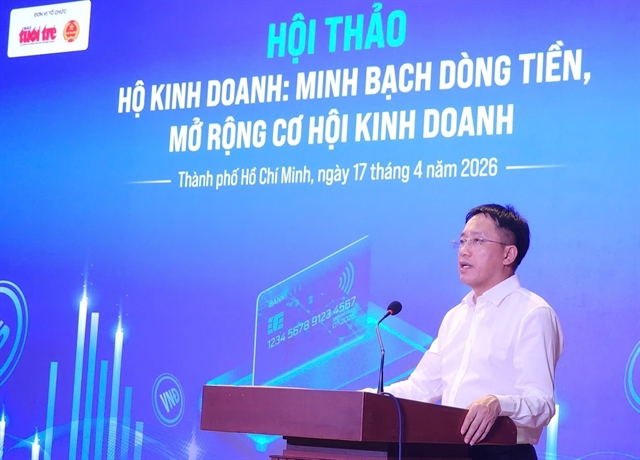
HCM CITY — Cash flow transparency is increasingly seen as a key factor in helping household businesses improve operational efficiency, expand access to bank financing and credit, enabling them to scale up production and business activities.
The issue was highlighted at the seminar “Household Businesses: Transparent Cash Flows, Expanding Business Opportunities,” held in HCM City on April 17. The event attracted nearly 400 household businesses and small traders, along with representatives from regulatory agencies and experts in taxation, technology, and finance.
Speaking at the seminar, Mai Sơn, deputy director of the General Department of Taxation, said the tax sector recently rolled out various measures to support household businesses in transitioning from the long-standing lump-sum tax regime to a self-declaration system, in line with policies to promote private sector development. The aim was to help taxpayers better understand, agree with, and gradually adapt to new tax requirements.
He noted that transparent cash flows would not only help household businesses better manage revenues, costs, and profits, but also enable authorities to provide more effective support in fulfilling tax obligations.
Clear financial records would also improve access to loans from banks and credit institutions, allowing businesses to scale up operations and contribute to the country’s target of reaching around two million enterprises by 2030.
To facilitate this transition, the tax sector had worked with solution providers, tax agents, consulting firms, and banks to build a low-cost support ecosystem. Many tools had been offered free or at preferential rates in the initial phase, including sales management software, accounting systems, e-invoicing, digital signatures, and online tax filing platforms.
Authorities had also strengthened connections with banks to support cashless payments, streamline cash flow management, and simplify tax compliance.
However, challenges remained. Many household businesses, particularly traditional small traders, still faced limitations in adopting technology, improving accounting skills, and accessing policy information, he said.
“We want to fully listen to the concerns of household businesses, from practical issues such as tax filing, invoicing, and obligations to broader questions about fairness and compliance costs. Matters within our authority will be addressed promptly, while others will be studied and adjusted to better reflect real conditions,” Sơn said.
At the event, tax officials provided hands-on guidance on tax declaration procedures, the use of e-invoices, and the management of revenues and payment accounts. Supporting tools and a practical handbook were introduced, enabling participants to practise tax filing and payment processes in a clear and user-friendly way.
A dialogue session between household businesses, regulators, and experts also drew strong engagement. Key issues such as tax obligations for online sales, determining deductible expenses, and handling invoicing errors were addressed in detail, helping remove bottlenecks in implementation.
Banks, tax authorities partner to support household businesses

SACOMBANK has recently signed an agreement with the General Department of Taxation and tax authorities in 14 localities to deploy solutions supporting household businesses in revenue management, e-invoicing, and tax declaration and payment.
ABBank has also signed a similar agreement covering 22 provinces and cities, aiming to provide digital tools that help taxpayers fulfil obligations more quickly, conveniently, and transparently.
Under these partnerships, users can access integrated e-tax services directly on banking platforms while receiving updates on tax policies and tailored financial solutions. Banks and tax authorities will also strengthen communication and guidance efforts to ensure compliance with new regulations.
Mai Sơn said the participation of banks and technology providers, alongside the proactive engagement of the business community, would accelerate the shift toward a more modern and transparent tax management system, helping household businesses enhance competitiveness and achieve sustainable growth in an increasingly integrated economy.
Nguyễn Minh Tâm, deputy CEO of SACOMBANK, said the bank recognised the diverse nature of household businesses and had developed tailored solutions focused on simplicity, ease of use, and cost efficiency. Sacombank had also worked with tax authorities in several localities to promote tax policies and guide users in adopting e-invoicing, including through on-site support teams.
Sacombank said it would continue refining its ecosystem of solutions for household businesses while strengthening coordination with tax authorities in communication, training, and hands-on support to ease the transition.
Meanwhile, ABBank said it would continue developing digital solutions that allow users to manage sales, track revenue, and complete tax declaration and payment directly on its banking app. The bank also offered financial packages to support cash flow management, access to capital, and business expansion.
Tax authorities will continue coordinating with banks to connect systems, enhance e-tax services, and expand communication and training programmes. The goal is to help household businesses transition to declaration-based taxation and gradually move toward formal enterprise models. — VNS