Tech stock sell-off seen as valuation reset rather than weakening fundamentals
The rapid development of AI technologies and changing customer demand have raised concerns that the traditional software outsourcing model could face increasing pressure in the coming years.
HÀ NỘI — Technology stocks have come under heavy selling pressure following a prolonged rally, but analysts say the correction reflects a market-wide valuation reset rather than a deterioration in corporate fundamentals, with long-term growth drivers remaining intact.
The recent pullback mirrors a broader reassessment of information technology stocks globally as investors reconsider earnings prospects for the sector.
The rapid development of AI technologies and changing customer demand have raised concerns that the traditional software outsourcing model could face increasing pressure in the coming years.
According to a recent technology sector report by MB Securities (MBS), investor sentiment weakened after Anthropic introduced its Agentic AI Claude Cowork platform, while Accenture, the world's largest IT services company, reported revenue growth below market expectations and issued a cautious outlook for 2026.
At the same time, international capital has increasingly shifted towards new AI investment opportunities, including major initial public offerings, adding further pressure on IT service stocks.
The global trend has quickly spread to Việt Nam.
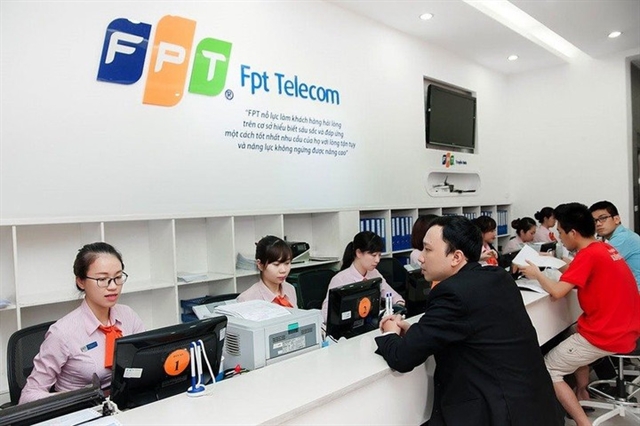
During July alone, technology shares corrected more sharply than the broader market. While the market benchmark VN-Index fell more than 6.6 per cent, ITD Technology Corporation (ITD) dropped over 10.6 per cent, FPT Telecom JSC (FOX) declined nearly 15 per cent and Viettel Global (VGI) lost more than 8 per cent.
In the first seven months of the year, several industry leaders have recorded even steeper declines. FPT Corporation (FPT) fell nearly 30 per cent, CMC Corporation (CMG) slid more than 25 per cent and Elcom Technology Communications Corporation (ELC) dropped over 39 per cent.
MBS said the sector's revaluation is justified. For years, IT service companies traded at relatively high price-to-earnings (P/E) multiples because of their superior earnings growth. As revenue expansion has begun to moderate, market valuations have adjusted towards more sustainable levels.
However, analysts argue that share-price movements do not fully reflect business performance.
According to a technology sector report by Mirae Asset Vietnam, most technology companies maintained positive business results during the first half of 2026.
Among telecommunications companies, VGI, FOX and Viettel Construction (CTR) continued to post revenue and profit growth, supported by expanding telecommunications demand, digital infrastructure investment and stable business operations.
Performance within the IT services segment became more differentiated. Joint Stock Company for Telecom and Informatics (ICT) and ELC reported positive second-quarter growth, while ITD recovered revenue after a difficult period. CMG, meanwhile, showed signs of slower expansion.
For FPT, consolidated results were affected by changes in the consolidation scope of FPT Telecom. Excluding that impact, the company's core technology business still recorded first-half revenue growth of 12.6 per cent and net profit growth of 14.1 per cent, driven mainly by rising demand for overseas IT services, particularly in Japan, and large-scale digital transformation projects.
Mirae Asset Vietnam said the recent correction has made valuations more attractive. The average P/E ratio of ICT companies has fallen below its three-year average, while MBS noted that many Vietnamese IT service providers are now trading at their lowest valuation levels in roughly five years.
Looking beyond the short-term market adjustment, analysts continue to view the industry's medium- and long-term outlook positively.
MBS said the global IT services industry is entering a new phase in which growth is shifting away from traditional outsourcing towards higher value-added segments, including digital transformation, digital infrastructure, data centres and advanced technology solutions.
Future growth is expected to favour companies capable of offering innovation, product development and integrated technology services rather than those relying primarily on labour-intensive outsourcing.
Việt Nam's prospects are supported not only by IT service exports, but also by the country's ongoing digital transformation and the global relocation of technology supply chains.
According to HSBC Global Research, Việt Nam's share of global trade in AI-related equipment increased from 1.2 per cent in 2015 to 12.4 per cent in 2025, representing the fastest growth among all economies during the period.
The trend suggests Việt Nam is steadily strengthening its position in the global technology value chain, from electronics manufacturing to digital infrastructure development. — BIZHUB/VNS