Tân Cảng-Lạch Huyện logistics centre opens new chances for Hải Phòng economy
On May 27, the Tân Cảng-Lạch Huyện Logistics Centre opened at Lot KB1 in the Xuân Cầu Industrial Park and Free Trade Zone, marking another step forward in the process of completing the logistics ecosystem associated with the largest deep-water port in the North.
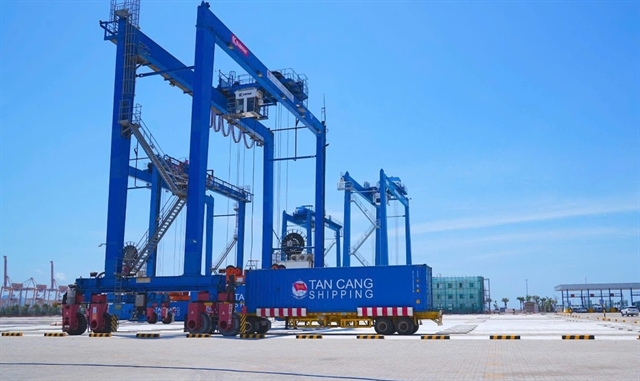
HÀ NỘI — The appearance of Tân Cảng-Lạch Huyện Logistics Centre not only solves the problem of port infrastructure for the largest deep-water port cluster in the North, but also opens another strategic link in the ambition to make Hải Phòng a regional logistics and maritime economic centre.
On May 27, the Tân Cảng-Lạch Huyện Logistics Centre opened at Lot KB1 in the Xuân Cầu Industrial Park and Free Trade Zone, marking another step forward in the process of completing the logistics ecosystem associated with the largest deep-water port in the North.
The project is a strategic cooperation model between Tân Cảng-Saigon Corporation and Xuân Cầu Holdings – two entities with strengths in port operation, logistics, industrial infrastructure development, and free trade zones.
Phase 1 of the project covers 12.4 hectares with a container yard capacity of approximately 8,000 TEU, along with Container Freight Station (CFS) warehouses, bonded warehouses, general warehouses, and value-added logistics services such as packaging, labelling, and quality control.
One of the project's biggest advantages is its location right behind the Lạch Huyện port area, directly connected to the Hà Nội – Hải Phòng – Quảng Ninh expressway and the planned future Việt Nam – China railway link.
In particular, its location within a new-generation free trade zone also creates a competitive advantage in terms of customs procedures, tariffs and investment environment for this logistics centre.
In recent years, the Lạch Huyện deep-water port area has gradually affirmed its role as a strategic maritime gateway in northern Việt Nam.
The ability to receive large container ships directly to Europe and America has significantly changed the import-export logistics structure of the northern region, reducing dependence on international transshipment, shortening transport time, and optimising costs for businesses.
Data from the Hải Phòng Maritime Port Authority shows that in 2025, the volume of goods handled through the port system will reach approximately 114.5 million tonnes, an increase of nearly 10 million tonnes compared to the previous year. Container throughput alone will reach over 8.2 million TEU, an increase of over 10 per cent.
Hải Phòng continues to maintain its position as the busiest seaport in the country with over 40,000 vehicle movements, including about 19,000 ships.
However, the rapid growth of port operations also brings increasing pressure on the logistics infrastructure behind the port. Without a synchronised logistics system, the risk of container congestion, prolonged cargo hold times, and increased transportation costs can reduce the operational efficiency of the entire deep-water port cluster. This is also a pressure that many import-export businesses in the North have been facing in recent years.
In this context, the Tân Cảng Lạch Huyện Logistics Centre is considered a pioneering project for a new generation of port logistics ecosystem in the Lạch Huyện area.
Not only does it play a role in port logistics, this centre is also positioned as a crucial link in Hải Phòng's maritime and logistics development strategy in the new phase.
The center acts as a connector between container ports, ICDs, and the multimodal transport networks of the enterprises, forming a closed-loop logistics chain encompassing deep-sea ports, warehouses, inland waterway transport and road transport. — VNS