Sustainability, consumer trust crucial for business competitiveness: workshop
Sustainability and consumer trust are increasingly becoming essential competitive advantages for businesses, especially amidst the rapid expansion of e-commerce and digital transactions.
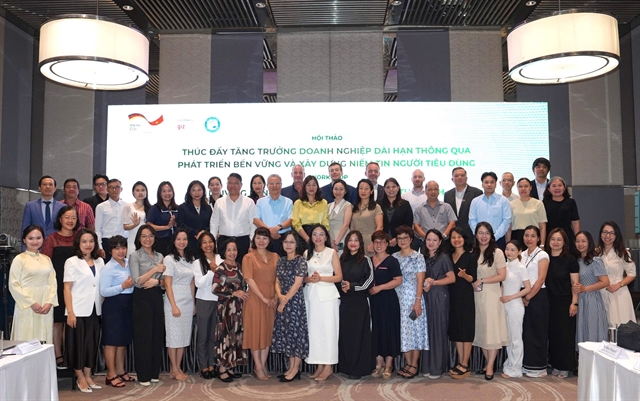
HCM CITY – Sustainability and consumer trust are increasingly becoming essential competitive advantages for businesses, especially amidst the rapid expansion of e-commerce and digital transactions.
This key observation was made during a workshop titled "Driving Long-Term Business Growth through Sustainability and Consumer Trust," jointly organised by the Ministry of Industry and Trade and the Deutsche Gesellschaft für Internationale Zusammenarbeit (GIZ) GmbH in HCM City on Thursday.
Part of the ASEAN Regional Economic Integration programme supported by the German Government, the workshop provided insights into the latest regulatory changes and market trends related to sustainability and consumer protection. It also presented practical solutions aimed at helping businesses enhance their competitiveness, proactively meet emerging market demands, and maintain market access in an increasingly integrated global economy.
Experts at the seminar highlighted that sustainability and responsible business practices have become central focal points in the trade policies of numerous leading economies in recent years.
Speaking at the event, Trần Thị Mai Hương, vice president of the Vietnam Competition Commission, emphasised that in the context of the global economy transitioning towards green initiatives, digitalisation, and sustainable development, the expectations of the international market from businesses now reach beyond product quality and competitive pricing.
Hương explained that consumers nowadays not only care about the quality of products but also about how they are manufactured, the transparency of companies, the respect for the legal rights and interests of consumers, data protection, and the disclosure of accurate information.
“Protecting consumers' rights is not only a legal obligation but also a foundation for sustainable business growth and stronger competitiveness. As markets increasingly value transparency and accountability, consumer trust has become a strategic asset that determines a company's ability to access markets and achieve long-term success,” she added.
On a global scale, many significant markets and advanced economies are in the process of refining policies concerning the circular economy, sustainable consumption, corporate responsibility within supply chains, and consumer protection in the digital realm.
For instance, the European Union has introduced the European Green Deal along with various green policies that have already begun impacting, or are expected to influence, goods exported to the EU market. Apart from environmental goals, the EU is progressively bolstering its regulatory framework to promote fair, transparent, and responsible business practices while strengthening consumer safeguards.
At the regional level, ASEAN states have endorsed the upgraded ASEAN Trade in Goods Agreement (ATIGA), transitioning the focus from primarily reducing tariffs to encouraging sustainable trade and deeper economic integration. Via the enhanced ATIGA, the circular economy is acknowledged as a pivotal element in boosting the competitiveness, resilience, and long-term expansion of ASEAN enterprises. Additionally, alongside economic integration, ASEAN nations are enhancing regional cooperation regarding consumer protection.

Through the implementation of regional plans and the gradual alignment of policies, ASEAN aims to foster a transparent, secure, and dependable trading environment while strengthening consumer protection not only within individual member states but also across e-commerce and cross-border trade.
Aligned with these global trends, Việt Nam continues to fortify its legal and policy framework to amplify environmental safeguards, promote sustainable development, and expedite the transition towards a circular economy.
According to Hương, sustainable development has been established as a continual focus across economic and social development strategies in Việt Nam. Simultaneously, legislation pertaining to consumer rights protection is continuously being refined to meet the demands of the digital economy and global integration.
The country is dedicated to fostering a fair and transparent business environment while solidifying consumer protection.
On June 20, 2023, the National Assembly ratified the 2023 Law on Protection of Consumers' Rights, expanding the scope of consumer protection and introducing new provisions to address evolving market dynamics and the digital economy.
Furthermore, several associated legal frameworks have been updated and modernised to bolster consumer protection, including the 2025 Law on Advertising, the 2025 Law on Personal Data Protection, and the 2026 Law on E-Commerce.
Sita Zimpel, Project Director at GIZ Vietnam, stressed during the workshop, “In both the digital and circular economy, transparency and integrity are the foundation for building consumer trust and enhancing business competitiveness."
"Through its initiatives in Việt Nam and across ASEAN, GIZ supports small and medium-sized enterprises in adopting sustainable and responsible business practices that meet evolving market regulations and standards—from responsible advertising to product traceability. These efforts not only strengthen businesses’ competitiveness within the region but also create new opportunities for sustainable growth and access to international markets." — VNS