Stable beginnings, powerful breakthroughs for Việt Nam’s private economic sector
As Việt Nam enters a new stage of development, sustained private-sector growth will require not only supportive policies but also a stable and transparent environment that ensures fair competition, Chinese Professor Tao Yitao said.
BEIJING — One year after the implementation of Resolution 68 on private economic development, the outcome can be summed up as a stable beginning and a powerful breakthrough.
Its revolutionary nature lies in redefining the private sector from a supplementary component of the economy into a key driving force, according to a Chinese expert.
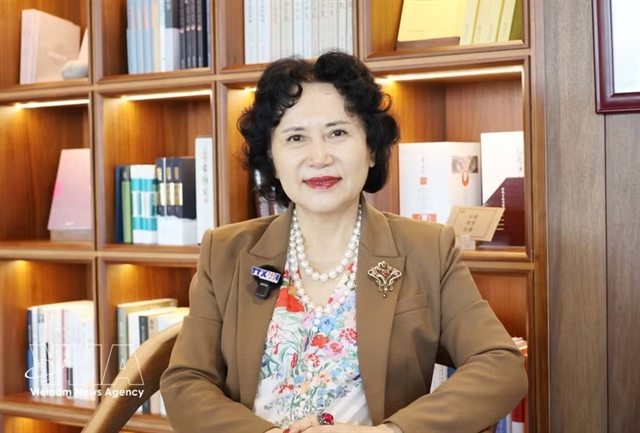
In an interview with Vietnam News Agency correspondents in China, Professor Tao Yitao, director of the China Centre for Special Economic Zone Research, said that the first achievement has been institutional reform and the rebuilding of confidence.
The resolution supports private enterprises through state-backed credit policies, elevating them from beneficiaries of preferential treatment to drivers of endogenous growth.
This shift in top-level policy design has significantly strengthened the confidence of both domestic and foreign investors in the stability of Việt Nam’s economic system, Tao noted.
She went on observing that market access is being further liberalised, while the movement of production factors is becoming freer. The principle that all sectors are open to market entry unless explicitly prohibited is beginning to take effect in areas previously characterised by monopoly, such as energy and finance.
Invisible barriers are starting to crack, and competitive neutrality is gradually becoming the norm. A trend is emerging in which capital, technology and talent are increasingly flowing towards the private sector.
According to the scholar, the business environment has improved.
The simplification of administrative procedures has reduced start-up costs for private enterprises, while the digital economy and cross-border e-commerce sectors have demonstrated notable innovative vitality.
In addition, mechanisms for protecting property rights have continued to be strengthened.
Administrative review processes and the application of legal measures in resolving property-rights disputes involving businesses have become more effective, helping to reinforce confidence within the business community.
She said the financial environment has seen significant improvements. Policy banks have redirected lending towards small- and micro-sized enterprises, while the expansion of the Growth Enterprise Market (GEM) and private capital markets has helped ease funding shortages.
Tao stated that the first year of implementing Resolution 68 could be described as a process of exchanging time for space within the system. Its deeper significance, she argued, lies in demonstrating that all economic reforms ultimately depend on political reform.
If public authority is not exercised in accordance with the law and resources are not opened to the market, the effectiveness of any resolution will ultimately be undermined by shortcomings in implementation.
She suggested that Việt Nam’s next step should not be to issue more resolutions, but rather to ensure fewer exceptions, uphold the universality of the law, and grant the private sector equal institutional status from the outset.
In other words, all economic actors should be treated fairly and given equal opportunities to develop from the moment they enter the market.
The professor emphasised that Việt Nam is now at a critical juncture in pursuing what its leadership has described as a new era of national rise.
In the long term, the development of the private economic sector will depend not only on supportive policies but also on a stable, transparent institutional environment that guarantees fair competition.
In this context, public power must be exercised within the framework of the law, while resources should be allocated primarily through market mechanisms. These are essential conditions for improving the efficiency of the sector and advancing the development of Việt Nam’s socialist-oriented market economy, Tao concluded. — VNA/VNS