Seminar highlights green strategies for food exports to EU
Vietnamese food exporters need to meet increasingly stringent EU standards on food safety, traceability, and sustainability to maintain access to the European maảket.
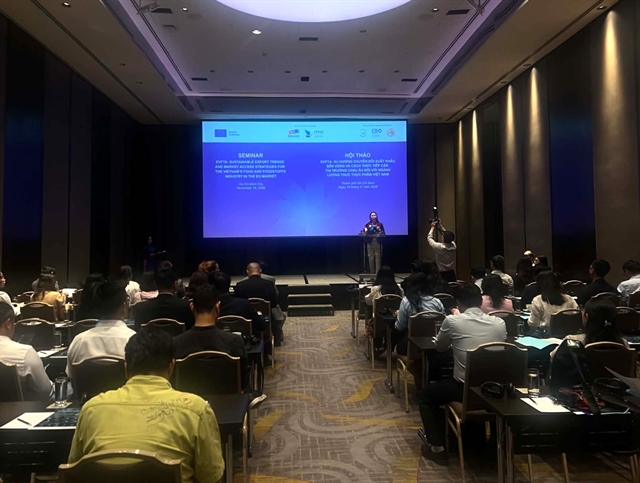
HCM CITY — Vietnamese food exporters need to meet increasingly stringent EU standards on food safety, traceability, and sustainability to maintain access to the European market, experts told a seminar in HCM City on November 18.
The seminar, which focused on sustainable export trends and market strategies for the food industry, was organised by the European Chamber of Commerce in Việt Nam (EuroCham Vietnam) and the city's Investment and Trade Promotion Centre (ITPC).
Hồ Thị Quyên, vice director of the ITPC, said the European Union is one of Việt Nam’s key export markets, particularly for agricultural, seafood and processed food products.
She said the EU-Việt Nam Free Trade Agreement (EVFTA) has created favourable conditions for Vietnamese goods by reducing tariffs, expanding market access and improving their competitiveness.
A report released by the Việt Nam Chamber of Commerce and Industry on November 9 shows that bilateral trade reached US$74 billion in the first 10 months of this year, with Việt Nam exporting $57.42 billion worth of goods to the EU.
Quyên said many of Việt Nam's key food products continue to have a strong position in the European market.
In the first 10 months of 2026, the EU accounted for 40.9 per cent of Việt Nam's total coffee exports at $2.89 billion.
However, Vietnamese businesses still face several challenges in accessing the EU market.
Jean-Jacques Bouflet, vice chairman of EuroCham Vietnam, said despite the market's potential and the tariff preferences offered by the free trade agreement, lower tariffs alone are no longer enough to guarantee market access.
“Vietnamese exporters must also meet the EU's increasingly strict requirements on food safety, product standards, traceability and sustainability.
“The EU has strict requirements on pesticide residues, contaminants, allergens and product labelling. Recent EU food safety alerts have also highlighted problems such as undeclared allergens, salmonella, Vibrio cholerae and chemical substances migrating from packaging into food.”
He urged businesses to strengthen quality control, adopt good agricultural practices, and test their products before shipping them to the EU.
EU buyers also increasingly expect businesses to provide clear information about the origins of their products, viewing traceability as essential to demonstrating compliance and building trust, he said.
Businesses must be able to trace products throughout the supply chain, using farm-level data, geolocation information, and supply-chain records to meet requirements under the EU Deforestation Regulation and rules against illegal, unreported and unregulated fishing, he added.
Environmental standards are also becoming increasingly important for exporters to the EU.
The EU's Packaging and Packaging Waste Regulation introduces new requirements covering recyclability, packaging reduction, and restrictions on certain hazardous substances.
EU rules on environmental claims also require businesses to provide evidence for descriptions such as eco-friendly, green, or carbon neutral.
Bouflet said businesses must back up their sustainability claims with reliable information and evidence rather than vague statements.
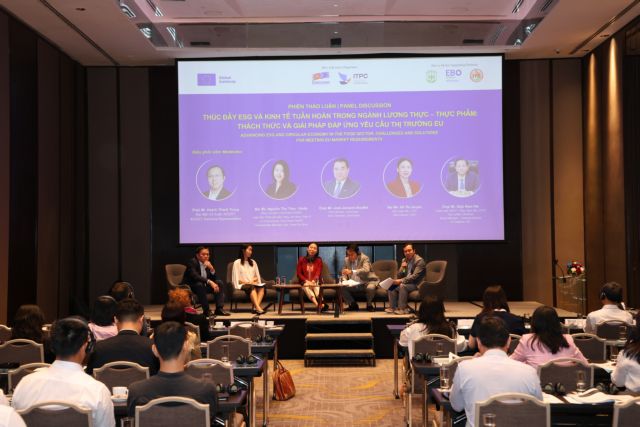
Experts at the seminar also discussed the three-year Inclusive Circular Economy Programme launched in April this year by EuroCham Vietnam, the Asia Society for Social Improvement and Sustainable Transformation, and the European Business Organisation Worldwide Network.
The programme seeks to help Vietnamese micro, small, and medium-sized enterprises and non-state actors adopt environmental, social and governance practices and circular economy principles, bringing their operations in line with the EU Green Deal, the EVFTA, and national policies, including Việt Nam's National Green Growth Strategy.
It focuses on three sectors – food, packaging and textiles – in HCM City, Hà Nội and Đà Nẵng.
Participants will receive support through training in ESG and circular economy practices, access to practical toolkits, in-depth on-site coaching and capacity-building programmes for businesses and support organisations. — VNS