SBV allows banks to exclude loans of three major developers from credit quotas
The State Bank of Việt Nam (SBV) has allowed commercial banks to exclude newly extended loans to 18 major projects developed by Vingroup, Sun Group and Masterise from annual credit growth quotas, in a move to facilitate financing for large-scale infrastructure and economic development projects.
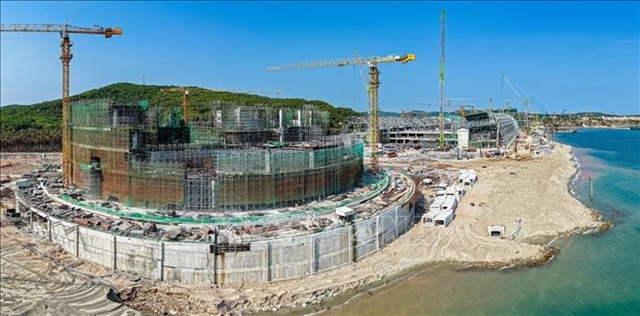
HÀ NỘI — The State Bank of Việt Nam (SBV) has allowed commercial banks to exclude newly extended loans to 18 major projects developed by Vingroup, Sun Group and Masterise from annual credit growth quotas, in a move to facilitate financing for large-scale infrastructure and economic development projects.
The projects span a wide range of sectors, from airport infrastructure and high-speed rail developments to facilities serving APEC events, with total financing needs exceeding VNĐ752 trillion (US$29 billion).
Under Document 5386/NHNN-TD, commercial banks that provide loans for the designated projects may exclude newly arising outstanding loans from their annual credit growth calculations.
However, lenders must separately monitor such loans and report them to the central bank in accordance with regulations.
Banks are also required to ensure that borrowers strictly manage the total financing needs for each project, provide written commitments that loan proceeds will be used for approved purposes and that total outstanding debt does not exceed the capital requirements declared for each project.
The SBV said the projects are considered nationally important developments with strong spillover effects for regional and local economic growth.
Guidance from the central bank follows proposals from three developers seeking preferential treatment for loans related to the projects.
Also included in the proposals are adjustments to regulations on the ratio of short-term funds used for medium- and long-term lending, and consideration of lending limits applicable to a single borrower or related group of borrowers.
Regarding the ratio of short-term funds used for medium- and long-term lending, the SBV issued Circular 25/2026/TT-NHNN on June 22, amending and supplementing Circular 22/2019/TT-NHNN. Commercial banks are required to comply with the revised regulations.
The central bank said funding demand for the projects is substantial and encouraged commercial banks to arrange syndicated loans.
When a bank's lending exposure exceeds regulatory limits for a single customer or a related group of customers, the lender must report the case to the SBV for submission to the Prime Minister for consideration.
The SBV stressed that commercial banks remain responsible for assessing and approving loans and ensuring that credit is extended to eligible borrowers for approved projects and in compliance with relevant regulations.
Lending decisions must be based on evaluations of project feasibility, business effectiveness, borrowers' repayment capacity and the banks' own funding capabilities and prudential requirements.
Eighteen projects
According to the list attached to the document, the mechanism applies to 18 projects with combined financing needs of more than VNĐ752 trillion.
Projects linked to preparations for the Asia-Pacific Economic Cooperation (APEC) forum account for nearly VNĐ170 trillion in funding demand.
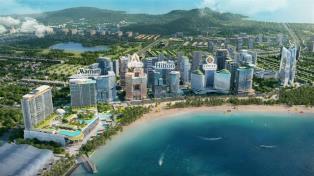
They include an APEC convention centre, the expansion of Phú Quốc International Airport, the Bãi Đất Đỏ mixed-use urban area, the Núi Ông Quán eco-tourism urban development and the first section of an urban railway line.
The Bãi Đất Đỏ area is the largest project in the group, with an adjusted investment capital of more than VNĐ101.4 trillion, while the Phú Quốc airport expansion is estimated at over VNĐ59.3 trillion.
Another group includes public-private partnership projects with a total capital demand of more than VNĐ162.3 trillion. The largest is the Rạch Chiếc National Sports Complex, with total investment of nearly VNĐ145.6 trillion.
The list also includes two road projects connecting Gia Bình Airport with Hà Nội, one passing through Hà Nội with investment of nearly VNĐ28.8 trillion and another through Bắc Ninh with investment exceeding VNĐ25 trillion.
High-speed railway projects account for the largest financing need, at more than VNĐ212.3 trillion in total. These include the Bến Thành-Cần Giờ railway, with estimated investment of around VNĐ102.4 trillion, and the Hà Nội-Quảng Ninh railway, at about VNĐ147.4 trillion. The latter alone is expected to require more than VNĐ125 trillion in borrowed capital.
The rest are eight projects forming part of the Gia Bình International Airport complex with a total capital demand of nearly VNĐ208 trillion, including the airport, an air traffic control tower, connecting roads, resettlement areas, utility relocation works and three build-transfer counterpart projects. — VNS