Resolution 79 to support double-digit growth from 2026, PM says
The new policies must focus on optimising State resources, improving governance, promoting digitalisation and green development, and balancing State and private sector resources, while reducing unnecessary administrative intervention.
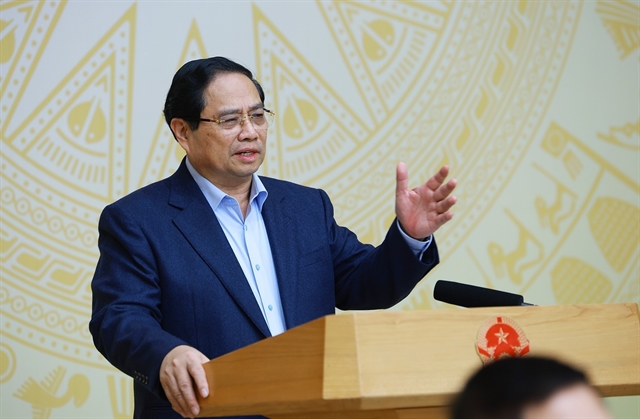
HÀ NỘI — The effective implementation of Resolution 79 on developing the State-owned economy would help support double-digit economic growth from 2026 and beyond, said Prime Minister Phạm Minh Chính.
PM Chính, who heads the national steering committee overseeing the resolution’s implementation, made the remarks while chairing the committee’s first meeting in Hà Nội on Sunday.
He urged ministries, agencies and local authorities to implement the resolution flexibly and proactively, stressing the need for swift and decisive action to ensure policies deliver tangible results for economic growth and public welfare.
The PM called for rapid dissemination of the resolution’s contents to build social consensus and directed ministries and localities to develop detailed action plans with clearly defined objectives, timelines and responsibilities.
At this first meeting, PM Chính requested the steering committee to focus its discussions and contributions on the Government’s draft resolution on its action plan to implement Resolution No. 79-NQ/TW; the National Assembly’s draft resolution on some special mechanisms and policies for the development of the State-owned economic sector; and the draft regulations on the operation of the steering committee, ensuring substantive, practical, and effective implementation, avoiding formality.
He also instructed Government agencies to seek public and expert feedback on the draft resolutions through official online portals.
According to PM Chính, the new policies must focus on optimising State resources, improving governance, promoting digitalisation and green development, and balancing State and private sector resources, while reducing unnecessary administrative intervention.
He said the State should clearly define the tasks it must undertake while maintaining its leading role, and refrain from areas where the private sector can operate more effectively.
The Government should also expand public-private partnerships, with State resources playing a guiding role, he added.
The PM said policymakers should review Resolution 79 to identify areas requiring special or pilot mechanisms that differ from existing laws or are not yet regulated, allowing for immediate implementation or future legal amendments under a defined roadmap.
He assigned the Ministry of Finance to incorporate feedback and finalise draft resolutions for submission to the Government, with completion targeted for February 2026, and to continue restructuring State-owned corporations and improving tax and fee policies.
Other ministries were tasked with reviewing and proposing legal amendments in their respective areas, including land use, environmental protection, sustainable resource exploitation, underground space management, housing policy, and personnel recruitment and appointment mechanisms at State entities and public service units.
He requested steering committee members, ministries and State-owned enterprises to submit written feedback on the draft resolutions, stressing that the flexible and proactive implementation of Resolution 79 would contribute to achieving double-digit economic growth from 2026 onwards.
Delegates said the resolutions are needed to maximise the role of State-owned enterprises in stabilising the economy and driving growth during the 2026-30 period.
They noted that the global environment remains complex and unpredictable, requiring stronger coordination and innovation to achieve Việt Nam’s development targets.

According to delegates, Resolution 79 for the first time provides a comprehensive definition of the State economy, setting out nine core components comprising resources owned, managed or controlled by the State.
These include land and natural resources, infrastructure assets, the State budget, national reserves, non-state financial funds, State capital in enterprises where the Government holds 50 per cent or less of equity, State-owned enterprises (SOEs), State-owned credit institutions and public service units.
A key focus is the restructuring of SOEs to improve efficiency and governance in line with international standards.
By 2030, Việt Nam aims to have 50 SOEs among Southeast Asia’s 500 largest firms and one to three in the global top 500.
All SOEs are expected to adopt modern, digital-based governance systems, while all State economic groups and corporations must apply OECD corporate governance principles.
The resolution also targets the development of large State-owned economic groups and commercial banks capable of competing regionally and globally, with at least three State-owned commercial banks ranking among Asia’s 100 largest by total assets.
By 2045, Việt Nam aims to place around 60 SOEs among Southeast Asia’s 500 largest companies and five within the world’s top 500.
The resolution envisions the State economy becoming a solid foundation for strategic autonomy, resilience and the overall competitiveness of the economy, underpinned by modern, transparent and efficient governance, strong competitiveness and deep integration into the global economy. — VNS