Reforming education model to lead AI development: Deputy PM
The success of education in the age of artificial intelligence must not be measured by the amount of technology introduced into classrooms, but by the genuine progress made in each individual’s capabilities, character and creativity.
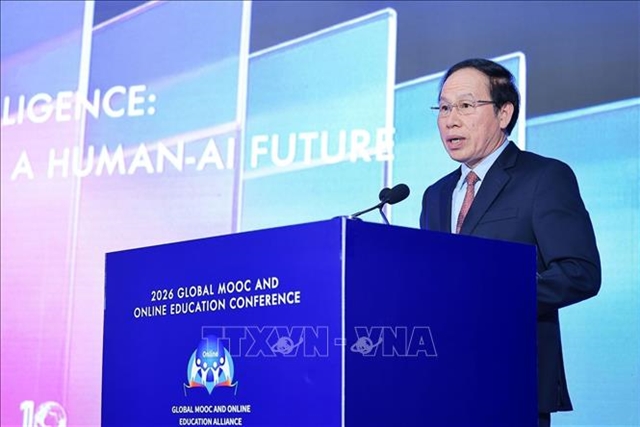
HÀ NỘI — Deputy Prime Minister Lê Tiến Châu on Tuesday emphasised the need to reform the education model in order to lead artificial intelligence (AI) development.
He made the remarks while speaking at the 2026 Global MOOC and Online Education Conference, themed 'Reallocating Intelligence: Transforming Education for a Human-AI Future'.
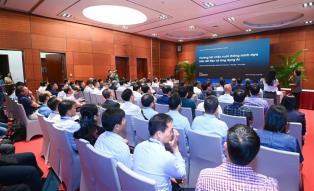
Co-organised by the Việt Nam National University, Hà Nội (VNU Hà Nội) and the Tsinghua University of China in Hà Nội, the conference brought together nearly 400 delegates, including university leaders, experts, scientists and representatives of international education organisations.
The conference focused on the profound transformations taking place in higher education in the AI era, particularly redefining the respective roles of humans and technology and the ways in which they collaborate, in order to renew teaching, learning, scientific research and university governance.
VNU Hà Nội President Bùi Thế Duy said that VNU Hà Nội wished to strengthen cooperation with members of the Global MOOC, Online Education Alliance and international partners in developing digital education and applying AI.
The priorities would include jointly developing and sharing open online courses and high-quality digital learning materials, developing training programmes, co-teaching, and conducting joint research on AI in education, thereby helping to improve the quality of education and expand access to knowledge.
Deputy PM Châu said that reallocating intelligence in the age of artificial intelligence would not simply mean transferring intelligence to machines. Rather, it would mean enabling technology to help people focus on developing independent thinking, critical-thinking skills, creativity and a lifelong learning mindset.
“Most importantly, human beings must always remain the subject that sets the direction for values and controls technology. The success of education in the age of artificial intelligence must not be measured by the amount of technology introduced into classrooms but by the genuine progress made in each individual’s capabilities, character and creativity,” the Deputy PM affirmed.
High-quality human resources
For Việt Nam, education and training are a top national priority, playing a decisive role in the country’s future development.
Aiming to become a developed, high-income country by 2045, Việt Nam is strongly transitioning to a development model based on knowledge, science, technology, innovation and high-quality human resources, with people at the centre as both the subject of and the driving force behind development.
Việt Nam’s policy is to build an open, modern, equitable and internationally integrated education system and to promote digital transformation and the application of artificial intelligence in order to fundamentally renew teaching and learning methods, research and educational governance.
The Deputy PM noted that, in this process, higher education must play a pioneering role in training high-quality human resources, creating knowledge and promoting innovation.
Drawing on Việt Nam’s experience, the Deputy PM outlined several directions that should be prioritised and promoted in the time ahead.
First, universities need to proactively adjust their curricula, teaching methods, assessment and examination practices, and institutional governance; they should focus on developing digital learning materials and building digital competencies, including standards-based competence in the use of artificial intelligence.
Next, the comprehensive development of human capabilities – particularly those of learners and teaching staff – must be placed at the centre of the transformation process.
In this regard, teachers are required both to master new technologies and to maintain their role in guiding values, educating character, transmitting the nation’s cultural and historical traditions, and inspiring creativity among generations of pupils and students. For learners, it is necessary to promote self-learning capacity alongside a sense of responsibility and ethical conduct in the use of artificial intelligence.
Particularly, it is essential to promptly complete a system of standards for applying artificial intelligence in teaching, research and academic assessment, in line with international practice.
In addition, substantive international cooperation should be promoted to build an open, inclusive and sustainable education ecosystem.
Recent experience has confirmed that no country, institution or individual can resolve on their own all of the challenges posed by artificial intelligence, especially in the field of education and training.
Deputy PM Châu said that, in the new stage of development, Việt Nam’s vision and aspiration would be to strive to become a leading centre in the region and the world for education, training, research and innovation – truly a place that brings together knowledge and talent to create new values.
“The Government of Việt Nam is continuing to improve its institutions in an open, transparent and stable direction, and we welcome scientists, educators, intellectuals and international partners to come to Việt Nam to work with us in creating shared prosperity in the new era,” the Deputy PM said. — VNS