Prime Minister Lê Minh Hưng outlines 12 key tasks to drive socio-economic growth
Central to the agenda is the need to unify thinking, awareness, ambition and action to achieve the double-digit economic growth target, while sustaining macroeconomic stability and mobilising resources effectively for development, he said.
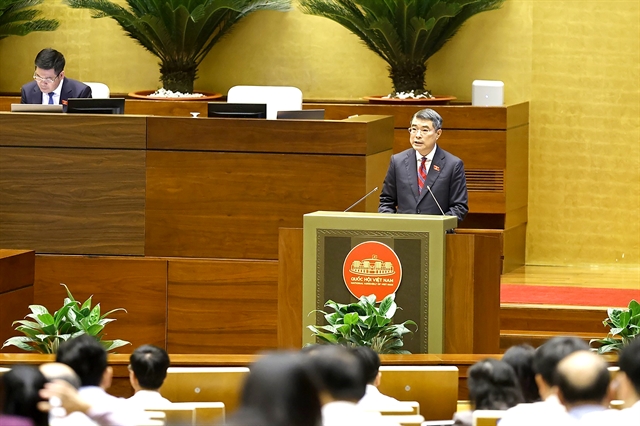
HÀ NỘI — Prime Minister Lê Minh Hưng called on Party secretaries and heads at all levels to take direct responsibility in developing practical plans and ensuring timely, coordinated and effective execution to implement the tasks.
The PM has set out 12 priority groups of tasks and solutions to steer socio-economic development in the remaining months of this year.
The proposals were presented on Thursday afternoon at the first sitting of the 16th National Assembly, where he delivered a Government report reviewing the supplementary results of the 2025 socio-economic development plan and assessing the implementation of this year's plan.
Central to the agenda is the need to unify thinking, awareness, ambition and action to achieve the double-digit economic growth target, while sustaining macro-economic stability and mobilising resources effectively for development, he said.
On macro-economic management, the Government will closely monitor global and domestic developments, strengthen forecasting, and respond with flexible and timely policy measures.
Fiscal, monetary and other macro-economic policies will be coordinated in a consistent and effective manner to safeguard stability and avert any risk of economic crisis.
“Fiscal discipline will be tightened, with contingency measures in place to respond to volatility,” he added.
The central budget will retain its leading role, while local budgets will be managed proactively in line with regulations.
“By this April, growth targets are to be reviewed, adjusted and assigned to each sector, locality and State-owned enterprise for both 2026 and the 2026-30 period,” he said.
Ensuring energy security, strengthening key markets
Ensuring national energy security, both in the short and long term, will be a key priority, particularly maintaining adequate supplies of crude oil and gas.
Electricity and energy conservation will be enforced rigorously to prevent shortages under any circumstances, alongside efforts to improve the efficiency of power system operations.
The Government will also work to stabilise and strengthen key markets, notably real estate, corporate bonds and monetary markets.
Supply-demand management and price controls for essential goods will be tightened to prevent hoarding and price manipulation.
Product quality oversight, traceability and consumer protection will be enhanced, while efforts to combat smuggling, trade fraud and intellectual property violations will be intensified.
“Mobilising and using resources effectively is identified as a critical solution for achieving double-digit growth,” he said.
Measures include increasing State budget revenue by 10 per cent, cutting regular expenditure by more than 10 per cent and seeking an additional 5 per cent in savings.
The Government also plans to issue Government and local bonds, expand access to ODA loans, boost investment by State-owned enterprises, and attract greater private and foreign direct investment.
Foreign-invested enterprises will be encouraged to reinvest retained earnings in Việt Nam, while FDI attraction will be linked more closely with technology transfer.
The authorities will also consider raising foreign ownership limits in sectors that do not affect national security.
Efforts will be made to develop medium- and long-term capital markets, improve the country’s credit rating, upgrade the stock market status and attract international investment funds.
Long-delayed projects will be reviewed and bottlenecks resolved decisively.
Growth drivers from investment, consumption and exports will be further leveraged.
Public investment disbursement will be accelerated, with a stronger focus on efficiency, using public investment as a catalyst for broader social investment.
Ministries and localities are required to complete guidance on output-based capital allocation and socio-economic accounting by this month.
Development investment is set to account for 40 per cent of total State budget expenditure, while the number of publicly funded projects in the 2026-30 period will be reduced by at least 30 per cent compared with the previous phase.
Domestic markets will be strengthened through demand stimulus, the development of e-commerce ecosystems and the expansion of cashless payments.
A national strategy for domestic trade development is expected in the second quarter of this year, alongside initiatives promoting the 'Vietnamese people use Vietnamese goods' campaign.
A new import-export strategy to 2030 will also be finalised within 2026, with a focus on expanding export markets, diversifying products and supply chains, maximising traditional markets and accelerating negotiations on new free trade agreements.
The Government will push ahead with restructuring industries and economic sectors, while fostering new economic models.
In industry, the focus will be on modernising the national industrial base and enhancing competitiveness in key foundational sectors to integrate more deeply into global value chains.
In agriculture, restructuring will aim for higher efficiency, sustainability and added value.
Policy reforms on rice land quotas will be studied to improve land use efficiency while ensuring national food security.
A comprehensive inventory of forest cover and land use is to be completed in this year.
Efforts will also be intensified to address the EU’s “yellow card” warning on illegal, unreported and unregulated (IUU) fishing.
The services sector will be developed through the modernisation of service ecosystems, with breakthrough measures to attract international visitors.
These include piloting long-term visa exemptions and multiple-entry visas by the second quarter of this year, with a target of welcoming 25 million international tourists that year.
Further priorities
Further priorities include fostering breakthroughs in science, technology, innovation and digital transformation; improving the legal and institutional framework; cutting administrative procedures; and enhancing the investment and business environment.
The Government also aims to improve education and training quality at all levels, attract and retain talent, and develop modern, integrated infrastructure, particularly in transport, railways, airports, seaports, energy and urban systems.
Administrative reforms will continue, with greater decentralisation and delegation of authority linked to resource allocation, while ensuring effective operation of two-tier local government and strengthening accountability among heads.
Social and cultural development will be promoted alongside improvements in living standards and social welfare.
National defence and security will be reinforced, with efforts to maintain social order and safety, while deepening international integration and elevating the country’s global standing.
Prime Minister Hưng stressed that 2026 marks the first year of implementing the 2026-30 socio-economic development plan.
“The tasks ahead are substantial but carry critical importance in laying the groundwork for future growth,” he said.
He underscored that effective implementation will be decisive in translating policies into tangible outcomes, calling on Party secretaries and heads at all levels to take direct responsibility in developing practical plans and ensuring timely, coordinated and effective execution.
Achievements and challenges
The report also said that macro-economic conditions remain broadly stable, inflation is under control, and major economic balances are maintained.
GDP growth in the first quarter of this year is estimated at 7.83 per cent, with four localities recording growth above 10 per cent. Average CPI rose by 3.51 per cent.
State budget revenue in the first three months is estimated at VNĐ829.4 trillion (US$ 34 billion), up 11.4 per cent.
FDI inflows increased strongly, with realised capital reaching US$5.4 billion, up 9.1 per cent.
Total import-export turnover is estimated at US$249.5 billion, up 23 per cent.
All three economic sectors recorded solid growth.
Agricultural production remained stable, while industry continued to expand, with manufacturing growing by 9.7 per cent.
Trade and services maintained momentum, with nearly 6.8 million international tourist arrivals, up 12.4 per cent.
Socio-economic infrastructure development has been implemented in a coordinated manner, focusing on major projects such as expressways, high-speed rail, airports and digital infrastructure.
However, the economy continues to face significant external headwinds, and achieving double-digit growth remains a formidable challenge.
Production and business activities in several sectors are under strain, while traditional growth drivers have yet to reach their full potential.
Domestic demand remains weak, and exports still rely heavily on the FDI sector.
New growth drivers are at an early stage and will require time to yield results.
The real estate market is recovering slowly and carries potential risks. Administrative procedures remain cumbersome in some areas, and online public services are not yet fully user-friendly.
Decentralisation and the capacity of local-level officials remain limited in some areas, while infrastructure and equipment are not always utilised effectively.
Meanwhile, security and social order challenges persist, with complex developments in drug-related crime, cybercrime, online fraud, smuggling, trade fraud, intellectual property violations and food safety issues. — VNS