PM urges foreign firms to move beyond manufacturing in Việt Nam: AEF
At the Autumn Economic Forum 2026 in HCM City, Prime Minister Lê Minh Hưng has urged international companies to go beyond investment and manufacturing to help Việt Nam develop its R&D capabilities, advance strategic technologies and move up global value chains.
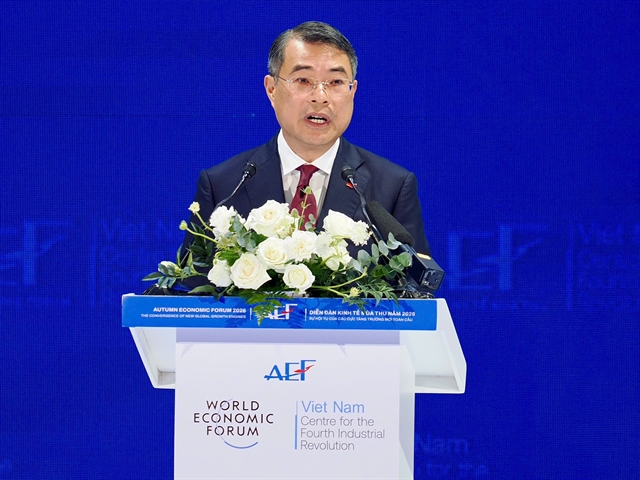
HCM CITY — Prime Minister Lê Minh Hưng on Wednesday called on foreign investors to work more closely with Vietnamese businesses on research, technology and innovation, as Việt Nam seeks to move into higher-value activities in global supply chains and achieve annual economic growth of at least 10 per cent through 2030.
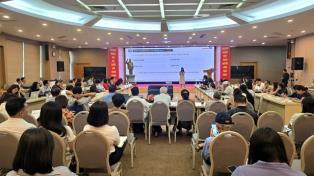
Speaking at the high-level plenary session of the Autumn Economic Forum (AEF) 2026, co-branded with the World Economic Forum (WEF), in HCM City, he urged international companies to go beyond investment and production to help develop the country’s research and development (R&D) capabilities and create new sources of growth.
“We want our international partners not only to ‘invest in Việt Nam’, but to ‘invest with Việt Nam’; not only to ‘produce in Việt Nam’, but also to join us in research and development, promote innovation and create new value chains with regional and global competitiveness,” he said.
The Government wants international companies to work with Vietnamese businesses and local authorities on strategic technologies, including artificial intelligence (AI), semiconductors and advanced materials.
The PM also called for closer cooperation with the WEF and other international partners to train workers in digital technology and advanced science, helping Vietnamese businesses adopt and develop new technologies.
“Việt Nam is ready to work with technology companies to test emerging technologies, including AI and new energy, in controlled environments before wider deployment,” he said.
He also proposed mobilising more medium- and long-term capital through international financial centres in HCM City and Đà Nẵng to support infrastructure, energy, the green transition and innovation.
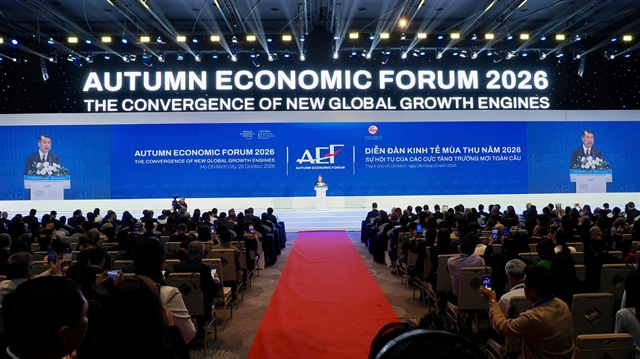
Growth ambitions
The PM said Việt Nam was entering a new phase of development amid geopolitical uncertainty, strategic competition, conflicts and changes in global supply chains. Advances in AI and digital technology, along with the green and energy transitions, were reshaping production and creating new sources of growth.
He said the economy grew 9.01 per cent in the first nine months of 2026, its strongest performance since 2011, while total trade turnover exceeded US$987 billion, up more than 30 per cent year-on-year.
Registered foreign direct investment reached $50.36 billion, an increase of 76.4 per cent, while disbursed FDI rose 12.1 per cent to $21.07 billion.
Việt Nam aims to become a developing country with modern industry and upper-middle income by 2030, and a developed, high-income country by 2045.
The Government has set a target of average annual economic growth of at least 10 per cent in 2026-30, while maintaining macroeconomic stability, controlling inflation and promoting sustainable development.
The PM said attracting foreign investment must go hand in hand with improving the capacity of Vietnamese businesses, raising productivity and strengthening the economy’s resilience.
He called for the forum’s discussions to lead to practical results rather than end with general commitments.
The Government would assign responsible agencies to feasible proposals, establish roadmaps for potential projects and work to address investors' concerns, he said.
Technology and investment
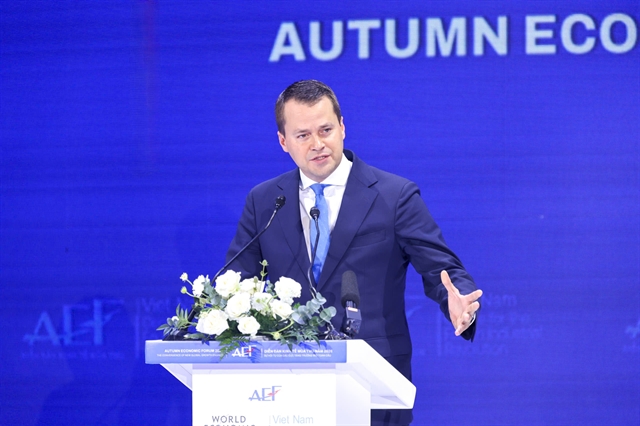
Stephan Mergenthaler, managing director and chief technology officer of the WEF, said intelligent systems, resilient and sustainable industry, and connectivity would shape the next phase of global growth.
AI and other advanced technologies could transform businesses and public services, but the challenge was to turn technological advances into higher productivity, more competitive businesses, better jobs and improvements in people's lives, he said.
He also stressed the importance of ensuring that small and medium-sized enterprises could benefit from new technologies. Businesses were increasingly considering resilience and sustainability, as well as efficiency, when deciding where to invest and produce.
Stronger links between ideas, capital, talent and markets would also be important, he said, adding that HCM City’s business dynamism, industrial base and international outlook could help connect Vietnamese companies with global investors and technology partners.
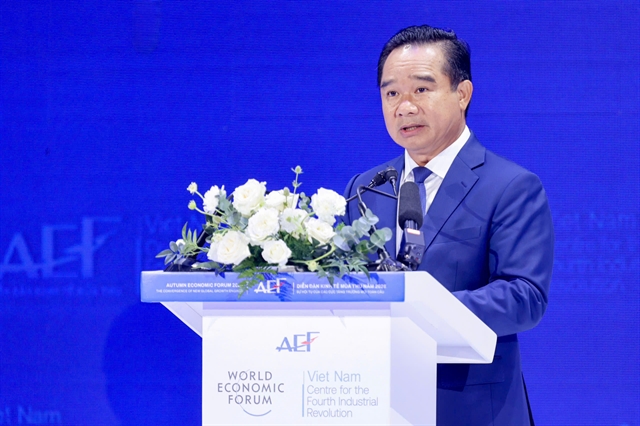
Nguyễn Văn Được, chairman of HCM City People’s Committee, said the city wanted to develop from a major economic growth centre into a hub connecting regional and global economies.
The city was seeking to link investment with technology, knowledge with talent, and markets with production.
Its plans include developing an international financial centre, a free trade zone and an ecosystem for science, technology, innovation and digital transformation.
Ambassador of the European Union to Việt Nam Julien Guerrier said Việt Nam’s growth ambitions and investment needs offered opportunities for cooperation in renewable energy, sustainable manufacturing, semiconductors, AI, transport and logistics.
“Governments should set the right framework. But it is businesses that make investment decisions,” he said.
Investors needed clear, predictable and consistent rules, including effective implementation of laws across provinces, he said.
Protecting businesses’ intellectual property and technical know-how and ensuring that small and medium-sized enterprises could access incentives were also important to building confidence.
The EU is ready to support Việt Nam through its Global Gateway initiative and financial instruments designed to reduce investment risks, strengthen industrial ecosystems and connect public priorities with private capital, Guerrier said.
The PM said Việt Nam remained committed to international integration and would work with partners to address shared challenges and create new development opportunities.
The forum should help turn international cooperation into concrete initiatives and projects, he noted. — VNS