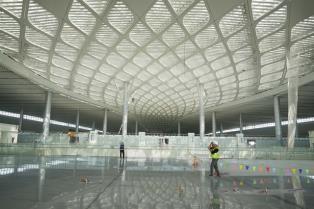
PM sets target to launch Long Thành airport operations by late 2026
To date, work valued at around VNĐ64.1 trillion (US$2.4 billion) has been completed, equivalent to 74 per cent of total contracted value, while disbursement has reached approximately VNĐ40.7 trillion.
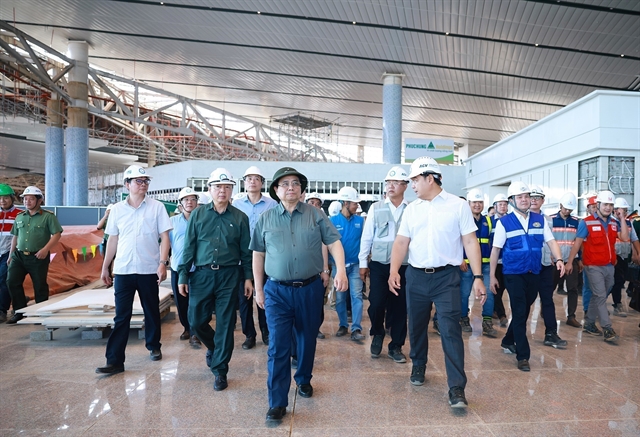
ĐỒNG NAI — Prime Minister Phạm Minh Chính has called for accelerating construction of Long Thành International Airport in southern province of Đồng Nai to ensure it begins commercial operations in the fourth quarter of 2026.
During an on-site inspection on Sunday, the PM reviewed progress and sought solutions to bottlenecks in line with directions from Party General Secretary Tô Lâm. He was accompanied by Deputy PM Trần Hồng Hà, along with leaders of ministries, central agencies, Đồng Nai Province and HCM City.
Following conclusions by the Party chief and the Government, the Airports Corporation of Việt Nam (ACV) has stepped up coordination with relevant agencies, contractors, and consultants to expedite implementation.
All construction packages have now mobilised sufficient managerial and technical staff, contractors, and supervision consultants, with nearly 9,000 personnel regularly on site alongside full deployment of machinery and equipment.
Component project 3 of the Long Thành international airport project, including 145 construction and consultancy packages, is being accelerated. To date, work valued at around VNĐ64.1 trillion (US$2.4 billion) has been completed, equivalent to 74 per cent of total contracted value, while disbursement has reached approximately VNĐ40.7 trillion.
Contractors are revising timelines to reflect actual conditions, aiming to complete construction by this September in order to begin commercial operations in the fourth quarter of this year.
In parallel, relevant ministries, sectors, units and localities are accelerating key transport links, including extending the Bến Thành–Suối Tiên metro line (the first one to be operational in HCM City) to Đồng Nai Province’s administrative centre and the airport, as well as road connections linking the airport’s main axis to provincial routes.
At a working session with ministries, sectors, investors and contractors following the inspection, PM Chính reiterated that Long Thành International Airport is a key national project passed by the National Assembly in 2015 and approved by the Government in 2020, though construction of major components only began in August 2023, with first test flight conducted in September last year.
After more than two years, several components have been completed or are nearing completion, including the air traffic control centre, runway, and apron, while the passenger terminal is in the final stages of construction. Other systems such as baggage handling, hangars, utilities, and internal transport infrastructure are being rapidly installed.
He underscored the principle that any violations must be handled strictly, while those acting responsibly should be protected, and urged the Ministry of Public Security to soon conclude its review to help unblock payment procedures.
The government leader called for coordinated solutions to support units because of rising input costs, while urging investors and contractors to continue completing key systems, including fuel supply, electricity, water, telecommunications, and operational facilities.
He gave specific directions to accelerate major transport projects connecting the airport, including expressways such as Biên Hoà–Vũng Tàu, Bến Lức–Long Thành, and HCM City–Long Thành–Dầu Giây, as well as urban rail lines linking Suối Tiên–Biên Hoà–Long Thành, and Tân Sơn Nhất and Long Thành airports.
Reaffirming the deadline, PM Chính stressed that construction must be completed by the third quarter of 2026 at the latest, to enable commercial operations in the fourth quarter.
He also called for ensuring quality, technical standards, environmental sustainability, and safety, while preventing corruption and waste. In addition, he urged the swift restructuring of the ACV’s organisational apparatus, the establishment of a working group to address project bottlenecks, and the development of plans for non-aviation works and an airport city to support the broader aviation economy. — VNA/VNS