Nation's carbon market must become reliable investment opportunity
As Việt Nam’s carbon market takes shape, businesses and investors highlight the need for credible emission reductions, transparent measurement and stronger access to green finance.
Mai Hương – Hồng Linh
As Việt Nam builds its domestic carbon market and moves towards international integration, the quality of carbon projects will become increasingly important. Three experts from the business and investment sectors share their views with Việt Nam News on credible emission reductions, stronger verification, financing and the infrastructure needed to build investor confidence.
Andri Meier
Deputy Head of Development Cooperation, Embassy of Switzerland in Việt Nam
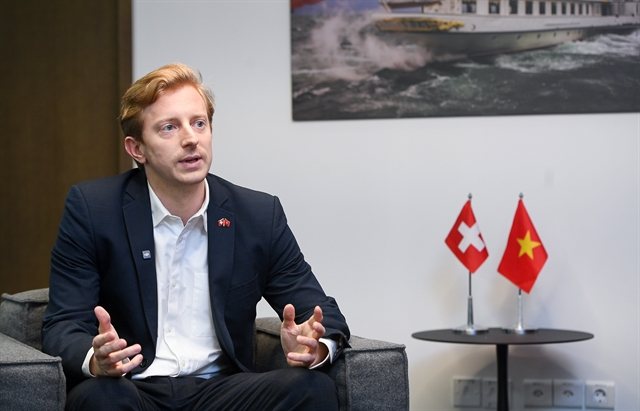
Việt Nam has established the framework through a legal mandate and governance mechanism, an essential first step. Based on international experience, operationalisation is successful when treated as a long-term market infrastructure and business development strategy.
The underlying infrastructure is crucially important in creating operational credibility. This includes introducing a reliable measurement, reporting and verification (MRV) system and secured registry that are interoperable before launching pilot projects to test the registry and verification/accreditation infrastructure.
With the development of institutional capacity and private sector readiness, pilots can eventually be scaled. This calls for a sound incentive framework that is attractive to market participants, be it net sellers or buyers. It is equally important to build fundamental capacity for companies, including data management, transparency and MRV.
For Switzerland, the carbon market is not an isolated climate instrument. It fits directly into our broader objective of supporting Việt Nam’s transition towards a competitive, resilient and low-carbon economy. Our Cooperation Programme 2025-28 focuses on sustainable trade and innovation, sustainable public and private finance, and climate-smart industrial and urban development.
A credible carbon market can connect these priorities. It can put economic value on reducing emissions, help businesses finance cleaner technologies, mobilise private investment and strengthen the competitiveness of Vietnamese companies as global markets increasingly demand lower-carbon products.
Việt Nam has already taken important steps by establishing the framework for its domestic carbon market and international carbon-credit transfers. The next opportunity is to translate this framework into high-quality, investment-ready mitigation projects.
Switzerland and Việt Nam can deepen cooperation in areas such as market integrity and MRV, capacity building, sustainable finance and the development of projects where carbon revenues can unlock additional investment and technology. Once our bilateral Article 6 cooperation agreement is signed and becomes operational, it can add another financing channel for qualifying projects.
Sử Thanh Long
Director of International Dairy Projects, TH Group

Many businesses think that participating in the carbon market is very demanding and difficult. But in reality, the State and businesses, including our company, want to participate in the carbon market because we want to promote green products and enable them to enter the international trading system and eventually be traded globally.
If we want to participate in the carbon market or achieve carbon neutrality, the most important thing is to reduce emissions as much as possible before offsetting what remains. Businesses therefore need to make emission reduction a priority across every factory, plant and operation.
When it comes to offsetting, we need to measure carefully and work with reputable organisations to avoid counting the same emission reduction more than once. Reducing emissions within our own operations does not automatically create tradable carbon credits.
If a company reduces its emissions from 100 tonnes to 10 tonnes, for example, it only needs to offset the remaining 10 tonnes. The 90 tonnes already reduced are internal emission reductions, not credits that can be traded or counted again.
So, businesses should first reduce emissions and costs to the lowest possible level, then offset what remains. The carbon credits used for this purpose should represent genuine carbon removal, such as through afforestation or technologies that capture CO2 from the air and store it underground.
As for the legal framework, ultimately, it needs to be based on international rules and be compatible with them. Only then can Việt Nam’s carbon market connect with international markets. We now have a relatively clear framework in place, but having clear rules is one thing; implementing them is another, and this remains very challenging.
The first challenge is measurement and verification – accurately determining how much carbon is emitted and having an independent third party verify it. This requires businesses to engage independent organisations and bear the associated costs. At the same time, reducing emissions often requires investment in new technologies, machinery and production lines, which creates another financial burden.
That is why access to capital, particularly international green finance, would be very helpful for Vietnamese businesses. We also need consulting and advisory teams that can help businesses accurately measure their emissions and determine how much needs to be offset.
Nguyễn Ngọc Tùng
Head of VinaCarbon Fund, VinaCapital

If we look back just two years, Việt Nam’s carbon market was still a rather unfamiliar concept. Today, the picture is very different and the market is becoming increasingly complete.
First, we now have relatively comprehensive rules of the game, covering the domestic carbon exchange, international carbon credit transfers and forest carbon credits. The State has put in place most of the legal framework for the market to operate transparently and under control.
Second, we now have the tools to put the framework into practice. At the end of June, the carbon exchange began operating at the Hà Nội Stock Exchange and recorded its first transaction. Emission allowances, previously figures on paper, have now become tradable assets with real commercial value.
Third, the Government has taken a clear approach by focusing initially on major emitting sectors. The pilot phase covers thermal power, steel and cement – three of the highest-emitting industries.
Fourth, Việt Nam has stepped into the international market. A carbon credit cooperation agreement with Singapore under Article 6 of the Paris Agreement shows that Vietnamese carbon credits are gaining international recognition and can be transferred overseas.
Looking ahead, we need to improve measurement, reporting and verification, gradually tighten emission allowances, expand the market beyond the three pilot sectors and strengthen cross-border trading.
We believe environmental obligations can become an opportunity to raise capital only when businesses can turn those requirements into an asset that can be measured, verified and used to create economic value.
Vietnamese businesses should not look at emission reductions, waste treatment, energy efficiency or forest development simply as costs incurred to meet regulations. If properly prepared, these activities can create environmental value and economic value at the same time, while also improving access to international capital.
From VinaCarbon’s investment experience, we normally look at a carbon project from three main perspectives: the quality of the carbon credits; the sustainability of the project; and the measurement, reporting and verification system. Without these, it is very difficult to persuade international investors to put their money into a project.
International investors are not simply investing in carbon credits. They are investing in a company and a business model in which carbon credits can create additional value. VNS