NA discusses banking system safety, digital economy development
The documents discussed were the draft amendments to the Law on the State Bank of Việt Nam, the Law on Anti-Money Laundering and the Law on Credit Institutions.
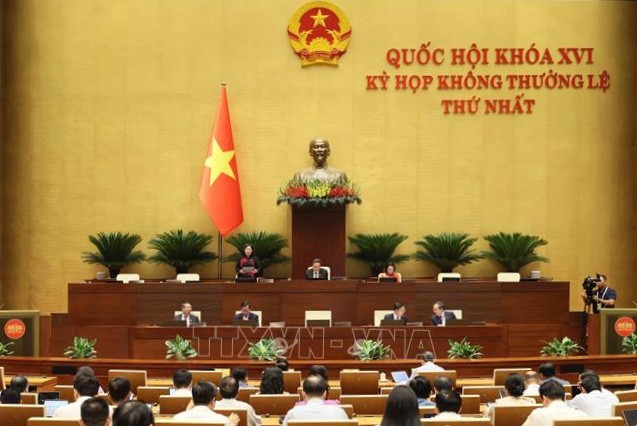
HÀ NỘI — National Assembly (NA) deputies on Sunday morning discussed a number of draft laws related to the banking and financial systems as their first extraordinary session continued in Hà Nội.
The documents discussed were the draft amendments to the Law on the State Bank of Việt Nam, the Law on Anti-Money Laundering and the Law on Credit Institutions.
The session took place under the chairmanship of NA chairman Trần Thanh Mẫn and NA vice chairwoman Nguyễn Thị Hồng.
Discussing the draft Law on Credit Institutions, deputy Lê Văn Thế from Ninh Bình Province expressed his support of the draft's supplement of the responsibility to control conflicts of interest to commercial banks when they act as managing agents for collateral for corporate bonds.
"If a bank acts as both a lender to the enterprise and the manager of the bond collateral while also participating in distribution, payment or other services for the issuance, conflicts of interest may arise when the enterprise faces financial difficulties," Thế said.
"The bank's interest in recovering the debt may not fully align with the interests of the bondholders."
If designed well, the policy could offer a more professional solution for collateral management and help bolster investor confidence, he added, and proposed that a mechanism should be designed to ensure commercial banks fulfill this responsibility.
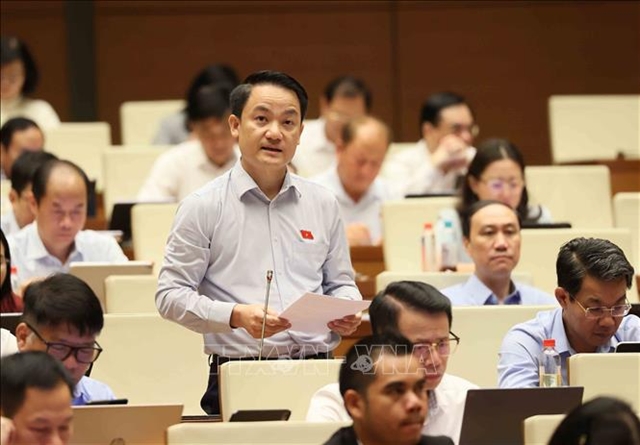
Immediately after the law is enacted, the Government should to issue specific regulations regarding the conditions, scope and principles for implementing collateral management agency activities, as well as mechanisms for identifying, disclosing and controlling conflicts of interest, Thế said.
He also raised the need for policies to prevent the practice of requiring customers to purchase additional goods or services that they don't need, in order to get the products they do need.
This is because currently in the banking sector, there is already a risk that customers are required by commercial banks to purchase, or to commit to purchasing corporate bonds or other investment products in order to be granted credit extension, disbursement, loan renewal or loan restructuring.
Thế urged the Government and the State Bank to pay special attention to preventing this activity.
He proposed two guiding principles for drafting the law: the expansion of authority must be accompanied by legal limits, data safeguards and accountability, and the expansion of banking activities must go hand-in-hand with the control of conflicts of interest and investor protection.
Legal framework for crypto-assets
Commenting on the legal framework for crypto-assets, Deputy Nguyễn Minh Đức from HCM City acknowledged that Việt Nam has officially recognised the concepts of digital assets and crypto-assets in the 2025 Law on Digital Technology Industry, while also laying the groundwork for a pilot digital asset market.
The draft Law on Anti-Money Laundering has added crypto-asset service providers as 'reporting entities' with specific obligations, which is an essential, accurate and legally sound step that aligns with property rights regulations in the Civil Code, he said.
"However, the draft law should not attempt to redefine technical terms itself, but should include provisions that clearly reference the definitions of digital assets, crypto-assets and crypto-asset services as established in the Law on Digital Technology Industry and the Civil Code," Đức said.
The draft should also clearly stipulate specific obligations for crypto-asset service providers such as implementing customer identification and verification procedures, applying the 'travel rule' to all crypto-asset transfer transactions to ensure transparency regarding sender and recipient information, he added.
The obligations may also involve establishing systems to log blockchain transactions and promptly reporting high-value or suspicious transactions, while remaining compatible with asset protection mechanisms.
The state management responsibilities of the State Bank, the Ministry of Finance, the Ministry of Public Security and the Ministry of Science and Technology should be further defined and discerned, which will help create a safe and transparent digital economy in Việt Nam while ensuring strict compliance with international standards, said Đức.
Credit growth flexibility
Discussing the draft Law on the State Bank of Việt Nam, other deputies expressed interest in provisions allowing for the application of 'alternative safety ratios' in credit growth to facilitate socio-economic development goals and major national projects.
Given the immense capital demand required for high growth targets, it is essential to create legal flexibility that enables credit institutions to expand their capital supply capacity, they said.
However, such special mechanisms must be subject to oversight by competent authorities, and credit institutions utilising them must have a roadmap to return to compliance with general regulations to ensure the system's safe development.
In his response regarding this issue, State Bank Governor Phạm Đức Ấn stressed that permitting the application of 'alternative safety ratios' does not imply increasing risks or easing regulations.
“The State Bank will conduct a careful and thorough review based on specific requests to make this mechanism applicable only to eligible credit institutions and national priority projects,” he said.
The State Bank will also make sure that the implementation of this policy will ensure system safety, avoid spreading risks and support economic growth.
The NA deputies also discussed draft amendments to the Law on Publishing. — VNS