NA debates sweeping reforms to land, housing and real estate laws
The three draft laws would simplify land-use planning, overhaul land valuation mechanisms, introduce nationwide digital identification for land parcels and strengthen safeguards for property transactions.
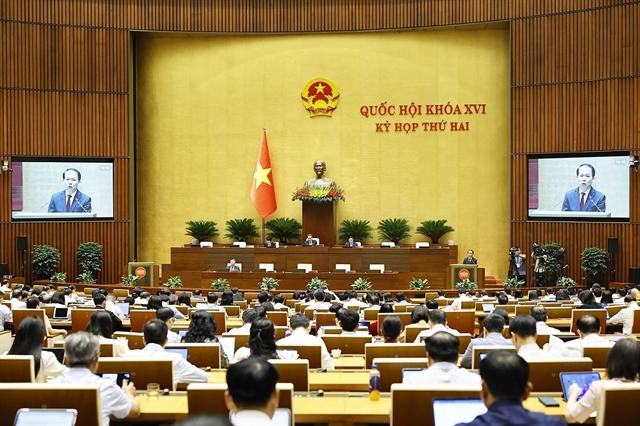
HÀ NỘI — The National Assembly (NA) on Thursday discussed sweeping revisions to the laws on land, housing and real estate business, aimed at unlocking land resources, expanding affordable rental housing and improving market transparency.
The three draft laws would simplify land-use planning, overhaul land valuation mechanisms, introduce nationwide digital identification for land parcels and strengthen safeguards for property transactions.
NA Deputies called for consistency among the three amended laws, stressing the need to align provisions on ownership, land use, property registration, and certificates to prevent situations where assets are legally owned or eligible for sale but conflicting regulations block transactions, potentially harming the legitimate interests of citizens and businesses.
Land reform: pricing, planning and compensation
Under the draft Law on Land, comprising 112 articles compared with 260 under the 2024 law, each land parcel would receive a unique national identification code, while digital land registration and certificates would have the same legal validity as paper documents.
The draft would replace market-based valuation with a framework based on state-issued land-price tables and adjustment coefficients.
To discourage land hoarding, investors could face progressively higher charges for failing to use allocated land, with land subject to recovery if it remained unused after 60 months.
The draft also provides for compensation in land or cash, broader resettlement options and measures to improve living conditions for people displaced by land recovery.
NA President Trần Thanh Mẫn said that the draft law should be capable of remaining effective for at least 10 to 15 years, warning against repeated amendments that could undermine regulatory stability.
He called for transparent valuation methods, reliable national price data and stronger action against speculation and price manipulation, urging crack-down on speculation and price manipulation.
Compensation and resettlement require equally careful treatment, he said. The draft should translate the principle that displaced households must enjoy living conditions equal to or better than before into measurable criteria, covering not only housing but also access to schools, healthcare and essential services.
Chairman of the NA Committee for Economic and Financial Affairs Phan Văn Mãi broadly supported the reform but called for clearer and more consistent rules on land recovery, compensation and resettlement.
The committee recommended keeping strict national controls on land designated for forests, rice cultivation, defence and security, while allowing other land uses to be managed more flexibly in line with socioeconomic development priorities.

Housing: a stronger push for rentals
The draft Housing Law, with 130 articles compared with 198 under the 2023 law, would classify housing into four groups: commercial, rental, official residence and policy-supported housing.
A new chapter on rental housing would establish eligibility rules, investment models and incentives for developers. Rents would be negotiated between landlords and tenants but remain subject to ceilings set by provincial authorities.
The draft would also incorporate pilot policies for social housing, tighten resale restrictions for social housing during the first five years and give provincial authorities greater control over where developers can subdivide land for sale.
Phan Chí Hiếu, chairman of the NA's Committee on Legal and Judicial Affairs, called for stricter and more transparent controls over eligibility for preferential housing policies to prevent abuse and speculation.
He also urged lawmakers to reconsider developers' obligations to contribute to social and rental housing.
Hiếu warned that overlapping provisions on social housing for rent and the wider rental housing market could discourage investment unless the two policy frameworks were clearly distinguished. He also called for clearer rules governing the proposed housing fund, including its funding sources and financial oversight.
Property transactions: greater transparency
The draft Law on Real Estate Business, reduced to 61 articles from 83 under the 2023 law, would introduce electronic identification codes for real estate and market participants, clarify transaction procedures and expand the types of contracts that can be transferred.
The draft proposes cutting four of twelve administrative procedures and simplifying seven business conditions.
It would also provide safeguards for the remaining 5 per cent of contract value in certain property transactions through escrow accounts or arrangements agreed by the parties.
But lawmakers warned that inconsistencies between the three laws could undermine legal certainty in property transactions, particularly over when ownership rights are established, contracts take effect and property must be registered.
NA’s Vice President Nguyễn Hồng Diên said the bills governed different but interconnected stages of the property market: the land law establishes land-use rights, the housing law regulates home ownership, and the real estate business law governs market transactions.
Diên stressed the need for consistent provisions on ownership rights, land-use rights and the issuance of certificates, as well as coordinated implementation of the three laws. — VNS