Materials, manufacturing industries seen as pillars of economic ambitions
At a conference on Việt Nam’s materials industry and manufacturing sector in a new development era held on June 15, policymakers, industry leaders and experts outlined institutional and policy reforms aimed at transforming the materials and manufacturing industries into foundational pillars of the economy.
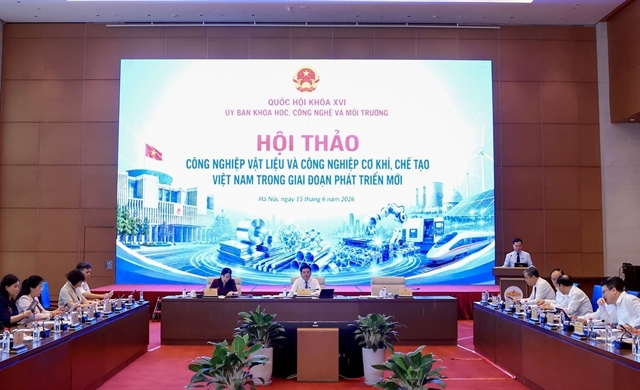
HÀ NỘI — Policymakers, industry leaders and experts outlined institutional and policy reforms aimed at transforming the materials and manufacturing industries into foundational pillars of the economy.
The sectors are expected to underpin Việt Nam’s industrialisation and modernisation drive while strengthening the country’s strategic autonomy.
Opening the conference on Việt Nam’s materials industry and manufacturing sector in a new development era held on Monday, National Assembly (NA) Vice Chairman Nguyễn Hồng Diên emphasised that as global competition intensifies in areas such as advanced technology, supply chains, energy, new materials, artificial intelligence, semiconductors, robotics and smart manufacturing, the development of materials and manufacturing industries has evolved beyond a sectoral issue to become a matter of national strategic importance, he said.
Diên noted that Party General Secretary and State President Tô Lâm has pointed out three priority categories for the development of the materials industry, including basic materials, strategic materials and future materials.
He stressed that the country must shift from exporting raw resources to deep processing, mastering core technologies, increasing value-added production, and building a materials industry driven by science and technology, high-quality human resources and nationally competitive enterprises capable of leading the market.
The NA vice chairman called on conference participants to identify the most significant bottlenecks facing the sectors, assess Việt Nam’s current level of self-sufficiency in materials, equipment and technology, and propose major policy recommendations to support the development of both industries in the next phase of growth.
Speaking at the conference, Nguyễn Thanh Hải, chairwoman of the NA’s Committee for Science, Technology and Environment, underscored the strategic role of the materials and manufacturing sectors in Việt Nam’s long-term development agenda.
According to Hải, the two industries are not merely conventional manufacturing sectors but form the foundation for achieving the country’s development goals through 2030 and 2045.
They are also essential for implementing major national projects, including the North–South high-speed railway, nuclear power development, the semiconductor industry, defence manufacturing, national data centers, digital infrastructure, renewable energy and other strategic technology sectors.
After four decades of economic reforms, Việt Nam’s materials industry has made substantial progress, establishing a relatively comprehensive production ecosystem spanning construction materials, metals, chemicals, textiles, plastics and certain high-tech materials, Hải said.
However, despite notable advances, neither the materials industry nor the manufacturing sector has yet emerged as a true foundational industry for the economy.
The sectors continue to face the absence of a comprehensive national strategy, fragmented institutional and policy frameworks, insufficient mechanisms to foster national champion enterprises and a shortage of highly skilled workers.
Recommendations
To meet the demands of a new development stage, the committee recommends prioritising three categories of materials – basic, strategic and future materials – while focusing on high-tech manufacturing products serving semiconductors, artificial intelligence, robotics, new energy, nuclear power, defence, high-speed rail and other strategic industries.
Hải also called for comprehensive reforms to institutions, legislation and policy mechanisms governing the two sectors. These include the urgent development of a National Materials Industry Strategy to 2030 with a vision to 2045, as well as a new strategy for the manufacturing sector.
In parallel, Việt Nam should review and amend regulations related to investment, science and technology, innovation, technology transfer, standards and technical regulations, minerals management, supporting industries, taxation, credit and technology-upgrading incentives.
She also proposed studying the introduction of the Law on Key Industries and a Law on the Management and Development of Construction Materials.
A key recommendation from Hải was the creation of a genuine innovation ecosystem linking government agencies, businesses, research institutes, universities and experts.
She stressed that the development of materials and manufacturing industries should be closely aligned with major national initiatives, including the North–South high-speed railway, nuclear energy projects, semiconductors, defense industries, national data centers, digital infrastructure, renewable energy and other strategic technology programs.
Deputy Minister of Construction Nguyễn Văn Sinh highlighted that in the construction materials sector, the current legal framework remains fragmented and lacks a dedicated industry law. Strategic planning for construction materials is not sufficiently integrated with resource zones, market demand and related planning frameworks. Mineral value chains remain weakly connected, while the capacity to develop advanced materials for strategic infrastructure projects remains limited.
Sinh also pointed to shortcomings in sectoral databases and digital transformation efforts, as well as inadequate incentives for businesses to invest in new technologies and green materials.
“The development of a dedicated law on the management and development of construction materials is increasingly necessary,” Sinh said.
“Such legislation would institutionalise the Party’s strategic directions and the leadership’s policy priorities, establish a transparent and stable legal framework for the entire construction materials value chain, and address the current fragmentation and inconsistency of regulations.”
Meanwhile, Nguyễn Chí Sang, chairman of the Việt Nam Association of Mechanical Industry Enterprises, argued that despite a number of important National Assembly resolutions, institutional bottlenecks remain significant.
Current policy mechanisms are largely defined through broad government decrees that provide insufficient guidance for enterprises, investors and even project management authorities, he said.
In addition, Việt Nam has yet to establish a unified national system of technical standards and regulations, making coordination more difficult and increasing both investment and operational costs.
Sang proposed mandatory requirements on local content, technology transfer and the use of domestic suppliers in large-scale projects, particularly in railway infrastructure, energy and defence.
He also recommended selecting 15–20 core enterprises to undertake strategic national missions in key sectors, establishing long-term credit programs with appropriate interest rates, and introducing tax incentives for research and development and technology acquisition.
Head of Hòa Phát Group’s railway division, Phan Bội Châu urged authorities to accelerate the issuance of a comprehensive set of industry standards that could serve as a roadmap for enterprises pursuing technological self-reliance in Việt Nam’s railway industry.
Such standards, he said, would provide critical guidance for businesses as the country seeks to develop an independent and competitive railway manufacturing ecosystem. — VNS