Markets face October test as post-upgrade optimism meets selling pressure
The market's September performance has made October a test of its ability to absorb selling pressure following a strong rally.
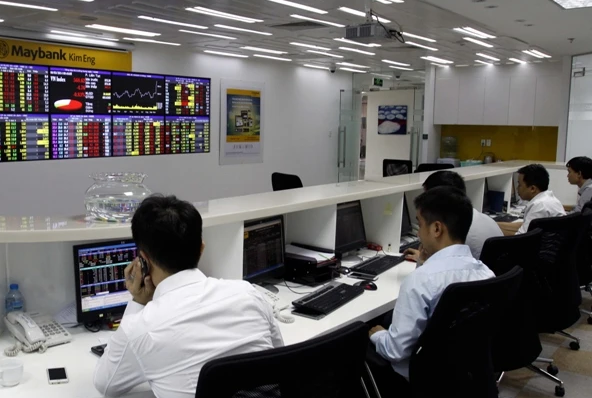
HÀ NỘI — The stock market came under mounting pressure last week, with the VN-Index falling for five consecutive sessions as widespread selling, weak liquidity and heavy foreign outflows weighed on investor sentiment.
On the Hochiminh Stock Exchange (HoSE), the benchmark closed the week at 1,737.71 points, down 2.66 per cent from the previous week. This marked its second consecutive losing week.
The HNX-Index on the Hanoi Stock Exchange (HNX) also declined, losing 2.01 per cent to 266.75 points.
Liquidity remained subdued, with weekly matched trading volume 6.6 per cent below its 20-week average, indicating continued caution among investors.
On the HoSE, average trading value fell nearly 4 per cent to nearly VNĐ15.5 trillion (US$595.5 million) per session.
Selling pressure affected several major sectors, although the intensity varied. Banking, securities, real estate and industrial stocks faced considerable declines as investors became more cautious, particularly towards the end of the week.
Foreign investors added to the pressure, recording net selling of nearly VNĐ4.9 trillion across the two exchanges during the week.
The market entered October under pressure after the VN-Index fell 3.47 per cent in September, as profit-taking following the country's market upgrade, weakening liquidity and foreign net selling weighed on sentiment.
Viet First Securities (VFS) attributed the reversal to 'sell-on-news' pressure, as investors took profits after positive expectations surrounding the upgrade had already been reflected in share prices.
The market's September performance has made October a test of its ability to absorb selling pressure following a strong rally. Seasonal patterns also offer little reassurance.
According to MB Securities (MBS), the VN-Index has fallen by an average of more than 2 per cent in October over the past decade, with the market recording four consecutive monthly declines in October since 2022.
After rising 7.6 per cent in October 2021, the index fell 9.2 per cent in October 2022, 10.9 per cent in October 2023, 1.8 per cent in October 2024 and approximately 1.3 per cent in October 2025.
However, historical performance has varied considerably.
In October 2025, the market gained 6.3 per cent in the first half of the month before retreating sharply amid profit-taking and foreign net selling. The VN-Index ended the month at 1,639.7 points, down 1.3 per cent from September.
Before the upgrade, expectations of foreign capital inflows had been an important driver of the market's rally.
SSI Research previously estimated that passive capital allocation linked to FTSE indices could reach US$2.28 billion in its base-case scenario, with disbursements spread from September 2026 to September 2027.
Under a more positive scenario, passive inflows could reach $4.46 billion.
The September correction, however, highlighted the gap between expectations of future capital inflows and actual trading activity following the upgrade.
Earnings and liquidity in focus
According to VFS, two key factors to watch in October are whether the VN-Index can establish a bottom around technical support levels and how foreign capital flows develop after the upgrade.
VFS identified a support range of 1,715-1,760 points.
If the index holds this range, liquidity improves, third-quarter earnings are positive and foreign net selling eases, the market could recover towards 1,800-1,850 points, VFS said.
Conversely, continued heavy foreign selling and weak domestic liquidity could leave the index consolidating for longer within the 1,680-1,780 point range.
MBS, meanwhile, observed that cash flows were concentrating in two main groups: commodity-related stocks benefiting from higher prices and defensive stocks offering stable dividends.
The firm highlighted six stocks for October: Vinhomes (VHM), Vietcombank (VCB), Sacombank (STB), BaoViet Holdings (BVH), Vietnam Rubber Group (GVR) and Tay Ninh Rubber JSC (TRC).
The third-quarter earnings season is another factor that could influence capital allocation.
Stocks that have corrected but retain positive earnings prospects may attract renewed interest if results exceed expectations. Conversely, shares that rallied strongly ahead of earnings but fail to meet market expectations could remain under profit-taking pressure. — BIZHUB/VNS