Market sentiment outweighs earnings in stock price movements
Since the beginning of the year, foregin investors have recorded net sales of around VNĐ80 trillion (US$3 billion) as global capital has shifted toward markets expected to benefit more from the artificial intelligence and semiconductor boom
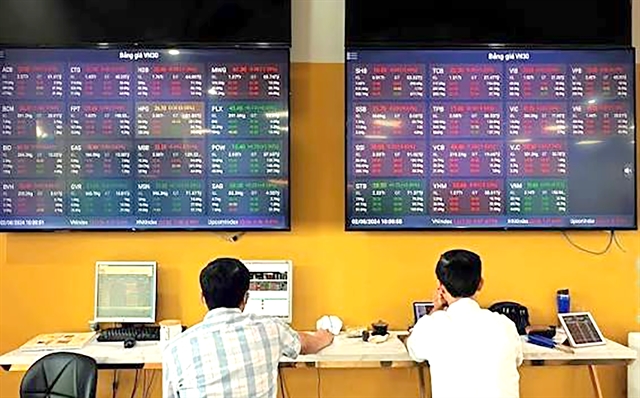
HÀ NỘI — Many listed companies continue to report robust earnings growth, yet their share prices have failed to keep pace, highlighting an increasing disconnect between corporate fundamentals and stock market performance as investors focus more on macro-economic risks and market sentiment.
The divergence has left many investors questioning why companies with improving business results continue to see their stocks decline.
According to Đinh Đức Minh, a portfolio manager at VinaCapital, the mismatch between share prices and business performance stems from a combination of macro-economic factors that have weighed on market sentiment.
He noted that foreign investors' persistent net selling has been one of the major headwinds for the market.
Since the beginning of the year, foreign investors have recorded net sales of around VNĐ80 trillion (US$3 billion) as global capital has shifted toward markets expected to benefit more from the artificial intelligence and semiconductor boom, including the US, Japan, South Korea and Taiwan (China).
Despite the short-term weakness, Minh said investors should avoid focusing solely on recent market fluctuations.
"In the long run, stock prices will reflect the intrinsic value of businesses," he said at a recent event held by VinaCapital, adding that factors such as higher interest rates, inflation and geopolitical tensions have largely been priced into current market valuations.
From a valuation perspective, Thái Quang Trung, CFA and Chief Investment Officer at VinaCapital, said the recent performance of the VN-Index has not fully reflected the broader market because most of the index's gains have been driven by Vingroup-related stocks.
Excluding the Vingroup group, the Vietnamese stock market's forward price-to-earnings (P/E) ratio for 2026 is estimated at only about 9.3 times, close to its lowest valuation level in the past decade, he said.
According to VinaCapital's analysis, markets trading at lower valuation levels historically offer investors a greater probability of generating superior returns over a two- to three-year investment horizon.
Over longer periods of five to 10 years, investors who maintain long-term equity holdings have generally achieved double-digit returns.
Based on those observations, Trung recommended that investors maintain a disciplined long-term investment strategy and accumulate shares gradually rather than reacting to short-term volatility. He said periods of pessimistic market sentiment that push valuations to attractive levels may provide opportunities to accumulate fundamentally strong shares.
Analysts at VNDirect also maintain a positive outlook for the market. They forecast corporate earnings growth of around 21 per cent in 2026, with the VN-Index trading at a forward P/E of approximately 12.2 times. Excluding Vingroup-related stocks, the market's forward P/E falls to about 10.1 times, suggesting further upside potential.
VNDirect expects the second half of 2026 to offer more favourable conditions for the stock market as several supporting factors gradually converge.
The securities firm said that an official market upgrade by FTSE Russell, together with ongoing improvements in market infrastructure, could strengthen investor confidence and attract fresh capital inflows.
Combined with a stable macro-economic environment and continued corporate earnings growth, these factors are expected to provide additional momentum for the country's stock market in the second half of the year. — BIZHUB/VNS