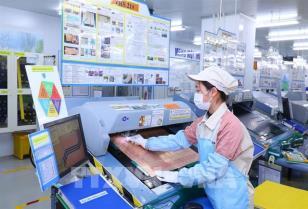
Low productivity a systemic challenge: economists
The low productivity has become a systemic challenge, affecting nearly every sector and demanding both short-term fixes and long-term structural solutions.

HÀ NỘI — In an increasingly competitive regional economy, low labour productivity remains one of the biggest obstacles to the competitiveness of Vietnamese enterprises, according to economists.
Compared to ASEAN peers such as Thailand, Malaysia and Indonesia and to foreign-invested firms operating inside Việt Nam, productivity at domestic companies remains far lower. This has become a systemic challenge, affecting nearly every sector and demanding both short-term fixes and long-term structural solutions.
According to Dr Nguyễn Quốc Việt, Deputy Director of the Vietnam Institute for Economic and Policy Research (VEPR), Việt Nam faces dual pressure. It must compete with other countries that are technologically more advanced while also competing at home with FDI enterprises that operate with global management standards. Without major productivity gains, Vietnamese companies will struggle to escape low-value contract-manufacturing roles.
Many domestic firms still rely on medium or low-level technologies with limited automation. By contrast, Malaysia and Thailand have already integrated automation across many industries. Management capacity – which determines how effectively a business turns inputs into outputs – is another clear weakness. Many companies operate based on personal experience rather than data. They lack KPIs, standardised processes and basic performance monitoring, which leads to productivity losses throughout daily operations.
The gap becomes even clearer when compared with FDI enterprises. Foreign-invested firms typically run modern production lines, use lean and efficient management systems, maintain optimised global supply chains, and invest heavily in training their workforce.
Another major bottleneck is labour quality. The proportion of workers with recognised training remains low. Digital skills are limited and many employees do not yet meet the requirements of modern, technology-driven production.
Experts say this is one of the biggest barriers preventing productivity growth, even when companies invest in new machinery or software. Given this picture, experts argue that Vietnamese businesses must do more than just acknowledge their weaknesses – they need to identify which changes will create the strongest impact.
According to Dr Võ Trí Thành, Director of the Institute for Brand and Competitiveness Strategy, productivity improvement must begin with technology and labour. Better technology creates higher efficiency, but it only works when paired with a skilled workforce. Raising labour productivity, he said, would be one of the strongest drivers helping Việt Nam move beyond low-value growth.
In the short term, experts say businesses do not need to invest heavily or undertake full digital transformation all at once. Instead, they should begin with practical, low-cost improvements. The first step is standardising operations and applying lean management methods such as LEAN, Kaizen and 5S. Simply removing unnecessary steps can raise productivity by 5 to 10 per cent without any additional capital investment. Companies can also digitise individual processes such as warehouse tracking, production monitoring or order planning. These small but effective steps are well suited to small and medium-sized enterprises with limited budgets.
On the labour side, the fastest way to improve productivity is retraining based on real business needs. Companies can partner with vocational schools or training centres to build skills in equipment operation, digital tools and problem-solving. According to Nguyễn Xuân Dương, Chairman of Hưng Yên Garment Corporation, training is far cheaper than the cost of lost productivity.
“We found that just one training course on line management cut our defect rate by 20 per cent,” he said.
Looking ahead, experts say Vietnamese enterprises need stronger long-term strategies. These include large-scale technology investment and a shift from mechanical production to smart factories using IoT, AI and real-time data. This will allow companies to move into higher-value segments of global supply chains instead of being limited to basic assembly. Firms will also need to build a strong talent ecosystem, create internal training programmes and develop engineers, technicians and data specialists capable of working with advanced technology. — VNS