Latest advances, challenges discussed at forum on intelligent robots and automation
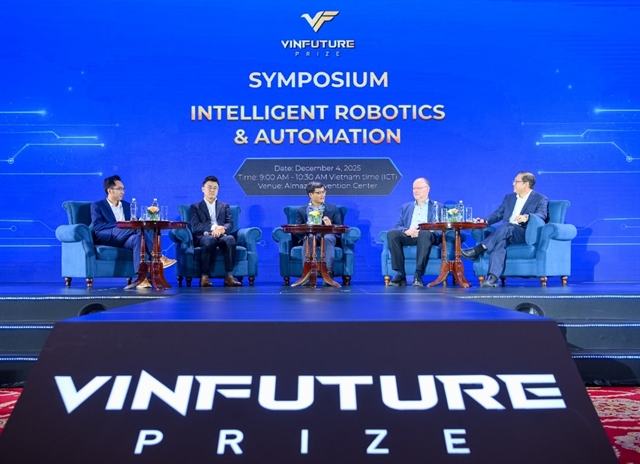
The symposium, titled 'Intelligent Robotics and Automation', is part of the 'Science for Life' symposia, organised by the VinFuture Foundation in Hà Nội from December 2 to 6.
HÀ NỘI — Advances in soft materials, physical intelligence and multimodal AI are redefining the concept of robots. The world's leading scientists believe that future robots will not be mere machines, but entities capable of perceiving their environments, interacting delicately and operating safely alongside humans.
Scientists shared the latest updates on robotics and the challenges facing large-scale automation at an international forum on December 4.
The symposium, titled 'Intelligent Robotics and Automation', is part of the 'Science for Life' symposia, organised by the VinFuture Foundation in Hà Nội from December 2 to 6.
At the event, experts discussed the latest trends in the field of robotics, from humanoid robots with social interaction and multidisciplinary applications, to collaborative robots in smart services and healthcare as well as robotic rehabilitation systems supporting healthcare.
Speakers outlined a strong transformation phase for humanoid robots: from experimental devices in the laboratory to tools for application in industry, medicine, rehabilitation and services. The combination of artificial intelligence (AI), advanced soft materials and smart sensors has helped robots become more flexible and safer in interacting with humans.
According to the International Federation of Robotics, there were nearly 4.3 million industrial robots in operation worldwide by 2023, with more than half a million new robots installed each year. The service robot market is forecast to surpass the US$100 billion mark by the end of the decade, showing wide potential in manufacturing, services, healthcare and education.
Advances in hardware, controls and AI are enabling a new generation of humanoid robots to become more sophisticated, capable of taking on complex tasks, from factory operations to healthcare support. Automation is also giving a powerful boost to manufacturing, logistics and service operations, contributing to increased safety, cost optimisation and improved operational capabilities.
In particular, the combination of language, vision and robotic AI models is beginning a new era in which robots can observe, analyse and interact with the environment in a more natural, human-like way, thereby significantly expanding the scope of applications.
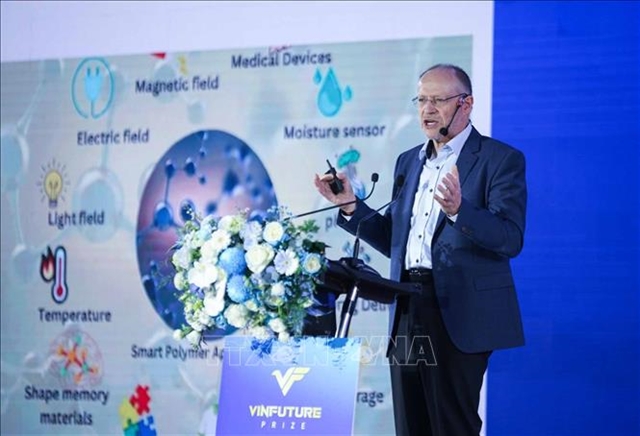
Professor Kurt Kremer from the Max Planck Institute for Polymer Research in Germany said that the development of soft materials is playing a fundamental role in the next generation of flexible robots.
Although the proportion of polymers in robots is not large, the technical requirements (such as fire resistance, dynamic durability and recyclability) are extremely strict. Reducing dependence on traditional materials and replacing them with new soft materials is opening up a generation of robots that are safer and interact more naturally, according to Kremer.
From the control perspective, Professor Ho-Young Kim from Seoul National University in South Korea said that robots may have facial expressions or “artificial muscles” in the near future, but only at a simple simulation level.
Kim expressed the belief that the biggest challenge for modern robots is controlling and manipulating soft materials, from fabrics, wires and textiles to medical materials. Because they have shapes that change constantly, they are difficult to predict and are very hard for machines to handle, whether in the kitchen, factory or while performing household chores.
“The most difficult problem is still creating an artificial muscle system and a nervous system with human-like sensitivity to control it – something that science is still gradually approaching,” said Kim.
“Manipulating soft materials is not just a scientific problem, but the key to opening the way for a new generation of advanced automation, where robots can take on delicate, flexible tasks that are closer to those in human life,” Kim added.
“It is a long journey, but it is an essential condition for robots to truly enter life and production.”
Professir Tan Yap Peng from VinUni University in Việt Nam predicted that by 2050, there will be one billion robots living alongside humans. Robots are currently programmed to solve a specific task, but in the future, they are expected to do many things to a higher level.
However, Peng stressed, even if hardware makes great strides, the ability to control behaviour so that robots “behave like humans” is still far away. Visual language models help robots understand instructions and context more effectively, but human sophistication, sensitivity and flexibility remain the long-term goal.
Peng also emphasised that nanorobots will open up new prospects in regenerative medicine, microsurgery and replacing damaged body parts.
In addition, they also discussed major challenges related to safety and ethics in AI, to ensure that robotic technology develops in a humane, safe and sustainable direction for society.
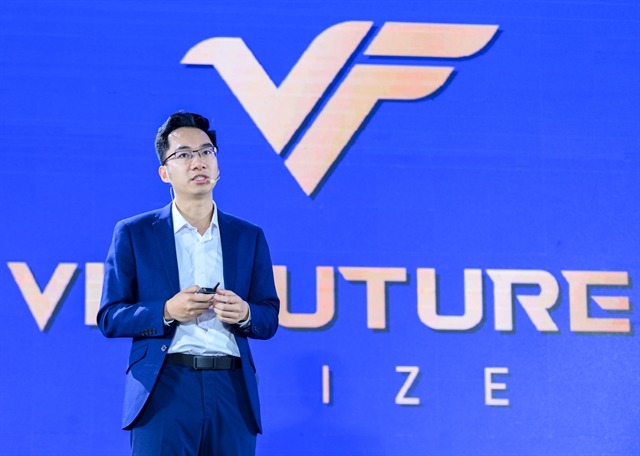
Dr Nguyễn Trung Quân from the University of Southern California, who is Chief Scientific Officer of VinMotion, a humanoid robotics company founded by Vingroup, also spoke at the event. He presented the concept of physical AI, a combination of artificial intelligence and physical robots, a field that is expected to reach a scale of $10 trillion in the next 10 years.
Quân said that three barriers prevent robots from entering mainstream life: physical safety, data security and social acceptance.
“Only when people feel safe standing next to robots can robots operate naturally in real environments,” he noted.
According to Quân, the population is ageing, younger generations are no longer interested in many manual or boring jobs and a shortage of workers in many different professions is not only happening in developed countries, but also more gradually in developing countries like Việt Nam.
After seven months since its establishment, VinMotion has introduced five versions of humanoid robots. The current version has made many advances, such as moving more flexibly and much faster than three months ago. It also includes AI that is integrated with flexible multilingual communication, especially in Vietnamese and English.
He said that VinMotion's goal is to develop humanoid robots that are increasingly flexible, intelligent and versatile so that they can gradually enter life in many different areas, from services and industry to housework.
Amid a global shortage of robotics engineers and rising labour costs, Quân predicted that if Việt Nam positions itself correctly, it can become a new counterweight in the robot value chain worldwide.
“This is a time when the gap between Việt Nam and the world is not too far, and if there is a proper investment strategy, Việt Nam can completely become the centre of robot research and production in the region," he said.
Quân noted that Việt Nam possesses many advantages in all three important aspects of humanoid robots: good hardware, strong software and the ability to operate safely and reliably.
“Việt Nam has all these factors and can develop them simultaneously, creating a foundation to enter the international technology competition,” he said. — VNS