Institutions, tech critical for Việt Nam to become a strong maritime nation
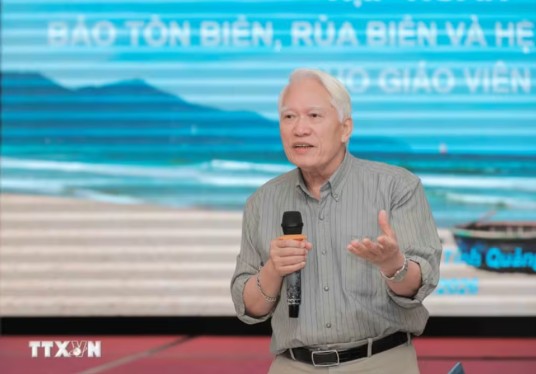
Vietnam News Agency spoke with Nguyễn Chu Hồi, former deputy director general of the Vietnam Administration of Seas and Islands and standing deputy chairman of the Vietnam Fisheries Society, about the current development of Việt Nam’s marine economy and solutions for the country to become a strong maritime nation.
Party General Secretary and President Tô Lâm at the third Plenum of the 14th Party Central Committee highlighted a review of the implementation of the 12th Party Central Committee's Resolution 36-NQ-TW dated October 22, 2018 and discussions on a new resolution to develop Việt Nam into a strong maritime nation.
Vietnam News Agency spoke with Nguyễn Chu Hồi, former deputy director general of the Vietnam Administration of Seas and Islands and standing deputy chairman of the Vietnam Fisheries Society, about the current development of Việt Nam’s marine economy and solutions for the country to become a strong maritime nation.
How do you assess Việt Nam’s outstanding advantages and distinctive potential for developing a strong and sustainable maritime economy?
Việt Nam is a maritime nation with a sea area three times the size of its land territory and a coastline of more than 3,260km running from north to south, which gives the country a front-door advantage to the East Sea. Along the winding coastline are numerous rocky headlands, bays, river mouths, lagoons and low-lying areas with conservation value and diverse development advantages.
With more than 3,000 islands, Việt Nam is also among the countries with the largest number of islands in the world.
Nearly 2,400 out of the 2,773 coastal islands are concentrated in the waters off Quảng Ninh and Hải Phòng to form the unique limestone karst island complex of Bái Tử Long-Hạ Long-Cát Bà, which is exceptional not only in scale, but also in its outstanding global natural heritage value.
Next is the sea area of Khánh Hòa, with more than 225 islands and the country’s longest coastline of 490km, followed by An Giang, with more than 140 islands, including Phú Quốc, the country’s largest island.
The two offshore archipelagos of Hoàng Sa and Trường Sa are not only the country’s two most important centres of marine biodiversity, but also two outposts controlling the maritime space and activities along international shipping routes connecting the Indian and Pacific oceans and crossing the East Sea.
Together with its characteristic tropical monsoon meteorological and oceanographic conditions, these maritime areas constitute spaces for livelihoods and strategic security, provide abundant and diverse natural resources and create a foundation for Việt Nam to become a strong maritime nation.
Notable advantages include fisheries resources, marine biodiversity and marine and coastal ecosystems; oil and gas, gas hydrates and solid minerals; marine renewable energy, offshore wind power and offshore solar power, marine biofuels, seawater chemicals and blue carbon; the ecosystem services provided by marine ecosystems; and the potential of marine, island and coastal areas for port and maritime development, tourism and coastal urban development.
In your opinion, has Việt Nam’s maritime economy development matched its existing advantages? What are the biggest bottlenecks hindering a breakthrough in the country’s maritime economy?
The contribution of Resolution 36 to the country’s economic development and protection of maritime and island sovereignty during the past eight years has been evaluated and recognised.
However, amid complex global developments, the situation in the East Sea, climate change, natural disasters and epidemics, the resolution has not yet been carried out in line with its goals and expectations.
The use and governance of marine and island areas for maritime economic development remain below their potential and advantages, and are not yet sufficiently sustainable.
There are still bottlenecks hindering a breakthrough in Việt Nam’s maritime economy in the next few years.
First, there are significant differences in awareness of sustainable maritime economic development in the context of multi-sectoral growth and marine spatial governance.
Second, completing the institutional framework for integrated management and unified State management of the sea and islands has been slow.
Next is the lack of and ineffective operation of mechanisms for coordination among sectors, regions, agencies and different issues.
Economic development has often been prioritised on a sector-by-sector basis, with fragmented planning. As a result, the development of one sector or locality can, in many cases, reduce or even eliminate the development potential of another sector or locality, while the national marine spatial plan has not yet played its full role, particularly at the local level.
In addition, many methods of exploiting natural resources and managing the sea and islands still rely on outdated approaches and means, while the role of businesses and local communities remains limited. Meanwhile, effective use and management of marine and island areas require large investment, advanced science and modern technologies.
These bottlenecks have resulted in overexploitation and depletion of marine resources and limited the competitiveness of marine-based products and goods.
In particular, conflicts of interest and spatial conflicts in the process of exploiting the same maritime areas have not decreased, but have become even more frequent and complex. This is also a consequence of short-term, fragmented, narrow and incomplete thinking in maritime economic development based on a brown marine economy.
The administrative merger has created new development spaces. What strategic opportunities will this change create for maritime economic development and regional connectivity in the next few years?
The administrative merger has taken into account advantages from the sea entirely consistent with the advantages of a maritime nation.
After July 1, 2025, the ratio of provinces with and without access to the sea is now 21 to 34, compared with 28 to 63 previously.
This adjustment shows that the central Government has begun preparing a long-term strategic approach for Việt Nam to become a strong maritime nation.
Several strategic opportunities have opened up for localities and the national economy, including expanding development space, creating sufficiently large areas capable of attracting strategic investors, forming a multi-purpose ecosystem for diverse economic sectors and addressing administrative fragmentation in managing river basin and marine environments.
The merger also promotes cultural diversity among regions, particularly distinctive maritime culture, turning culture into not only a spiritual driving force but also a driver of development. It also facilitates regional connectivity, linking mountainous, midland and highland areas with coastal plains, the sea and islands to create new momentum and strength for maritime-oriented economic development, while supporting national defence and security through the new administrative territories.
How do you assess the opportunities to form new growth poles based on mountain-forest-sea or highland-seaport-logistics links following the mergers, and which green maritime economic sectors with strong potential should be prioritised?
The new development space and opportunities created by the merger have been translated by coastal localities across the country into maritime economic development scenarios for a new era, with a focus on rapid, green and sustainable development.
These localities all regard the maritime economy as a priority sector, focusing on linking mountainous and forested areas with coastal, marine and islands to develop logistics centres connected to seaports.
Main solutions include developing integrated transport infrastructure, digital infrastructure and natural infrastructure, not only to strengthen regional connectivity but also to shorten distances in management and improve the efficiency and effectiveness of the administrative system.
New maritime economic sectors are also being developed, including marine renewable energy, offshore wind power, offshore solar power, marine biofuels, the conservation economy, recreational fisheries, marine ecotourism, marine pharmaceuticals, maritime urban development, blue carbon and a cultural industry featuring Việt Nam’s distinctive maritime identity.
Việt Nam is gradually developing a green maritime economy, prioritising offshore wind power, marine pharmaceuticals and the conservation economy linked to marine and island tourism in marine protected areas.
To realise the goal of becoming a strong maritime nation in the 21st century, what breakthroughs does Việt Nam need to make?
Việt Nam needs to adopt a strategic approach to turn sea and island potential into a new growth driver while avoiding the risk of overexploitation or sacrificing the environment for economic development.
In the new context, offshore and deep-sea activities require large investment and a highly skilled workforce.
Institutions and technology are therefore critical to create a strategic breakthrough.
First, we need to prioritise investment in and the application of advanced marine technologies, as well as digital transformation and AI, to master more distant and deeper maritime areas, not only the space on the surface of the sea but also underwater. Deep-sea activities must be industrialised and automated.
Marine spatial planning and functional zoning must be applied from the early stages of development to minimise conflicts and inconsistencies.
Completing institutions, mechanisms and policies is also essential to removing barriers and enabling breakthroughs.
The Law on Marine and Island Resources and Environment should be amended to attract strategic investors while prioritising investment in renewable energy and new maritime economic sectors.
We cannot accept the reality of developing marine and island areas based on outdated thinking, and we must turn changes in administrative boundaries into a long-term development driver.
As Party General Secretary and State President Tô Lâm has called for, Việt Nam should develop its maritime economy rapidly and sustainably within a maritime space governed in an integrated, inter-sectoral, interconnected and coordinated manner.
The new thinking helps us recognise more clearly that sustainable development of Việt Nam’s marine and island areas should not simply be understood as balancing the three traditional pillars — economic, social and environmental — as has long been the case, but should also add the pillars of security and marine governance.
As a new development philosophy, marine spatial governance will give us a more comprehensive, strategic and sustainable vision. It will enable us to better identify the different dimensions of development in new maritime economic sectors and develop an integrated governance model for the sea, islands and coastal areas. — VNS