HCM City targets at least 10.3 per cent growth in H1
As the city has set a GRDP growth target of over 10 per cent for 2026, growth in the first half must reach at least 10.3 per cent, with the second quarter alone tartgeted at 11.59–12.49 per cent (average 12.04 per cent).
HCM CITY — HCM City’s economy showed encouraging signs in the first quarter of this year, with gross regional domestic product (GRDP) estimated to expand by 8.27 per cent year-on-year – the strongest performance in more than five years.
As it has set a GRDP growth target of over 10 per cent for this year, growth in the first half must reach at least 10.3 per cent, with the second quarter alone tartgeted at 11.59–12.49 per cent (average 12.04 per cent).
During January–March, the services sector remained the primary engine of growth, rising 8.91 per cent and accounting for 51.9 per cent of GRDP while contributing 56 per cent to overall expansion.
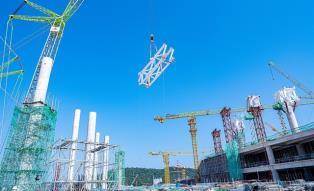
Despite some improvement, industry and construction fell short of expectations. The sector grew by 7.73 per cent, representing 35.2 per cent of GRDP but contributing only 32.6 per cent to growth. Construction activity increased by 8.05 per cent, adding around 2.2 per cent.
Several manufacturing industries have begun to recover; however, rising input costs, particularly due to fuel price volatility, continue to place pressure on enterprises.
A notable bright spot is the sustained attractiveness of the business environment. In the period, more than 13,600 new enterprises were established, up 46.7 per cent year-on-year, with total registered capital nearing VNĐ91.4 trillion (US$3.47 billion), up 46.6 per cent. The city also attracted nearly $2.9 billion in foreign direct investment, surging 219.7 per cent.
Nevertheless, external uncertainties continue to weigh on the economy. A survey of manufacturing firms showed that 77 per cent expect conditions in the second quarter to remain stable or improve, while nearly 23 per cent foresee challenges ahead.
On the domestic front, stimulating consumption, enhancing the price stabilisation programme, promoting large-scale trade and service events, and intensifying promotional campaigns are viewed as key measures. However, slow public investment disbursement remains a major bottleneck. In the first quarter, the city disbursed nearly VNĐ13.6 trillion out of a planned VNĐ147.6 trillion – less than 10 per cent.
Dr Trương Minh Huy Vũ, director of the Ho Chi Minh City Institute for Development Studies, said two major institutional levers – the Law on Special Urban Areas and a comprehensive master plan – will enable the city to shift from policy implementation to proactive policymaking. The master plan focuses on five priorities, including a specific development philosophy, multi-centre urban development, transit-oriented infrastructure development, three-dimensional spatial planning, and improved quality of life.
Dr Nguyễn Duy Quang of the Ho Chi Minh City University of Economics and Finance also underscored the urgency of transitioning from extensive to intensive growth driven by innovation, the digital economy and a knowledge-based model. Stronger decentralisation, coupled with more flexible governance mechanisms, will be essential for the city to full tap potential and sustain its role as the country’s leading economic hub. — VNA/VNS