Firms urged to build market-specific strategies for global growth
Enterprises should combine competitive products with stronger market intelligence, professional trade promotion, long-term business partnerships and a deeper understanding of individual export markets.
Ly Ly Cao
HÀ NỘI — As global supply chains continue to shift and international trade becomes increasingly competitive, Vietnamese enterprises are being encouraged to move beyond traditional export models and adopt market-specific strategies to strengthen their presence in key overseas markets.
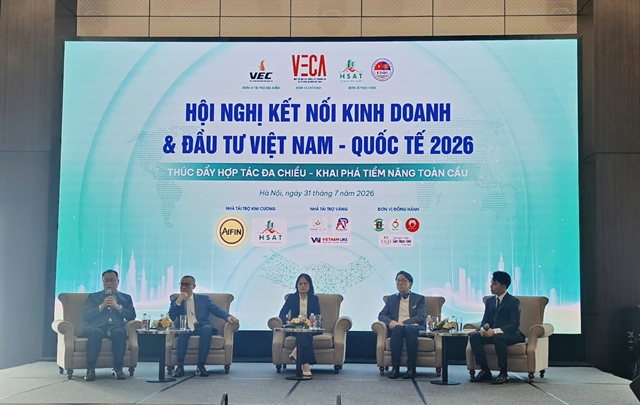
Speakers at the Vietnam – International Business and Investment Connection Conference 2026, held in Hà Nội on July 31, said the country's expanding network of free trade agreements, growing manufacturing capacity and rising international profile have created favourable conditions for businesses to access global markets.
However, they said that sustainable expansion will depend on building long-term partnerships, understanding individual market characteristics and investing in professional trade capabilities rather than relying solely on manufacturing advantages.
Opening the conference, Vũ Ngoạn Hợp, acting chairman of the Vietnam Association of Trade Fairs, Exhibitions and Event Organisation, said international cooperation has become increasingly important as the global economy undergoes profound changes driven by supply chain restructuring, technological advances and digital transformation.
"For Việt Nam, deeper international integration, together with an extensive network of next-generation free trade agreements, has created unprecedented opportunities for businesses to access global markets, attract high-quality investment, and participate more actively in global value chains," he said.
Hợp said the conference was designed to become an annual platform bringing together government agencies, trade promotion organisations, business associations and enterprises to exchange market intelligence, share policy updates and establish business partnerships.
"We firmly believe that the success of this conference should not be measured simply by the number of participants but by the quality of partnerships established and the tangible value created long after today's event concludes," he added.
South Korea was highlighted as one of the markets where Vietnamese exporters could significantly expand their presence by strengthening business-to-business engagement.
Bok Dug Gyou, head of the Korea Desk under the Vietnam Trade Promotion Agency and deputy director of KOTRA, said Vietnamese enterprises should take greater advantage of trade exhibitions and direct business networking rather than depending primarily on consumer promotion.
"I think the Vietnamese government and Vietnamese business community should focus on B2B and strengthen B2B relationships with Korea," he said.
According to Bok, participation in specialised exhibitions such as Seoul Food and beauty expos would help Vietnamese businesses connect directly with Korean importers.
He also encouraged organisers to attract more Korean buyers to Việt Nam so they could evaluate products firsthand through exhibitions and factory visits.
Beyond trade promotion, Bok argued that Việt Nam should invest more heavily in developing professional traders capable of operating in overseas markets.
"If you want to move toward the global market, training is a very important channel," he said, noting that South Korea's export success has been supported not only by manufacturing but also by institutions dedicated to training international traders.
For Vietnamese consumer products, he recommended identifying clear unique selling propositions (USPs) by capitalising on Việt Nam’s strengths in tropical agricultural products and natural ingredients.
He also suggested making greater use of the three free trade agreements connecting Việt Nam and South Korea while leveraging the large number of Korean tourists visiting destinations such as Đà Nẵng, Nha Trang, Hà Nội and HCM City as an effective promotional channel.
"You don't need to go to Korea right away to market your product. You can market your product in Việt Nam," Bok said, adding that Vietnamese communities living in South Korea and social media influencers could also help raise product awareness.
India was presented as another market offering expanding opportunities through deeper economic cooperation and complementary industrial strengths.
Indronil Sengupta, CEO of Invesify Company Limited and former Chairman of the Indian Business Chamber in Việt Nam, said bilateral trade reached nearly US$16.5 billion in 2025 and both governments have set a target of increasing two-way trade to $25 billion by 2030 following the elevation of bilateral ties to an Enhanced Comprehensive Strategic Partnership.
"The numbers tell part of the story. India and Việt Nam are, in many ways, complementary economies," Sengupta said.
He noted that India contributes strengths in engineering, pharmaceuticals, information technology and raw material processing, while Vietnam offers a globally integrated manufacturing base and strong economic growth.
"When two economies with different strengths and a shared strategic outlook begin to work closely together, the result is not competition. It is compounding," he said.
Sengupta encouraged businesses to work more closely with chambers of commerce, industry associations and trade promotion organisations to reduce barriers to market entry.
He also highlighted the importance of patient investment and reliable market information when developing overseas partnerships.
"Việt Nam is not a market to be tested cautiously from a distance. It rewards those who show up, build relationships, and commit for the long term," he said. — BIZHUB/VNS