EU-funded project supports circular Arabica coffee production in Sơn La
The project “Circular solutions for coffee MSMEs in Sơn La province” (CAFE-CIRCLE) aims to help more than 150 coffee businesses and cooperatives adopt circular production practices, reduce pollution and unlock new economic opportunities from coffee by-products.
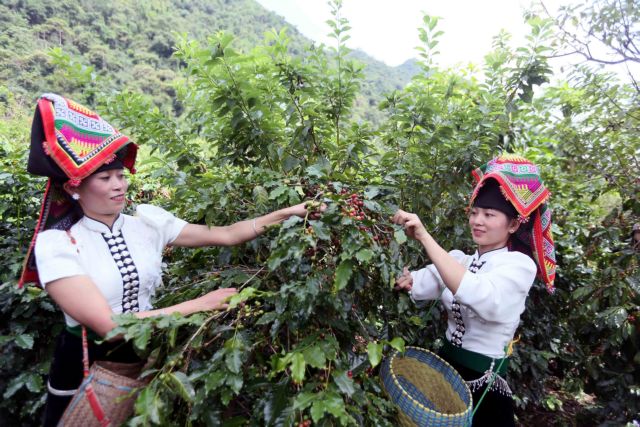
HÀ NỘI — A €1.75 million (US$1.92 million) project funded by the European Union (EU) and co-financed by CARE France was launched in Sơn La Province on November 18 to promote circular production and processing in the Arabica coffee value chain, helping businesses reduce waste and improve resource efficiency.
The project, “Circular Solutions for Coffee MSMEs in Son La Province” (CAFE-CIRCLE), will be implemented by CARE France and CARE International in Việt Nam, in coordination with Sơn La Province’s Department of Agriculture and Environment and local partners, until December 2029. It aims to help more than 150 coffee businesses and cooperatives adopt circular production practices, reduce pollution and unlock new economic opportunities from coffee by-products.
Speaking at the event, Brenda Candries, programme manager at the EU Delegation to Việt Nam, said the coffee industry’s future competitiveness would depend not only on product quality but also on resource efficiency and responsible production. Through CAFE-CIRCLE, the EU aims to help local businesses reduce their environmental impact and create new economic opportunities. She noted that the investment demonstrated a commitment to building a greener, more competitive and inclusive coffee value chain.
The project will focus on coffee-growing and processing areas, particularly Chiềng Mung Commune, Chiềng Mai Commune and Mường Chanh Commune, as well as neighbouring production clusters in Sơn La Province.
It centres on three interconnected solutions: water efficiency and pollution reduction, waste-to-value innovation, and cleaner energy and improved quality.
Accordingly, it will introduce water-efficient coffee pulping equipment and affordable biological wastewater treatment systems; convert coffee pulp and husks into organic fertilisers and explore higher-value products such as cascara tea; and promote solar-assisted drying systems to improve energy efficiency and maintain coffee quality.
These interventions will be complemented by technical training, business development support and market connections.
By December 2029, CAFE-CIRCLE aims to establish five demonstration models, document 10 case studies and enable at least 100 businesses and cooperatives to adopt circular practices. More than 6,000 farming households could benefit indirectly.
To address financial barriers, CAFE-CIRCLE will establish a competitive small-grant facility to support approximately 25 MSMEs and cooperatives, offering grants of up to €15,000 per business and requiring recipients to provide a matching contribution of at least 30 per cent.
The project will also facilitate access to green finance, encourage partnerships and demonstrate commercially viable circular business models.
By prioritising women-led businesses and ethnic minority communities, the project seeks to show how environmental responsibility, resource efficiency and business competitiveness can reinforce one another, contributing to a greener and more inclusive coffee value chain in Việt Nam.
Việt Nam is among the world’s leading coffee producers, with more than 718,000 ha of coffee plantations and annual production exceeding 1.95 million tonnes in 2024. According to a 2025 study by the United Nations Development Programme (UNDP) and the Institute of Strategy and Policy on Agriculture and Environment (ISPAE), the industry generates approximately 1.6 million tonnes of dry coffee husks annually, representing significant potential for resource recovery.
However, much of this potential remains untapped. Coffee processing generates substantial organic waste and wastewater, contributing to environmental pollution. In Sơn La Province, a major Arabica coffee-growing region, these challenges directly affect local communities and businesses.
An assessment by UNDP and the International Water Management Institute (IWMI) identified key barriers to adopting circular practices, including limited technical knowledge, inadequate wastewater treatment infrastructure, difficulties in recovering processing waste and insufficient investment. Smaller enterprises and cooperatives face particular challenges in accessing affordable technologies and financing. - VNA/VNS