End-of-day invoicing proposed for transactions below VNĐ50,000
Household and individual businesses with annual revenue of VNĐ3 billion (US$114,000) or less could issue a single consolidated electronic invoice for daily transactions of below VNĐ50,000 each if buyers do not request invoices.
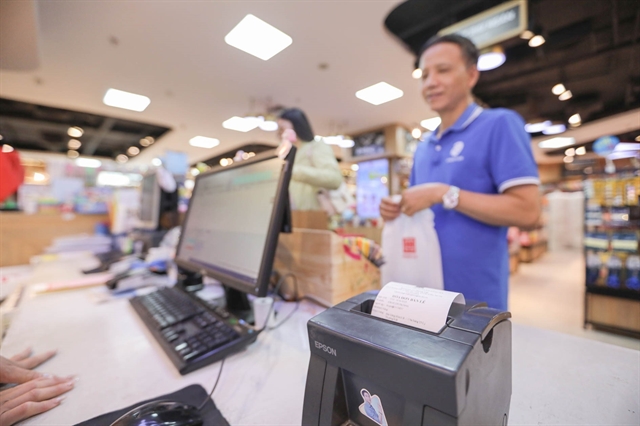
HÀ NỘI — The Ministry of Finance has proposed allowing small household businesses to issue a single consolidated electronic invoice at the end of the day for very small transactions, a move aimed at reducing compliance costs while maintaining tax management.
Under a draft decree on electronic invoices and electronic documents now open for public consultation, household and individual businesses with annual revenue of VNĐ3 billion (US$114,000) or less could issue a single consolidated electronic invoice for daily transactions of below VNĐ50,000 each if buyers do not request invoices.
Sellers would be responsible for recording those transactions in a daily summary and show them to tax authorities if requested.
The finance ministry said the proposal is designed to address practical difficulties faced by small retail operations such as street food vendors, small eateries and convenience shops, where low-value transactions occur frequently.
The measure could significantly reduce the administrative burden of generating invoices for each individual sale while ensuring sufficient data for tax monitoring, the ministry added.
However, some said the proposed VNĐ50,000 threshold is too low to meaningfully reduce the workload.
Small retailers say the requirement to issue e-invoices for each order has increased operating costs, including spending on invoicing software and electronic invoice packages.
Thanh Loan, who sells household goods, said most of her customers do not request invoices. But current regulations require one for every order.
“Selling a set of three clothes hangers for VNĐ99,000 or two bottles of cleaning solution for VNĐ69,000 still requires issuing an invoice,” she said, adding that small businesses end up spending most of the day dealing with invoices and paperwork.
She said that the threshold should be increased, adding that issuing invoices for transactions of VNĐ51,000 sounds impractical.
Loan also proposed allowing consolidated invoices to be issued daily, or even weekly or monthly.
Việt Nam has previously applied a higher threshold for aggregated invoices.
Lê Văn Tuấn, director of Keytas Tax Accounting Co., said a 2014 regulation allowed transactions below VNĐ200,000 to be recorded in a retail sales list, with a single invoice issued at the end of the day.
“The VNĐ50,000 threshold in the new proposal is only a quarter of the previous threshold and may not reflect current market conditions,” Tuấn said, adding that the VNĐ200,000 benchmark would be easier for businesses in practice and would be more effective in reducing invoicing costs.
IAM Law Firm director Nguyễn Quốc Toản said allowing aggregated invoices for small transactions is a reasonable step that could ease compliance pressure and allow household businesses to focus more on operations.
Any new policy must reduce compliance costs for small businesses while maintaining effective and transparent tax management, Toản said, adding that the Government should ensure clear data monitoring mechanisms to prevent tax evasion.
The draft decree also outlined several cases in which businesses may issue a single consolidated electronic invoice at the end of the day for sales to individual customers.
These include financial and digital services such as banking, securities, crypto-asset services, insurance and e-wallet money transfers, as well as electricity reconnection services, parking services, cinemas and associated products such as snacks and drinks,
Services related to e-commerce platforms, including postal and delivery services operating directly for online marketplaces, would also be covered under the draft.
Single consolidated electronic invoicing is also proposed for public transport services, including urban railways, bus networks and taxi services using fare calculation software.
Educational institutions may also issue a daily consolidated e-invoices when tuition fees or other payments are collected from individuals who do not require invoices. — VNS