Efforts intensify to maintain key agricultural export markets
Domestic agricultural enterprises are exerting efforts to maintain their standing in key export markets to avoid dependence on certain markets, especially the US.
HÀ NỘI — Domestic agricultural enterprises are exerting efforts to maintain their standing in key export markets to avoid dependence on certain markets, especially the US.
In the first quarter of 2026, the US remained Việt Nam’s second-largest export market for agro-forestry-fishery products, accounting for 18.3 per cent of total export value, though this marked a 5.2 per cent decline compared to the same period last year.
Despite its large scale and strong purchasing power, the market is becoming increasingly challenging due to fierce competition, stringent standards and rapidly shifting policies, requiring exporters to stay highly adaptable amid global geopolitical uncertainties and supply chain disruptions.
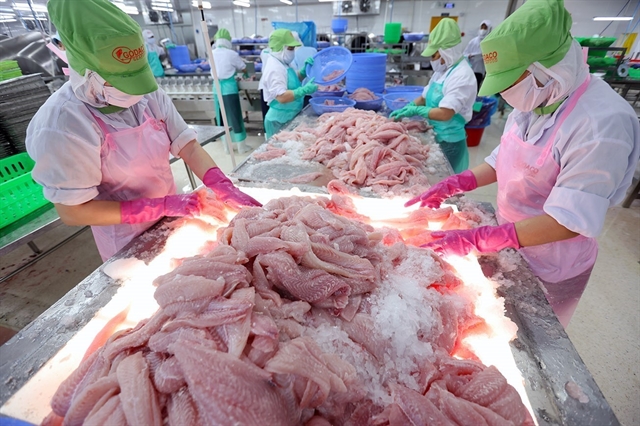
The Vietnam Association of Seafood Exporters and Producers (VASEP) reported that aquatic exports to the US fell by over 10 per cent in the first quarter, continuing to be a major bottleneck for the sector.
VASEP Deputy Secretary General Lê Hằng attributed the decline to weaker demand as well as mounting technical and tariff barriers.
Notably, new import regulations under the Marine Mammal Protection Act (MMPA), including mandatory certificates of admissibility (COA) effective from January 1, 2026, have increased compliance pressure. Anti-dumping duties on shrimp have also weighed heavily, with shrimp exports to the US dropping sharply, by 61 per cent year-on-year, to US$16 million in February. In the first two months, shrimp exports to this market reached nearly $60 million, down 22 per cent.
Looking ahead, shrimp exports are expected to remain under pressure in Q2 as the US tightens controls on antibiotic residues, food safety, traceability and import alerts, raising risks for customs clearance, delivery and costs.
Timber and wood product exports have also declined. In the first two months of 2026, Việt Nam was still the largest supplier of wooden furniture to the US, with turnover of $1.3 billion, but this was down 21.3 per cent year-on-year due to weaker demand, higher logistics costs and global economic uncertainty. The share of Vietnamese kitchen furniture also fell from 42.3 per cent to 39.4 per cent.
In contrast, cashew nuts have emerged as a bright spot, with exports to this North American market rising 1.6 per cent in volume and 0.6 per cent in value, lifting Việt Nam’s market share from 88.19 per cent to 88.68 per cent. However, demand is shifting towards processed and branded products with full traceability.
At the same time, ensuring origin transparency, particularly for imported raw materials, has become essential to benefit from tariff preferences and overcome technical barriers.
From a trade promotion perspective, Trade Counsellor and head of the Vietnam Trade Office in the US Đỗ Ngọc Hưng noted that after years of market expansion, the biggest challenge now was no longer how to enter the US market but how to maintain a foothold, retain customers and expand market share under increasingly competitive and demanding conditions.
This required enterprises to invest more systematically in internal governance, supply chain control, raw material data management, origin documentation, and compliance with labour, environmental and regulatory standards.
In addition to trade-specific challenges, exporters must also take into account broader global factors, including geopolitical tensions in the Middle East and fluctuations in energy and logistics markets.
Businesses were therefore advised to proactively develop flexible strategies for pricing, contract negotiation and delivery planning while factoring in freight costs and potential supply chain disruptions to mitigate risks and sustain exports in the time ahead. — VNA/VNS