Earnings growth fails to lift Vietnamese stocks as investors remain cautious
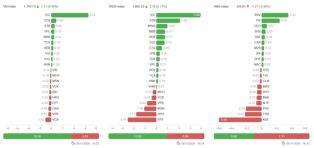
The VN-Index ended October down about 1.6 per cent, marking its second consecutive monthly decline after falling 3.5 per cent in September. The figure reflected continued caution among investors. Although bargain-hunting emerged at times, buying demand remained too weak to sustain a recovery.

HÀ NỘI — Strong third-quarter earnings have offered some support to Việt Nam's stock market, but persistent foreign net selling, weak liquidity and cautious investor sentiment are likely to limit gains in November.
The VN-Index ended October down about 1.6 per cent, marking its second consecutive monthly decline after falling 3.5 per cent in September. The figure reflected continued caution among investors. Although bargain-hunting emerged at times, buying demand remained too weak to sustain a recovery.
Continued net selling by foreign investors was another major headwind. They sold a net VNĐ2.69 trillion (US$104.9 million) worth of shares in the final week of October, with selling pressure extending beyond high-valuation stocks to companies reporting mixed earnings results.
Meanwhile, the third-quarter earnings season painted a relatively positive picture of corporate profitability.
As of October 30, a total of 880 companies had released their financial statements, reporting that combined after-tax profit attributable to parent company shareholders was up 48.5 per cent on-year, according to Nguyễn Anh Khoa, director of research at Agriseco Securities.
Excluding Vingroup companies, the growth rate of after-tax profit remained at 22.5 per cent.
However, stronger earnings have yet to translate into broader market gains. Khoa said capital flows in November are expected to remain selective, favouring companies with strong third-quarter results and positive growth prospects for the fourth quarter.
With interest rates elevated, foreign investors continuing to sell and geopolitical risks persisting, large capital inflows are unlikely to spread across the market. Instead, capital is expected to concentrate on companies with sound fundamentals, he said.
Head of research at Phu Hung Securities Nguyễn Thị Mỹ Liên agreed, saying the waning impact of the third-quarter earnings season was driven mainly by liquidity conditions rather than earnings quality.
Weak buying demand, low cash balances at securities firms, high margin lending and continued foreign net selling have made it difficult for even companies reporting strong results to generate significant share price gains, she said.
Meanwhile, Rong Viet Securities branch director Nguyễn Thế Hoài said capital was mainly rotating between stock groups, with no significant new inflows emerging to drive a decisive market breakout.
This could keep the market in a state of differentiation rather than trigger a broad-based rally following the earnings season, he said.
Lower valuations after two months of corrections may offer opportunities for medium- and long-term investors. However, with liquidity yet to recover, attractive price-to-earnings (P/E) ratios alone are unlikely to act as a catalyst without stronger earnings growth prospects and genuine capital inflows.

Broad-based gains remain elusive
Seasonal trends are another factor investors are watching when assessing the market outlook for November.
Data from Yuanta Vietnam Securities covering 2000-2024 shows that the VN-Index rose in November in half of the years over the period, gaining an average of 2 per cent during the month. Its strongest November gain was 23.8 per cent, while its steepest decline reached 14.1 per cent.
The figures suggest November is not necessarily a favourable month for stocks. Despite the positive average return, the 50 per cent probability of a gain indicates that market performance depends heavily on economic conditions, capital flows and investor sentiment in each year.
However, recent market performance suggests seasonal patterns alone are insufficient to predict market direction.
In November 2023, the VN-Index gained about 6.4 per cent after plunging 10.9 per cent in October. The recovery came amid expectations that the US Federal Reserve would end its interest rate hiking cycle, improving global equity markets and supportive liquidity conditions in Việt Nam's banking system.
By contrast, the index fell around 1.1 per cent in November 2024, despite recovering towards the end of the month after testing the 1,200-point level. Foreign net selling and cautious sentiment prevented the market from sustaining its gains.
In November 2025, the VN-Index rose approximately 2.3 per cent, but its performance was again significantly influenced by several large-cap stocks. This shows that an increase in the benchmark index does not necessarily mean most stocks are advancing.
For this year, seasonal trends thus need to be assessed alongside corporate earnings prospects and the strength of capital flows. Khoa from Agriseco Securities identified four sectors that could attract investor interest following the third-quarter earnings season.
Retail was among the strongest performers, with third-quarter profits rising about 71 per cent and 65 per cent of companies in the sector reporting earnings growth.
Steel and basic resources are also attracting attention. Their prospects are linked to steel consumption, progress on public investment projects and the potential for improved profit margins. However, investors should continue to monitor input material prices, inventories and consumption trends.
In banking, sector-wide after-tax profits increased approximately 21 per cent in the third quarter, with 81 per cent of banks reporting growth. Relatively low valuations could support the appeal of banking stocks. However, differences in asset quality, provisioning costs and net interest margins will remain key factors determining individual banks' ability to sustain earnings growth.
Utilities, particularly electricity and water companies, are also on investors' watchlists following positive business results. The sector could attract capital as investors favour companies with stable operations and relatively predictable cash flows.
Brokerages remain cautious in their forecasts for the benchmark index.
Khoa said the VN-Index could form a second bottom if it holds the support level of 1,730 points, provided liquidity and market breadth also improve. A breach of this level could send the index down to the 1,680-1,700 range, he said.
Vietcombank Securities (VCBS) also expects the market to need more time to consolidate around 1,740 points.
Meanwhile, ASEAN Securities forecasts the VN-Index will fluctuate between 1,720 and 1,770 points in the first week of November, with nearby support at 1,715-1,730 points.
Overall, November 2026 is likely to remain a period in which the market tests the strength of capital flows following two consecutive months of declines.
Corporate earnings growth and lower valuations provide a basis for accumulation, but are not enough to guarantee a sustained upward trend.
Rather than relying on seasonal patterns or expecting a broad-based recovery, investors will need to watch liquidity, foreign trading activity and the index's ability to hold the 1,730-point support level. These factors are likely to play a decisive role in shaping the market's outlook for November. — VNS