Double-digit economic growth within reach: HCM City Union of Business Associations
The target of achieving GDP growth of 10 per cent or higher through 2026–30 is ambitious but achievable, Nguyễn Ngọc Hòa, interim chairman of the HCM City Union of Business Associations, says.
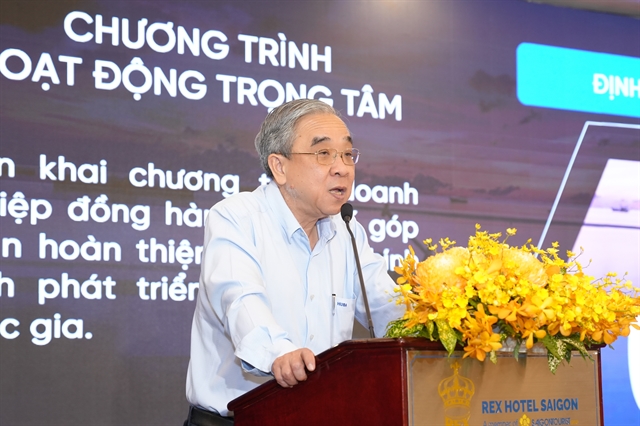
HCM CITY The target of achieving GDP growth of 10 per cent or higher through 2026–30 is ambitious but achievable, Nguyễn Ngọc Hòa, interim chairman of the HCM City Union of Business Associations, says.
He speaks to the media about the drivers behind this goal and the role of businesses in turning it into reality.
In the context of a volatile global economy and significant domestic challenges, how do you assess the feasibility of Việt Nam’s double-digit growth target in the coming period?
The business community in HCM City is highly attentive to and encouraged by the Party and State’s determination in setting a double-digit growth target – not only for 2026, but with the ambition of sustaining it over many years to create a breakthrough and usher the country into a genuine era of national rise.
To realise this goal, coordinated action by all stakeholders is essential, particularly in terms of State mechanisms, policies and strategic direction. Recently the Party has issued not only broad, overarching resolutions but also highly specific thematic ones, such as Resolution 68 on private sector development, Resolution 79 on the development of the State sector, and resolutions positioning science and technology as key drivers of growth. These are not merely general orientations; they are being translated into decrees, action programmes and practical support instruments.
For instance, the establishment of an International Financial Centre demonstrates that we are not merely setting growth targets but also preparing the tools to support them. For the business community, the most vital tool is capital. Given that most enterprises still face resource constraints, mechanisms for capital mobilisation and attracting investment funds are absolutely essential.
Furthermore, we expect the Government to accelerate the transition associated with local administrative mergers, moving from a three-tier to a two-tier local government model, while clarifying decentralisation and delegated authority.
Clearly defining what falls under the authority of departments and what remains at ward or commune level must be done swiftly. This will give officials the confidence to exercise their assigned powers decisively and support businesses more effectively.
A major advantage is that 2026 will mark the beginning of a new term across the Party, the National Assembly and People’s Councils and Committees at all levels. This means the entire political system will enter a new term with renewed spirit and momentum.
At the macro level, we hope agencies and institutions in the new term will act with greater urgency, boldness and proactiveness, working in close coordination to generate collective strength.
When the entire system acts in a synchronised and determined manner, I believe the double-digit growth target is well founded and entirely achievable.
What must businesses do to contribute to this growth goal?
First, enterprises must transform and adjust their business strategies. They should fully leverage the mechanisms and policies already issued by the State. For example, once the International Financial Centre becomes operational, businesses will have opportunities to access investment funds and present their projects. However, to do so, they must possess genuine internal capacity and transparent governance systems, from accounting records to financial management foundations.
Second, the HCM City Union of Business Associations is collaborating with the University of Economics to research breakthrough policies aimed at developing nationally and internationally recognised enterprises and brands. We need leading enterprises at the core, surrounded by an ecosystem of satellite firms participating in integrated value chains.
Third, the Government is accelerating public–private partnership investment models and boldly assigning major projects, such as high-speed railways and expressways, to the private sector. When implemented, these projects will stimulate growth across industries including steel, construction materials, mechanical engineering and logistics. Experience shows that when the right responsibilities are assigned to the right entities under appropriate mechanisms, project preparation time can be reduced significantly, from years to just months.
This also forces enterprises to upgrade themselves by adopting new technologies, undertaking digital and green transformation and pursuing sustainable development in order to qualify for large-scale projects both domestically and internationally.
Finally, the human factor is critical. Businesses need skilled personnel capable of developing projects with rigorous, scientific and persuasive techno-economic foundations to build investor confidence.

Exports are growing, but remain driven primarily by the FDI sector. What do domestic firms need to do to improve their standing?
This reality must be clearly acknowledged. In 2025, export growth was driven mainly by FDI enterprises, particularly in the electronics and high-tech sectors. The challenge is how Vietnamese firms can integrate more deeply into the supply chains of these corporations, becoming satellite suppliers of components and services within Việt Nam.
In sectors where Việt Nam holds advantages, such as agricultural products, food and consumer goods, businesses need to reorganise production, strengthen linkages with farmers, control production processes, ensure traceability, maintain transparency and comply with green standards.
More importantly, stronger linkages are needed among enterprises themselves and between domestic and international markets. The domestic market should serve as a springboard for global expansion, while businesses simultaneously pursue green and digital transformation and reduce logistics costs, which currently remain a significant burden.
HCM City is implementing programmes under Resolution 98, including interest rate support for projects in green and digital transformation and logistics. Businesses should proactively connect with the HCM City Union of Business Associations, as we have established an interdisciplinary task force linking the association with the HCM City Finance and Investment State-Owned Company (HFIC) to advance this programme. Enterprises are encouraged to engage actively to make full use of these policies.
Regarding Resolution 68 on private sector development, how has the business community received it? Has it been effectively implemented?
The core of Resolution 68 is the recognition of the private sector as the “most important driver” of the economy. The business community expects this emphasis on “most important” to be translated into concrete policies and substantive action.
In my view, private enterprises should be clearly categorised by scale and capacity to enable appropriate policy approaches. Large and capable private enterprises should be entrusted with major PPP projects, such as transport infrastructure and urban railways, with total investment reaching hundreds of trillions of đồng.
Medium-sized enterprises should be facilitated to participate in sectors such as logistics, warehousing and consumer goods. Meanwhile, the majority of small and medium-sized enterprises should receive support in accessing credit, land, technology and markets.
If policies are tailored by group rather than applied uniformly, private resources can be mobilised in a synchronised manner aligned with each segment’s capacity.
Alongside the private sector, Resolution 79 also focuses on developing the state-owned sector, which continues to control significant resources, making restructuring and reorganisation essential to optimise resource use.
HCM City plans to restructure dozens of state-owned enterprises into five to seven large corporations of sufficient scale and sectoral specialisation. Previously, they were numerous and fragmented, limiting efficiency.
SOEs should be categorised into distinct groups: public utility enterprises, infrastructure-leading corporations and financial-investment institutions.
Each requires a different mechanism and mandate.
For example, a financial institution such as HFIC should focus on mobilising capital, issuing municipal and project bonds and managing funds effectively for public investment programmes.
In short, both the private and state sectors must be reorganised in a streamlined manner, with clearly defined roles and strengths. This will allow resources to be concentrated and coordinated more effectively rather than dispersed as in the past. — VNS