Đồng Nai harnesses internal advantages for development
The province's development orientation prioritises strategic, selective and well-sequenced socio-economic growth based on its internal strengths, the advantages of the southern key economic region and a harmonised, well-coordinated development framework across all sub-regions.
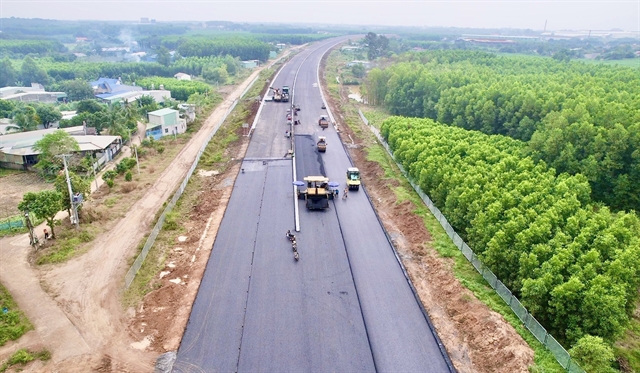
ĐỒNG NAI — Đồng Nai is emerging as a new growth engine in southern Việt Nam, as post-merger planning and renewed political consensus position the province to become a strategic hub for industry, agriculture, logistics and tourism in the next development phase.
At the first Congress of the Communist Party of the enlarged Đồng Nai Province for the 2025-30 tenure, delegates reached consensus on a development orientation that prioritises strategic, selective and well-sequenced socio-economic growth based on the province’s internal strengths, the advantages of the southern key economic region and a harmonised, well-coordinated development framework across all sub-regions.
Following administrative consolidation, Nha Bích Commune now encompasses a vast natural area and holds a highly strategic geographic position at the heart of key regional economic corridors.
Its relatively flat terrain offers favourable conditions for long-term master planning, including modern urban zones, concentrated industrial parks and large-scale agricultural production areas.
The land, consisting mainly of fertile grey soil on alluvium, is particularly suitable for high-value industrial crops such as rubber, cashew and speciality fruit.
This location positions Nha Bích as a strategic gateway linking major economic hubs like Đồng Nai and HCM City with the Central Highlands and Cambodia, thereby creating a competitive edge in attracting investment and developing logistics services.
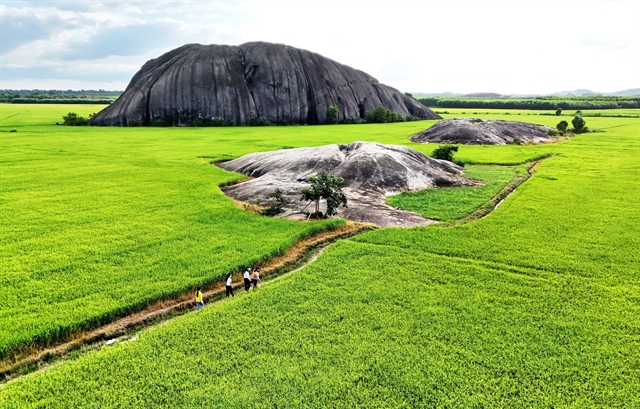
Nha Bích is also endowed with other invaluable natural assets, notably the Bé River and the expansive Phước Hòa Reservoir with more than 2,077 hectares of surface water.
Recognised as a national-level Class I irrigation reservoir, Phước Hòa not only secures water supply for the entire southeastern region but also shapes a striking natural landscape and a critical ecological buffer, while also providing the foundation for developing green economic models, eco-tourism and high-end resort-style urban areas.
According to Nguyễn Hồng Thái, chairman of the Nha Bích People’s Committee, the commune has a favourable combination of timing, location and social consensus needed to become a strategic investment destination.
Its location at the intersection of a network of major highways and national routes makes it more than adjacent to transport corridors, positioning it as a genuine hub of regional connectivity.
This creates exceptional advantages for industries that rely on rapid circulation, such as logistics, processing, trade, and services-based urban development catering to the southern key economic region, the Central Highlands and Cambodia.
Phước Sơn Commune, formed by the merger of three districts of former Bình Phước Province, likewise benefits from advantageous conditions for agricultural development, mineral resource utilisation and industrial expansion.
Several major transport arteries like provincial roads 753, 753B and 755 and the Gia Nghĩa-Chơn Thành Expressway run through it, enabling robust inter-regional links.
Internal financial resources from land clearance compensation and an abundant labour force expected to participate in future bauxite mining activities further enhance Phước Sơn’s capacity for accelerated socio-economic development, particularly in high-tech agriculture and agro-processing.
Nguyễn Thế Hải, secretary of the Phước Sơn Party Committee and chairman of the Commune People’s Council, emphasised that unlocking this potential would require a comprehensive review and adjustment of the commune’s master plan towards coherent and modern development aligned with efficient land allocation and investor attraction.
Transparent, streamlined and predictable mechanisms must be in place to mobilise private investment in priority industries.
Restructuring development space
Đồng Nai is restructuring its development space across the province to establish new drivers of growth and achieve its target of sustained double-digit growth.
The provincial plan identifies several strategic zones: a southern urban industrial belt; a northern industrial urban corridor; an economic belt around the reservoir area; a western urban–ecological riverside zone; and an eastern agricultural-ecological-tourism sub-region.
To realise this vision, the province is mobilising and allocating resources in a targeted manner to accelerate the development of modern infrastructure, investing in multi-modal transport systems to ensure seamless intra-provincial and inter-regional connectivity and enhancing transport corridors connecting the northern and southern regions.
In 2025-30 Phước Sơn aims for annual revenue growth of at least 10 per cent, with overall production increasing at a similar pace and average per capita income reaching VNĐ72 million (US$2,870).
To meet these targets, the commune will promote clean agriculture, high-tech farming and circular agricultural models.
It proposes crop restructuring, prioritising high-value items such as durian, coffee, rubber, and cocoa while revitalising rice cultivation over more than 600 hectares benefiting from the former Đăng Hà irrigation scheme.
Phước Sơn will also coordinate with provincial authorities to refine zoning plans for bauxite mining, establishing a solid foundation for future investment projects and infrastructure development.
Approved planning documents will be published in a transparent and accessible manner, and boundary markers placed on site to ensure compliance and public oversight.
Leveraging the advantages of the Gia Nghĩa-Chơn Thành Expressway and connecting routes, the commune seeks to attract enterprises in agro-processing, food preservation and supporting industries to fulfil its development goals.
Driven by strong aspirations for growth, Nha Bích considers investment attraction a strategic breakthrough and the key to realising its long-term development vision.
Among its key proposals is a 428-hectare integrated golf course, urban complex and resort expected to become a provincial landmark.
Lakeside ecological urban zones and resort-style residential areas will harness the scenic value of Phước Hòa Reservoir, while eco-tourism and cultural tourism initiatives will include resort clusters, homestays and thematic exploration tours showcasing the reservoir’s landscape, local culture and traditional culinary heritage.
With its logistical advantages, Nha Bích is positioned to develop modern shopping centres and large-scale logistics hubs serving the broader region.
Industrial development will prioritise infrastructure investment in the 285-hectare Minh Lập Industrial Park and secondary investment in the 74.5-hectare Nha Bích Industrial Cluster, focusing on high-tech, green and environmentally friendly industries, as well as deep agro-processing to enhance local product value.
The commune will also promote high-tech agriculture, organic farming zones, smart farming initiatives, and circular agricultural production supported by investment in pre-processing and processing facilities.
Chairman Thái said Nha Bích subscribed to the principle that “the success of investors is the success of the commune”.
Local authorities are committed to regular dialogue, direct support and prompt resolution of all problems faced by investors, according to Thái.
Administrative reform will be enhanced, with public satisfaction being the core measure of performance.
Investment procedures will be streamlined through a modern one-stop mechanism, supported by digital governance to ensure efficient service delivery.
Planning information, land-use plans, investment portfolios and policy documents will be made publicly accessible through official digital platforms. — VNS